At Khamenei’s funeral, mourners call for revenge


At Khamenei’s funeral, mourners call for revenge

Mourners in the Iranian capital, Tehran, hold up signs calling for revenge against President Trump. One reads “There Will Be Blood.” Credit: Atta Kenare/Agence France-Presse — Getty Images

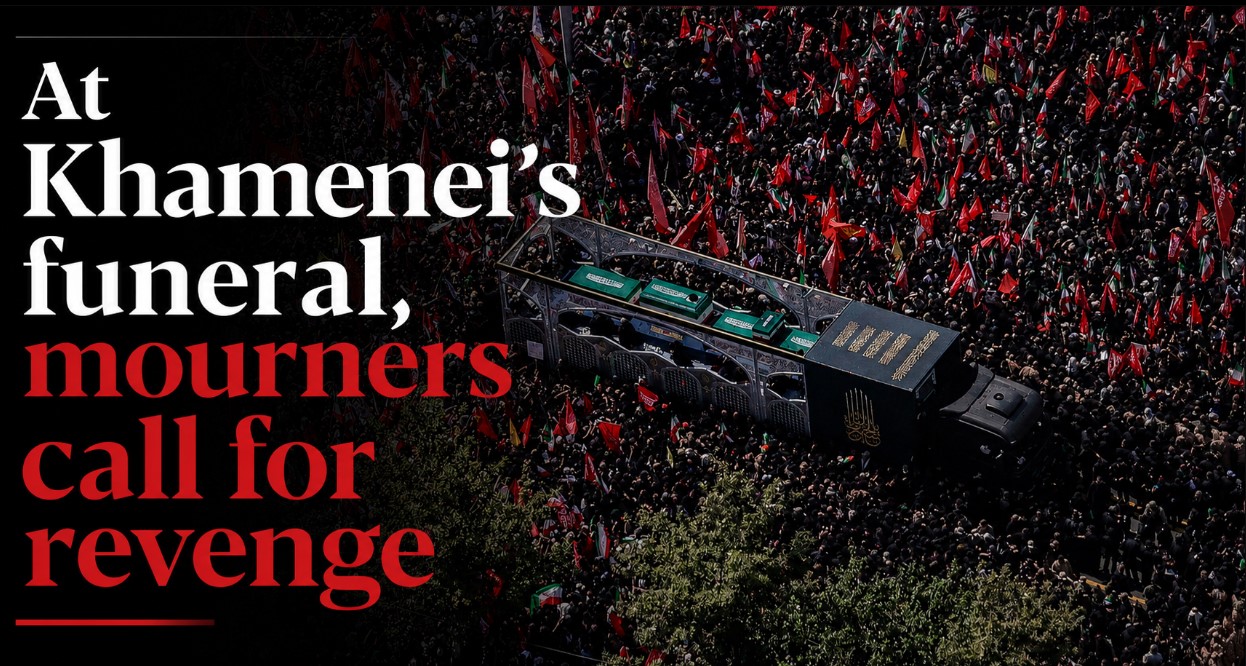
As hundreds of thousands of mourners streamed through the streets of Tehran on Monday in a carefully choreographed funeral procession for the country’s slain supreme leader, many carried signs calling for violent revenge in Persian and English.

Some posters displayed images of Ayatollah Ali Khamenei and the funeral’s official icon, a clenched fist, intended to symbolize the resilience of Iran’s authoritarian clerical regime in the face of the U.S.-Israeli war that began in late February.

Photographs taken in Tehran on Monday showed mourners at the funeral for the late ayatollah carrying portraits of President Trump and Vice President JD Vance behind menacing cross hairs.

“There will be blood,” read one frequently displayed English-language slogan, alongside an image of Mr. Trump. Some posters even sought to disparage Mr. Trump and Prime Minister Benjamin Netanyahu of Israel by connecting them to Jeffrey Epstein, the convicted sex offender.

“At such a tightly controlled event, such displays offer little insight into the wider political sentiments of the Iranian population.”— Sanam Vakil, Chatham House

The mass gathering offers the regime’s most fervent supporters a chance to display their views, but government opponents say they fear that any expressions of dissent at such an event would surely be met with violent suppression.

The slogans seen at the funeral do, however, offer a glimpse into the approved narrative that Iran’s new leadership is trying to cultivate, Ms. Vakil added. Beyond recurring motifs of strength and unity, the messages indicated that the regime has chosen to associate “resistance and resilience with the legacy of Ali Khamenei,” she said.

Calling for violence against Americans or their leaders is not new for the Iranian regime’s public messaging. After U.S. forces killed the powerful military commander, Maj. Gen. Qassim Suleimani in 2020, his successor swore revenge. U.S. intelligence agencies have also tracked potential Iranian threats against Mr. Trump.

While Ms. Vakil said that all threats should be taken seriously, Monday’s expressions of violent rhetoric were probably intended to dial up public displays of emotion more than to convey literal threats.

The anti-American narrative also plays into a central ethos of the regime — that its legitimacy stems from the ability to defend Iran from Western threats. And the message of resistance has long been a favored narrative, underscoring the continuity between the slain supreme leader and his son and successor, Mojtaba Khamenei, who has so far been absent from the funeral ceremonies.

“Ali Khamenei himself long touted that Iran shouldn’t trust the United States,” said Ms. Vakil, adding that the circumstances of his killing — in an Israeli airstrike in the opening salvos of the U.S.-Israeli war — only increase the salience of anti-American messages for regime supporters.

Roham Alvandi, a professor of Iranian history at the London School of Economics, said efforts to portray Mr. Khamenei as a martyr whose killing is worthy of violent revenge also serve a political function: It helps to legitimize the rule of his son and successor.

Linking Mr. Trump and Mr. Netanyahu to the Epstein scandal is a recurring theme for regime supporters, which was amplified on Monday by pro-government commentators in local media. Linking Mr. Trump with Mr. Epstein is part of an Iranian effort to draw a moral distinction between the regime and the U.S. administration, said Ms. Vakil.

Mr. Trump was a close friend of Mr. Epstein’s until the early 2000s. The president has repeatedly downplayed the relationship and denied any wrongdoing in connection with Mr. Epstein.

Iranian attempts to spotlight the Epstein scandal serve two purposes: one domestic and the other global, according to Moustafa Ayad, a Middle East expert at the London-based Institute for Strategic Dialogue, a research group.

“Firstly, it’s a longstanding narrative intended to highlight Western degeneracy in contrast to the moral purity of Iran’s clerical regime,” he said, a message that Mr. Khamenei himself frequently invoked before he was killed earlier this year, even as his regime was brutally oppressing dissent and killing thousands of anti-government protesters.

But it’s also intended by Iranian authorities to needle at one of Mr. Trump’s perceived political vulnerabilities domestically too, he said.

“Both these things are working simultaneously here,” said Mr. Ayad.

The White House did not immediately respond to a request for comment.

Abdi Latif Dahir contributed reporting from Tehran, Iran.

What else to know

Attendees: Mahmoud Ahmadinejad, a former Iranian president, was among the senior officials who attended the funeral ceremonies on Monday. According to U.S. officials, Mr. Ahmadinejad was injured in an Israeli strike in February intended to free him from house arrest. The New York Times later reported on a failed Israeli plan to install Mr. Ahmadinejad at the helm of a postwar Iran.

Itinerary: As part of a six-day tour that began on Saturday, Ayatollah Khamenei’s body is being transported through Iran and neighboring Iraq, mostly to cities with some sacred significance for Shiite Muslims. After Monday’s procession, the casket will be taken from Tehran to the Iranian city of Qom. From there, the ceremonies will continue in the Iraqi cities of Najaf and Karbala before the deceased leader will be interred in his hometown, Mashhad, in northeastern Iran.

Peace negotiations: The talks between Iran and the United States have been paused until after the funeral ceremonies. They have failed to prevent new bouts of fighting or to fully reopen shipping in the crucial Strait of Hormuz, let alone bring the two sides closer to resolving myriad thornier issues that were not covered by the countries’ cease-fire.

Our coverage: The New York Times was granted access to the funeral ceremonies of Ayatollah Khamenei by Iran’s government, which determined the ceremonies our reporters could attend, accompanied by a government-provided translator and a guide. The views expressed by people interviewed at these events may not be representative of many Iranians, while others may have felt unable to speak freely.