

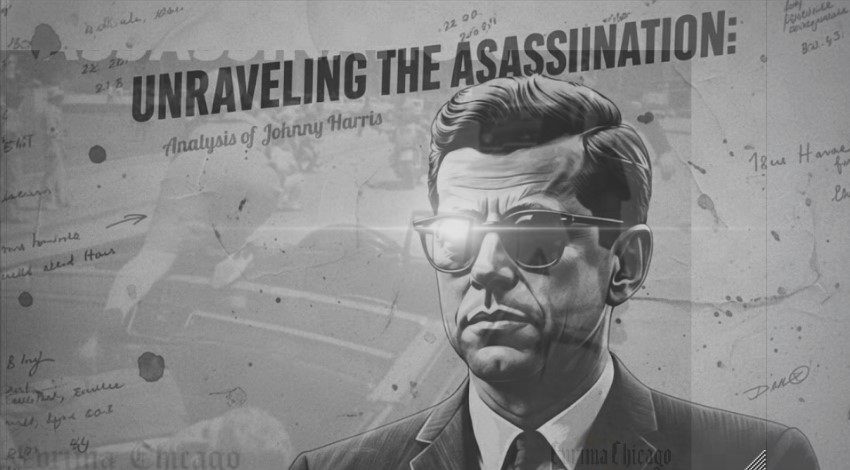
In his video titled “Why People Think The Government Killed JFK”, journalist Johnny Harris revisits one of America’s most enduring and divisive questions: who killed President John F. Kennedy, and why so many Americans continue to doubt the official explanation. Sixty years after the assassination in Dallas, skepticism remains deeply embedded in the public consciousness, sustained by inconsistencies, secrecy, and a prolonged failure of transparency by government institutions.
Harris approaches the subject with a measured, evidence-driven narrative, examining not only the assassination itself but the conditions that allow conspiracy theories to flourish. His argument is less about proving an alternative culprit and more about explaining how institutional behavior eroded public trust.
The Official Story and Its Flaws
Harris begins with the Warren Commission’s conclusion that Lee Harvey Oswald, a 24-year-old former Marine and Soviet sympathizer, acted alone when he fired three shots from the sixth floor of the Texas School Book Depository. According to the commission, those shots were sufficient to explain all of the wounds suffered by President Kennedy and Texas Governor John Connally.
Yet Harris underscores how quickly doubts emerged. Central to those doubts is the commission’s reliance on contested forensic interpretations and its dismissal of contradictory witness testimony. Rather than resolving questions, the investigation appeared to sidestep them.
The “Magic Bullet” Theory

At the heart of the controversy is the so-called “Single-Bullet Theory,” often referred to as the “Magic Bullet” theory. This explanation holds that one bullet passed through Kennedy’s neck, exited his throat, then struck Governor Connally, causing multiple injuries before being recovered in near-pristine condition.
Harris revisits why this theory has long troubled both experts and the public. The bullet’s alleged trajectory and limited deformation strained credibility, particularly when weighed against basic principles of physics and ballistics. For many, the theory appeared less like a conclusion drawn from evidence and more like a necessity to preserve the lone-gunman narrative.
A Cover-Up Born of Fear
Harris argues that the investigation’s shortcomings were not merely the result of incompetence but of deliberate narrative control. FBI Director J. Edgar Hoover declared Oswald the sole assassin almost immediately, before a full evidentiary review had taken place.
This haste, Harris suggests, was driven by Cold War anxieties. A credible link to Cuba or the Soviet Union risked provoking global instability and potential nuclear confrontation. To avoid panic, officials narrowed the scope of inquiry, endorsed the lone-gunman conclusion, and suppressed information that complicated the story.
The paradox, Harris notes, is that secrecy intended to reassure the public instead generated decades of suspicion.
Mounting Evidence of Hidden Truths

Later investigations only deepened public unease. Congressional inquiries in the 1970s revealed that both the FBI and CIA had withheld information, destroyed records, and shaped testimony. The presence of figures such as Allen Dulles, a former CIA director dismissed by Kennedy and later appointed to the Warren Commission, raised further concerns about conflicts of interest.
Harris also points to the disappearance of key physical evidence, including President Kennedy’s brain from the autopsy. Even after the declassification of millions of documents decades later, no definitive proof of a broader conspiracy emerged. Still, the cumulative pattern of obfuscation left lasting damage.
Conspiracy and Public Distrust
Harris situates JFK skepticism within a broader historical context. Revelations surrounding Vietnam, Watergate, and covert intelligence operations profoundly altered how Americans viewed their government. Against this backdrop, alternative theories about the assassination found a receptive audience.
While Harris does not endorse any specific conspiracy, he emphasizes that their persistence reflects institutional failure. When transparency is absent and contradictions remain unresolved, speculation becomes inevitable.
The Cost of Secrecy
Harris concludes with a sobering assessment: the greatest legacy of the JFK assassination may be the erosion of public faith in democratic institutions. Secrecy, even when motivated by fear or pragmatism, carries a long-term cost.
His video stands as both a critique of the Warren Commission and a broader warning. Conspiracy theories, Harris reminds viewers, do not thrive because people reject truth, but because truth is withheld.
Disclaimer:
This analysis is part of the Videonalysis Series by Evrima Chicago Editorial, under the supervision of Waa Say, Editorial Head. This article reflects our team’s interpretation and critical examination of Johnny Harris’s video, “Why People Think The Government Killed JFK” and is intended to provide a thoughtful exploration of the arguments and perspectives presented. The views expressed are those of the editorial team and do not necessarily represent Johnny Harris or any affiliated parties.
This analysis is part of the Videonalysis Series by Evrima Chicago Editorial, under the supervision of Waa Say, Editorial Head. This article reflects our team’s interpretation and critical examination of Johnny Harris’s video, “Why People Think The Government Killed JFK” and is intended to provide a thoughtful exploration of the arguments and perspectives presented. The views expressed are those of the editorial team and do not necessarily represent Johnny Harris or any affiliated parties.