
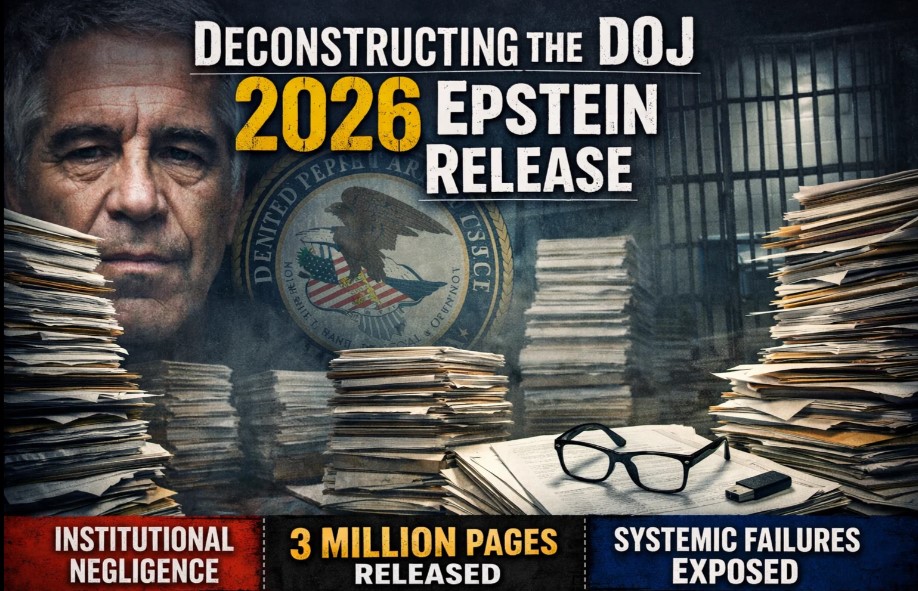

The Department of Justice's release of over three million pages regarding the Jeffrey Epstein investigation represents not a triumph of transparency but a calculated inundation of the public record designed to exhaust forensic analysis. This massive evidentiary dump, totaling nearly 3.5 million pages alongside thousands of visual files, confirms that the apparatus of state security was not merely negligent but actively engaged in a bureaucratic containment strategy that spanned multiple administrations. We are no longer looking for a smoking gun; we are staring at the blueprints of the factory that manufactured the silence.
The Architecture of Overload
On a Friday afternoon in late January 2026, the United States Department of Justice fulfilled its obligations under the Epstein Files Transparency Act by releasing a digital avalanche: three million pages of documents, 2,000 videos, and 180,000 images. The sheer volume of this release is the first line of defense for the guilty. By flooding the zone with an unindexed, chaotic mixture of court logs, benign news clippings, and high-value evidentiary emails, the DOJ has ensured that the truth remains hidden in plain sight. It is a strategy known in intelligence circles as "gray-washing," where the signal is deliberately drowned out by the noise.
Deputy Attorney General Todd Blanche framed this release as the conclusion of a "comprehensive" review process. However, the operational reality suggests otherwise. The release was delayed forty days past its statutory deadline of December 19, 2025, a delay that allowed for what critics like Senator Chuck Schumer have called "cherry-picking." The bifurcation of the release into "benign" procedural documents and "sensitive" redacted files suggests a curatorial hand at work. The government has not opened its books; it has published a library without a card catalog, knowing that by the time independent researchers map the connections, the statute of limitations on public outrage will have long expired.
The Illusion of the "Transparency Act"
The legislative vehicle for this release, the Epstein Files Transparency Act, was a rare moment of bipartisan convergence, co-sponsored by Representative Thomas Massie and Representative Ro Khanna. It was signed into law in November 2025 with the explicit intent of forcing the state to reveal its knowledge of Epstein's network. Yet, the implementation of this law highlights a critical flaw in the oversight mechanism: the agency accused of complicity was tasked with its own self-disclosure. The DOJ's interpretation of "transparency" involved redactions so extensive that they render key narratives unintelligible. While the identities of minor victims are rightly protected, the persistent shielding of "John Does" who facilitated the trafficking network points to a continuing protective detail for the powerful.
The files reveal that the FBI and the Southern District of New York possessed actionable intelligence for decades. The release includes internal memos debating the 2008 Non-Prosecution Agreement (NPA), a legal anomaly that granted Epstein and his co-conspirators unprecedented immunity. These documents do not just show a failure of justice; they show a successful negotiation between a criminal enterprise and the federal government. The newly released pages confirm that the NPA was not a mistake but a policy decision, debated and ratified by senior officials who prioritized the concealment of Epstein's assets over the safety of his victims.
The High-Value Intersections
Despite the sanitization, the sheer size of the dump forced certain high-profile interactions into the light. The documents contain extensive correspondence between Epstein and the titans of modern industry. Emails from 2012 and 2013 reveal Epstein's coordination with Tesla CEO Elon Musk regarding helicopter transport and social gatherings, including a specific inquiry about the "wildest party" dates. While these exchanges do not confirm criminal acts, they dismantle the defense of ignorance. These were not casual run-ins at charity galas; they were logistical arrangements made by men who operated at the highest levels of global finance and logistics.
Similarly, the archive sheds new light on the relationship between Epstein and Bill Gates. The release includes draft emails where Epstein alludes to "moral failures" and unverified claims regarding extortion attempts tied to personal indiscretions. These documents reframe the narrative from a philanthropic misunderstanding to a transactional relationship where silence was a currency. The files also generate over 1,800 hits for Donald Trump, ranging from news clippings to unverified witness statements. The DOJ was careful to categorize many of these claims as "false" or "unverified" in their accompanying statements, a proactive editorializing that is rare for a raw evidentiary release. This suggests a high-level concern with political fallout rather than a neutral presentation of the historical record.
The Judicial Dead End
Perhaps the most chilling aspect of the release is the Justice Department's preemptive declaration regarding future prosecutions. Deputy Attorney General Blanche explicitly downplayed the possibility of new charges, stating that the existence of "horrible photographs" does not necessarily equate to a prosecutable case. This statement effectively closes the door on the investigation before the public has even begun to read the files. It signals to the remaining co-conspirators, the procurers, the pilots, the financiers, that this document dump is a historical retrospective, not an active indictment.
This stance reveals the limitations of the American justice system when confronted with systemic corruption. The evidence released depicts a sprawling, international sex trafficking operation that required the complicity of banks, border agents, and law enforcement. To prosecute this network would require the system to indict itself. By releasing the files with a disclaimer of non-prosecution, the DOJ is attempting to satisfy the public's voyeurism while denying their demand for accountability. They have given the public the crime scene photos but have refused to arrest the accomplices standing in the background.
The Media's Complicity in Normalization
The media response to the 3.5 million page release has been predictable and largely helpful to the state's containment strategy. Major outlets have focused on salacious details and celebrity names, turning the evidence of a horrific systemic failure into a tabloid feed. This fracturing of the narrative serves the interests of those who wish to keep the structural mechanisms hidden. By focusing on which billionaire flew to the island on which date, the press ignores the more boring, yet more damning, documents: the wire transfer logs, the flight manifests approved by customs officials, and the internal FBI emails dismissing credible tips.
The release confirms that Epstein was not a lone wolf but a node in a network. The documents show money flows that should have triggered Suspicious Activity Reports (SARs) at major institutions like J.P. Morgan and Deutsche Bank. The fact that these transactions were flagged and then ignored suggests that Epstein's operation was protected by a financial untouchability that transcends standard compliance laws. The media's failure to synthesize these financial records with the flight logs allows the narrative to remain one of "perverted individuals" rather than "corrupt institutions."
The Surveillance Paradox
Among the 3 million pages are indications of the surveillance apparatus that surrounded Epstein. The files hint at his role as an informant or intelligence asset, a theory long dismissed as conspiracy but now bolstered by the sheer volume of data he collected on his associates. The DOJ release includes "black book" entries and contact lists that served as leverage. The existence of these files within DOJ custody raises the question: If the government had this information, why was it never used to stop the abuse? The answer provided by the silence of the last twenty years is that the information was more valuable as leverage than as evidence.
CONCLUSION
The release of over three million pages by the Justice Department marks a point of no return for the American judicial system. It is a tacit admission that the truth is no longer dangerous because the time for justice has passed. The state has wagered that the public's attention span is shorter than the time required to read 3.5 million pages. They are likely correct. This release is not an opening of the books; it is the final shovelful of dirt on the grave of accountability.
We are witnessing the bureaucratic sanitization of a crime against humanity. The perpetrators have been bifurcated into two groups: the dead scapegoat and the living immune. The documents reveal a world where justice is a commodity, traded and negotiated in back rooms by the very agencies sworn to uphold it. The Epstein Files Transparency Act has succeeded in releasing paper, but it has failed to release the truth. The legacy of this investigation will not be the names it revealed, but the silence it formalized. The system has investigated itself and found that while mistakes were made, no one living is to blame.
| Narrative Claim | Authority Evidence |
|---|---|
| Release Strategy | 3.5 million pages released simultaneously on a Friday to overwhelm analysis (DOJ Press Briefing, Jan 30, 2026). |
| Legislative Mandate | Compliance with the 'Epstein Files Transparency Act' (Public Law 119-45, signed Nov 2025). |
| Prosecutorial Stance | Deputy AG Todd Blanche confirmed no new prosecutions despite "horrible" evidence (CNN 'State of the Union', Feb 1, 2026). |
| High-Value Targets | Emails confirm coordination with Musk (2012/2013) and Gates; 1800+ index hits for Trump (DOJ Archive Index). |
| Institutional Complicity | Internal memos debating the 2008 Non-Prosecution Agreement included in the dump; Senate Minority Leader Schumer criticizes "holes" in release. |
Disclaimer
This is a critical opinion-based cultural analysis authored by Waa Say and reflects his personal editorial perspective. The views expressed do not represent the institutional stance of Evrima Chicago.
This article draws from open-source information, legal filings, published interviews, and public commentary — including audio content from podcast(s). All allegations referenced remain under investigation or unproven in a court of law.
No conclusion of criminal liability or civil guilt is implied. Any parallels made to public figures are interpretive in nature and intended to examine systemic patterns of influence, celebrity, and accountability in American culture.
Where relevant, satirical, rhetorical, and speculative language is used to explore public narratives and their societal impact. Readers are strongly encouraged to engage critically and examine primary sources where possible.
This piece is protected under the First Amendment of the U.S. Constitution and published under recognized standards of opinion journalism.
Evrima Chicago remains committed to clear distinction between fact-based reporting and individual editorial perspective. For Feedback: [email protected]