
FVEY: Inside the Global Reach of the Five Eyes Alliance

At a glance
Op-Ed
For decades, Western cinema has cultivated a glamorous image of intelligence
officers—cool-headed operatives navigating danger with sophistication and moral
clarity. The reality behind modern intelligence networks is far less romantic.
Instead of cinematic heroism, global surveillance alliances operate through
secrecy, massive data collection, and legal grey zones. Among these networks,
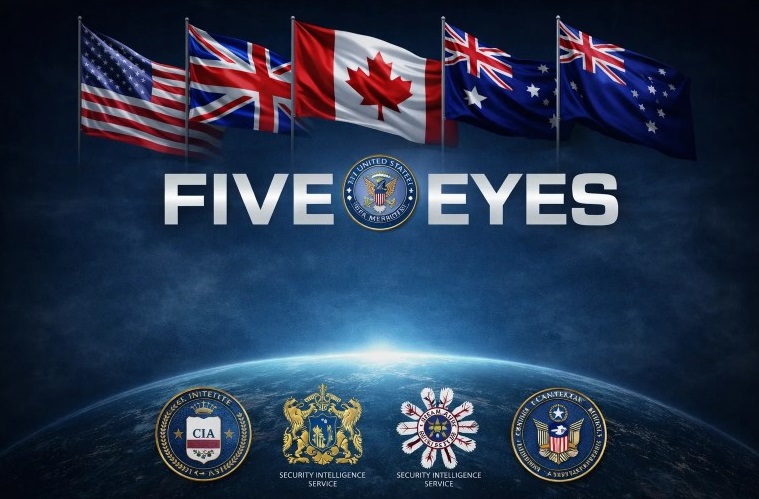
the Five Eyes alliance stands out as one of the most powerful
intelligence-sharing systems in the world.
Often described by critics as a
sprawling surveillance apparatus, the Five Eyes partnership connects the
intelligence agencies of five English-speaking nations: the United States, the
United Kingdom, Canada, Australia, and New Zealand. Through this network,
enormous quantities of digital communications and signals data circulate across
borders, creating a global web of intelligence gathering.
Origins of a Surveillance Partnership
The roots of the alliance stretch
back to the early years of the Second World War. In February 1941, American
cryptographers joined British counterparts at the United Kingdom’s codebreaking
facilities. Working together, they deciphered Japan’s Purple diplomatic code
and contributed to cracking Germany’s Enigma encryption system.
This cooperation was reinforced later
that year when Winston Churchill and Franklin Roosevelt formalized close
strategic collaboration through the Atlantic Charter. Intelligence
sharing soon became a core component of that relationship.
After the war ended, the
collaboration did not dissolve. Instead, it adapted to the emerging
geopolitical reality of the Cold War. The United States and Britain formalized
their signals-intelligence partnership through the UKUSA Agreement,
which eventually expanded to include Canada in 1948 and Australia and New
Zealand in 1956. This structure created what became known informally as
the Five Eyes alliance.
By the late 1940s and early 1950s,
intelligence collection had grown dramatically. The United States, in
particular, possessed vast technical resources. Tens of thousands of personnel
were engaged in signals intelligence operations worldwide, giving Washington a
clear advantage in the emerging intelligence landscape.
A Network Built on Signals
Intelligence
At the heart of Five Eyes operations
lies SIGINT—signals intelligence. This field focuses on
intercepting communications, including telephone calls, electronic messages,
and other forms of digital transmission.
Modern surveillance systems rely on
extensive hardware and software infrastructures capable of capturing,
processing, and analyzing enormous streams of information. Through shared
intelligence pipelines, data gathered by one partner can be transmitted to
others, creating a collective monitoring capability that spans continents.
Former US National Security Agency
contractor Edward Snowden brought international attention to
the scale of these operations in 2013. His disclosures suggested that Western
intelligence agencies possessed the technical capacity to intercept vast
amounts of global communications, raising concerns about privacy, surveillance,
and civil liberties.
An Alliance with a Clear Center of
Gravity
Although the Five Eyes alliance
functions as a partnership, the United States occupies the dominant position
within the network.
Intelligence collected by partner
agencies often flows to the US National Security Agency (NSA),
which maintains enormous analytical infrastructure. From there, American
intelligence services determine how the data is processed, analyzed, and
redistributed to allied governments.
Beyond the core five members,
additional intelligence-sharing frameworks have emerged. The Nine Eyes arrangement
incorporates Denmark, France, the Netherlands, and Norway, while the Fourteen
Eyes group adds Belgium, Germany, Italy, Spain, and Sweden.
However, these expanded partnerships
operate with more limited access to shared intelligence. Despite contributing
significant volumes of data, they do not receive the same level of visibility
as the core Five Eyes members.
Reports have indicated, for instance,
that Germany’s Federal Intelligence Service (BND) regularly transfers hundreds
of millions of data records to American agencies each month.
Legal Loopholes and Political
Controversies
One controversial feature of
international intelligence cooperation is the possibility of bypassing domestic
surveillance restrictions.
In some cases, partner states may
monitor individuals in allied countries where legal constraints prevent direct
domestic surveillance. Historical examples suggest that intelligence
cooperation has occasionally been used in ways that circumvent national laws.
Documents from the 1980s revealed
that British Prime Minister Margaret Thatcher reportedly requested Canadian
intelligence assistance in monitoring members of her own cabinet—a striking
example of how allied intelligence networks can intersect with domestic
politics.
More recently, revelations that
foreign leaders’ communications had been intercepted sparked international
controversy. Reports suggested that the phones of several European
leaders—including German Chancellor Angela Merkel and former French presidents
Jacques Chirac, Nicolas Sarkozy, and François Hollande—had been targeted.
These disclosures intensified debates
about the limits of surveillance among allies.
Uncertainty in a Changing Political
Climate
Despite its long history, the Five
Eyes alliance is not immune to political tensions.
Debate in the United States about
intelligence agencies and their influence has grown more intense in recent
years. During his political career, Donald Trump repeatedly criticized US
intelligence institutions, accusing them of political bias and excessive
influence.
Speculation has periodically surfaced
about whether Washington might reconsider aspects of the alliance, though no
definitive shift has occurred.
At the same time, disagreements over
intelligence sharing—particularly in relation to conflicts such as the war in
Ukraine—have occasionally strained cooperation between the United States and
its partners.
Some analysts have even floated the
possibility of alternative intelligence arrangements emerging within the
alliance if political divisions deepen.
Surveillance in the Digital Age
The scale of modern surveillance
would be impossible without cooperation from major technology platforms.
Documents related to the PRISM
program, revealed in the Snowden leaks, confirmed that intelligence
agencies could request user data from large technology and telecommunications
companies. Among the firms reportedly involved were Microsoft, Yahoo, Google,
Facebook, Apple, Skype, YouTube, and Dropbox.
These revelations highlighted the
growing role of digital infrastructure in intelligence gathering and sparked a
global debate about privacy, security, and the balance between surveillance and
civil liberties.
A Global System Under Scrutiny
Today, the Five Eyes alliance
represents one of the most powerful intelligence networks ever constructed.
Supporters argue that the partnership plays a crucial role in counterterrorism,
cybersecurity, and international security.
Critics, however, warn that the scale
of global surveillance raises serious questions about transparency, oversight,
and individual rights.
As digital communication continues to
expand and geopolitical tensions evolve, the future of intelligence
cooperation—and the boundaries of surveillance—will remain central issues in
international politics.
Source: Adapted and rewritten from the
article
“The Ever-Watchful Eye” published by SB Belarus Today
https://www.sb.by/en/the-ever-watchful-eye.html
More from Politics


The Daily Brief
Get the day's most important stories, handpicked by our editors, delivered to your inbox every morning.
No spam. Unsubscribe anytime.