

 he modern internet feels deceptively simple.
A search bar. A social feed. A banking app. A streaming platform glowing softly in the dark like a digital campfire. Most people experience the internet through polished surfaces designed for speed and convenience. Yet beneath that visible layer exists a sprawling ecosystem of protected systems, hidden infrastructure, specialized services, and authenticated environments that quietly power modern civilization.
This invisible middle ground is increasingly being described as the Gray Net.
Unlike the sensationalized mythology surrounding the Dark Web, the Gray Net is not necessarily criminal, secretive, or underground. In many ways, it is the opposite. It is the operational nervous system of contemporary life. It is where hospitals store patient records, where governments manage public services, where corporations collaborate internally, where financial systems move trillions of dollars, and where millions of older adults now access healthcare, communication, and digital independence.
The phrase “Gray Net” has evolved into a term with two distinct but interconnected meanings.

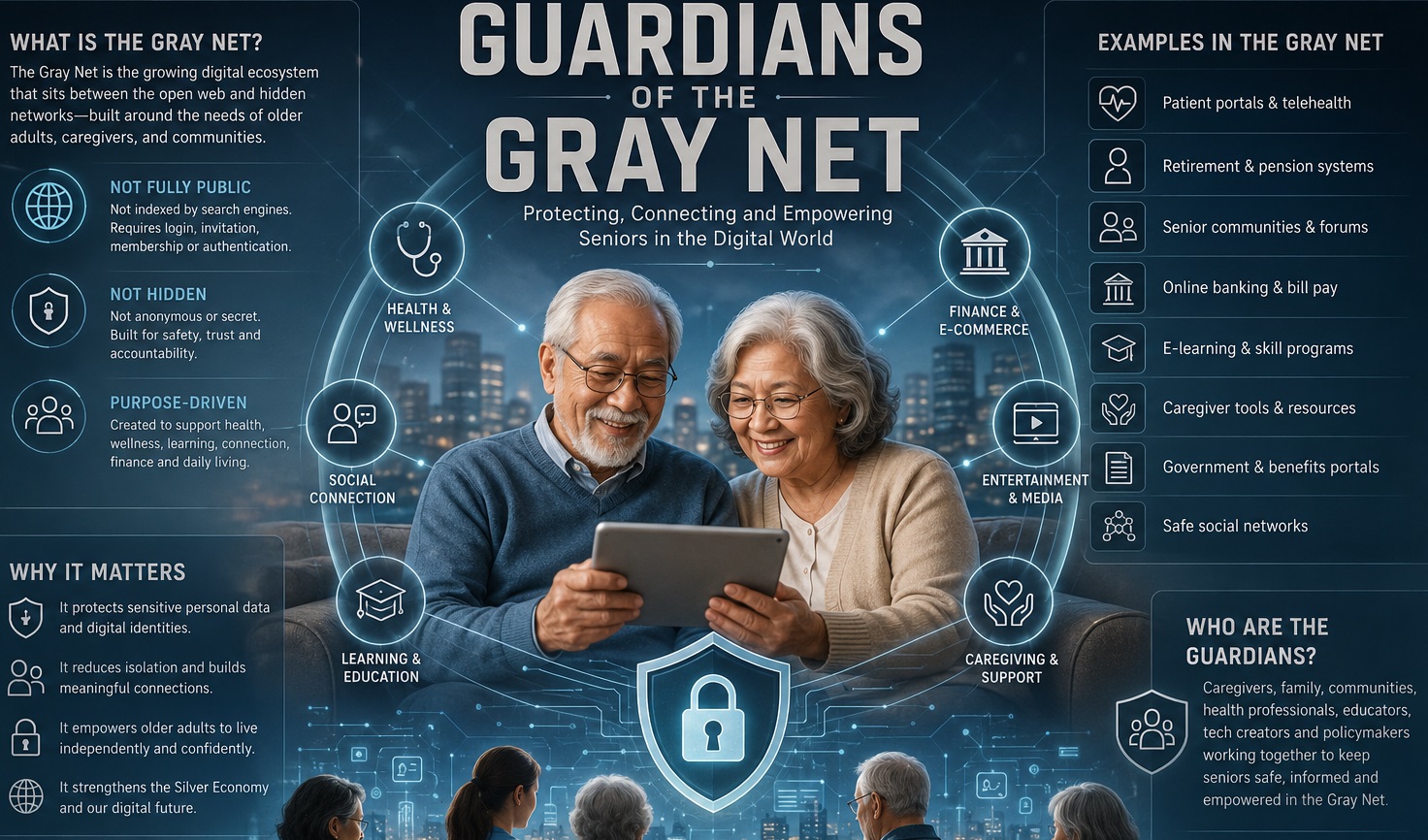
The first definition refers to the authenticated and semi-private digital infrastructure that exists between the public internet and intentionally hidden networks. The second refers to the rapidly expanding digital ecosystem supporting the “Silver Economy,” the global population of older adults increasingly dependent on accessible technology.
At first glance, these definitions appear unrelated. One is technical. The other is social. One concerns infrastructure. The other concerns human inclusion.
But together they reveal something profound:
The future of the internet will not merely depend on visibility. It will depend on trust, protection, accessibility, and intelligent design.
This is the domain of the Guardians of the Gray Net.
The Gray Net: Two Worlds Sharing One Name
The Gray Net is best understood not as a single network, but as a concept describing digital spaces that exist between extremes.
Not fully public.
Not entirely hidden.
Not purely technical.
Not purely social.
Instead, it represents protected, permission-based, human-centered infrastructure operating in the vast middle territory of the internet.

Definition A: The Authenticated Infrastructure Layer
The first and more traditional definition of the Gray Net refers to the enormous volume of internet-connected systems that are inaccessible to ordinary search engines yet remain entirely legitimate and essential.
This is the internet behind the login screen.
It is not indexed like the Open Web, nor concealed with anonymity tools like the Dark Web. Instead, it exists within a controlled access framework requiring authentication, permissions, subscriptions, or organizational credentials.
In practical terms, this means the Gray Net contains some of the most sensitive and valuable information on Earth.
What Exists Inside This Layer?
Financial Infrastructure
Modern banking systems, transaction platforms, retirement accounts, payroll services, investment dashboards, and international financial exchanges all operate within protected digital environments.
Without these authenticated systems, modern economies would collapse into chaos within hours.
Healthcare Networks
Hospitals, insurance providers, diagnostic labs, and telehealth systems rely heavily on Gray Net architecture. Electronic health records, imaging databases, prescription systems, and patient portals remain intentionally shielded from public visibility.
This hidden layer became especially vital during the rise of remote medicine and virtual healthcare services.
Government Portals
Tax systems, benefits applications, public service databases, licensing systems, and internal government communication platforms operate within secure authenticated networks.
Citizens interact with these systems daily, often without realizing they are participating in a protected digital ecosystem largely invisible to public indexing.
Cloud Collaboration Systems
The modern workplace lives inside the Gray Net.
Private cloud drives, enterprise communication platforms, shared workspaces, encrypted file-sharing systems, and corporate intranets form the backbone of global business operations.
The visible internet may generate attention, but the Gray Net generates productivity.
Communication Infrastructure
Private email servers, enterprise messaging platforms, authenticated conferencing systems, and secure communication tools form another major component of this hidden layer.
Ironically, much of what humanity considers “online life” actually occurs outside the publicly searchable web.
Why This Hidden Infrastructure Matters
The Gray Net is often misunderstood because invisibility is frequently associated with secrecy or criminality.
But invisibility can also represent protection.
A hospital database should not be searchable on Google.
A citizen’s tax records should not be publicly indexed.
A retirement account should not be open to anonymous browsing.
The Gray Net exists because civilization requires controlled digital spaces.
Yet this importance also creates vulnerability.
Cybercriminals increasingly target these semi-hidden systems because they contain exceptionally valuable data. Ransomware attacks, credential theft, financial fraud, and healthcare breaches frequently exploit weaknesses inside Gray Net environments.
In many cases, organizations devote enormous attention to public-facing websites while neglecting the quieter systems operating behind authentication layers.
The result is a paradox:
The most important parts of the internet are often the least visible.
Definition B: The Gray Net of the Silver Economy
The second interpretation of the Gray Net moves away from infrastructure and toward people.
This definition refers to the growing digital ecosystem designed specifically for older adults and the “Silver Economy.”
Here, the Gray Net is not about hidden databases or authentication layers. It is about accessibility, empowerment, independence, and digital adaptation for aging populations.
As global demographics shift, millions of older adults are becoming increasingly dependent on digital systems for healthcare, communication, finance, entertainment, transportation, and social participation.
This transformation is creating a new technological frontier.
A frontier where the internet must evolve not merely for efficiency, but for humanity.
The Rise of the Silver Economy
The global senior population is expanding rapidly.
Longer life expectancy, improved healthcare, and demographic aging have created one of the largest economic and technological shifts of the 21st century.
Older adults today are no longer digitally absent populations. They are active participants in online ecosystems.
They manage investments online.
Attend virtual medical appointments.
Use wearable health devices.
Participate in digital learning.
Maintain relationships through video calls and social platforms.
Yet traditional technology design often overlooks the realities of aging.
Small text.
Complex interfaces.
Overwhelming navigation.
Aggressive advertising.
Confusing security systems.
For many seniors, the internet can feel less like a tool and more like an obstacle course built by caffeinated engineers in a fluorescent labyrinth.
The Gray Net of the Silver Economy attempts to solve this problem.
What Exists Inside This Human-Centered Gray Net?
Telehealth and Remote Care
Modern healthcare increasingly operates through digital platforms.
Video consultations, medication reminders, prescription management systems, remote diagnostics, and virtual wellness monitoring allow seniors to receive care without constant physical travel.
For individuals with mobility challenges, these systems are transformative.
Health Monitoring Technology
Wearables and smart devices now track:
Heart rate
Sleep patterns
Blood oxygen
Fall detection
Medication schedules
These technologies form a protective digital cocoon around vulnerable populations.
Social Connection Platforms
Isolation remains one of the greatest challenges facing older adults.
Simplified communication tools, family-focused social platforms, and accessible video technologies help maintain emotional connection across generations and geographic distances.
In many ways, the Gray Net has become an emotional infrastructure as much as a technical one.
Adaptive Learning Systems
Lifelong learning no longer ends at retirement.
Senior-focused digital education platforms now offer:
Skill development
Language learning
Hobby instruction
Cognitive engagement
Community participation
Technology is increasingly becoming a bridge against intellectual isolation.
Safe Banking Systems
Financial fraud targeting seniors has become a global concern.
As a result, specialized banking tools increasingly incorporate:Simplified interfaces
Fraud detection systems
Identity protection
Assisted authentication
Family monitoring permissions
Security and accessibility must now coexist.
The Shared Philosophy Behind Both Definitions
At first glance, these two meanings of the Gray Net appear completely different.
One focuses on data.
The other focuses on people.
But beneath the surface, they share the same philosophical foundation:
Both exist to protect something valuable.
Definition A protects sensitive systems and information.
Definition B protects vulnerable populations and human dignity.
Both depend on trust.
Both require thoughtful architecture.
Both operate largely outside the public spotlight.
Both are essential to modern civilization.
The Gray Net is not merely hidden infrastructure.
It is infrastructure with responsibility.
The Guardians of the Gray Net
The phrase “Guardians of the Gray Net” carries symbolic weight because it represents a growing responsibility shared across multiple industries.
Cybersecurity professionals.
Healthcare innovators.
Accessibility designers.
Caregivers.
Policy makers.
Ethical technologists.
Digital educators.
Together, these groups shape the future of secure and inclusive digital systems.
The Guardians are not simply defending servers or writing software.
They are protecting:
Digital dignity
Human independence
Sensitive information
Public trust
Technological accessibility
Social inclusion
In an increasingly automated world, this mission becomes extraordinarily important.
Because the internet is no longer merely a network of machines.
It is a network of lives.
Why the Gray Net Will Define the Future
For decades, public conversation about the internet revolved around visibility.
Search engines.
Social media.
Viral content.
Public platforms.
But the next era of digital evolution may belong not to visibility, but to controlled, intelligent, human-centered infrastructure.
The future internet will likely become:More authenticated
More personalized
More health-integrated
More accessibility-focused
More privacy-sensitive
More adaptive to aging populations
In other words, more Gray.
The Gray Net represents the internet maturing from a public novelty into a societal operating system.
And as this transformation accelerates, the challenge will no longer be simply connecting people to technology.
The challenge will be ensuring technology protects, empowers, and understands the people connected to it.
Conclusion
The Gray Net is one of the most overlooked concepts in the modern digital landscape.
In one form, it represents the secure authenticated systems that quietly sustain governments, healthcare, finance, education, and global communication. In another, it symbolizes the rise of accessible technologies empowering older adults within the Silver Economy.
Together, these definitions reveal a profound truth about the future of the internet:
The most important digital systems are not always the most visible.
Some operate silently behind authentication layers.
Others work gently in the background helping vulnerable individuals remain connected, independent, and safe.
The Guardians of the Gray Net stand at the intersection of these worlds.
Their task is not merely technical.
It is human.
Because protecting the future of the internet ultimately means protecting the people who depend on it most.