

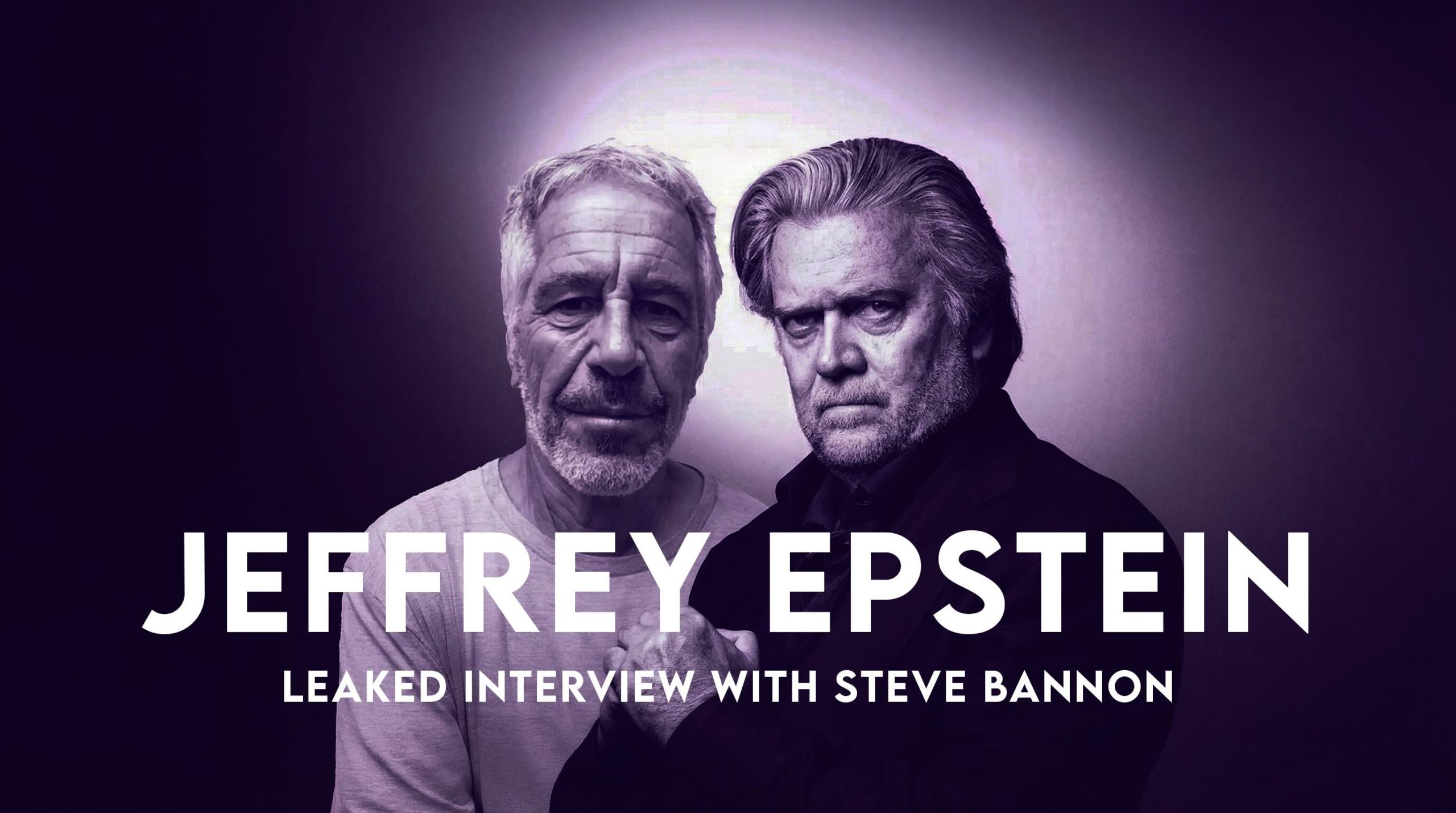
Interview between Jeffrey Epstein and Steve Bannon

At a glance
Transcript Analysis and Biographical Assertions - Evrima Chicago
This archival entry analyzes a recorded interview between financier Jeffrey Epstein and media strategist Steve Bannon, likely conducted circa 2019. The dialogue covers Epstein's involvement with the Santa Fe Institute, his experiences during the 2008 financial crisis while incarcerated, and his critiques of mathematical modeling in economics and biology. Epstein asserts that complex systems, including financial markets and human consciousness, defy traditional scientific measurement and require intuitive rather than algorithmic understanding.
Overview
The interview between Jeffrey Epstein and Steve Bannon documents a wide-ranging discussion concerning Epstein’s career in finance, his philanthropic focus on science, and his philosophical views on the limits of empiricism. The conversation, which references the 2018 documentary American Dharma, appears to have taken place shortly before Epstein's arrest and death in 2019. Throughout the exchange, Bannon questions Epstein on his rise to prominence, his connections to elite institutions, and his perspective on the global economic order .
A central theme of the discussion is Epstein's retrospective on the 2008 financial crisis. Epstein claims to have monitored the collapse of Lehman Brothers and the distress of Bear Stearns while serving a sentence in the Palm Beach County Jail. He describes communicating with high-level Wall Street executives via collect calls from solitary confinement, framing the crisis as a systemic biological failure rather than a mechanical error. He attributes the market collapse to political pressures regarding subprime lending, specifically citing policies under the Clinton administration .
The transcript also reveals Epstein’s shift away from the mathematical foundationalism he originally supported through the Santa Fe Institute. By the time of the interview, Epstein expresses a belief that science and mathematics are "old-fashioned" tools incapable of explaining "miracles" such as human life or the "soul," which he equates to dark matter. He argues that intuition, particularly in women and successful traders, offers a superior method for navigating complex systems than quantitative analysis .
Institutional Affiliations and Philanthropy
Rockefeller University and the Trilateral Commission
Epstein details his entry into elite circles, claiming he was invited to join the board of Rockefeller University in the late 1980s or early 1990s. He asserts that David Rockefeller recruited him to modernize the institution's financial strategy, moving it toward statistical portfolio management. Epstein characterizes this period as a shift from reputation-based business to calculation-based finance .
According to Epstein, David Rockefeller subsequently invited him to join the Trilateral Commission, a non-governmental international policy group. Epstein describes his first meeting in Tokyo, noting that he found the proceedings "boring" and observed that many world leaders lacked financial literacy. He argues that political leaders often misunderstand the nature of money, particularly the mechanics of fractional reserve banking and asset valuation .
David Rockefeller and the Architecture of Serious Power
Epstein lingers on David Rockefeller because Rockefeller represents something Epstein desperately wants proximity to: legitimacy that survives scandal, time, and criticism.
Rockefeller, in Epstein’s telling, is not merely wealthy. He is a custodian of continuity. Someone who understands that power is not held through charisma or ideology, but through institutions that outlast individual lives. Epstein recalls how Rockefeller spoke about money not as accumulation but as responsibility, how he treated subordinates with deliberate respect, how he explained global politics as a balancing act between instability and stewardship.
The anecdote about Rockefeller introducing his driver as a “colleague” is not a throwaway humanizing detail. Epstein is signaling a code. True elites, in this worldview, do not flaunt hierarchy. They normalize it.
Rockefeller’s creation of the Trilateral Commission occupies a central place in Epstein’s imagination. Epstein describes it as an answer to a structural problem: politicians rotate out, democracies are noisy, electorates are irrational, but capital and business endure. The Commission, bringing together North American, European, and Asian elites, is framed as an attempt to stabilize the world through people who cannot be voted out.
Epstein does not present this as conspiracy. He presents it as necessity.
This is why Rockefeller receives gravity in the interview. Epstein is not name-dropping. He is aligning himself with a lineage of power that sees itself as sober, rational, and burdened with responsibility for a world that cannot govern itself.
John D. Rockefeller and the Old Justification for Wealth
John D. Rockefeller appears only briefly, but his shadow is long. Epstein references Rockefeller University as an example of a time when wealth justified itself by building institutions that advanced knowledge.
This is not nostalgia. It’s a defense. Epstein is implicitly asking: if robber barons could cleanse capital through universities and research, why can’t modern money do the same?
The question is never answered. Epstein lets it hang.
According to Epstein, David Rockefeller subsequently invited him to join the Trilateral Commission, a non-governmental international policy group. Epstein describes his first meeting in Tokyo, noting that he found the proceedings "boring" and observed that many world leaders lacked financial literacy. He argues that political leaders often misunderstand the nature of money, particularly the mechanics of fractional reserve banking and asset valuation .
David Rockefeller and the Architecture of Serious Power
Epstein lingers on David Rockefeller because Rockefeller represents something Epstein desperately wants proximity to: legitimacy that survives scandal, time, and criticism.
Rockefeller, in Epstein’s telling, is not merely wealthy. He is a custodian of continuity. Someone who understands that power is not held through charisma or ideology, but through institutions that outlast individual lives. Epstein recalls how Rockefeller spoke about money not as accumulation but as responsibility, how he treated subordinates with deliberate respect, how he explained global politics as a balancing act between instability and stewardship.
The anecdote about Rockefeller introducing his driver as a “colleague” is not a throwaway humanizing detail. Epstein is signaling a code. True elites, in this worldview, do not flaunt hierarchy. They normalize it.
Rockefeller’s creation of the Trilateral Commission occupies a central place in Epstein’s imagination. Epstein describes it as an answer to a structural problem: politicians rotate out, democracies are noisy, electorates are irrational, but capital and business endure. The Commission, bringing together North American, European, and Asian elites, is framed as an attempt to stabilize the world through people who cannot be voted out.
Epstein does not present this as conspiracy. He presents it as necessity.
This is why Rockefeller receives gravity in the interview. Epstein is not name-dropping. He is aligning himself with a lineage of power that sees itself as sober, rational, and burdened with responsibility for a world that cannot govern itself.
Bill Clinton and the Convenient Villain of Systemic Failure
When Epstein turns to Bill Clinton, the tone changes. Clinton is not admired. He is blamed.
Epstein assigns Clinton a starring role in the prehistory of the 2008 financial collapse, arguing that political incentives around housing, deregulation, and vote-buying distorted risk at a systemic level. In this framing, Clinton is not malicious. He is ignorant. A politician making financial decisions without understanding the machinery he is interfering with.
This is a recurring theme: politicians, Epstein argues, are structurally unqualified to manage financial systems. Clinton becomes the emblem of that failure.
Notice what Epstein is doing here. He is not absolving banks. He is dissolving responsibility altogether. If everyone is operating inside a system they don’t understand, then no one can be fully blamed.
Paul Volcker, Alan Greenspan, Ben Bernanke: The Limits of Technocracy
Volcker, Greenspan, and Bernanke appear as figures of authority who nevertheless fail Epstein’s private test: full comprehension.
Epstein treats central bankers with a mixture of respect and quiet contempt. He acknowledges their intelligence and stature, but insists that even they are navigating complexity they cannot fully model. Numbers, he says, seduce decision-makers into thinking they understand reality, when in fact they are manipulating abstractions.
The critique is subtle but devastating: technocracy is not mastery. It is sophisticated guesswork.
Steve Bannon: The Interrogator as Instrument
Steve Bannon matters in this interview only insofar as he pressures Epstein to acknowledge human consequence. Bannon keeps dragging the conversation back to shame, irony, downfall. Epstein refuses the bait.
Bannon’s significance is structural, not historical. He represents populist rage knocking on the glass of elite rationalization. Epstein treats him patiently, almost indulgently, as someone emotionally invested in moral reckoning rather than systemic analysis.
They are not equals in Epstein’s internal hierarchy, and the interview makes that plain.
Jimmy Cayne, Bear Stearns, and the Jailhouse Market Desk
One of the most revealing sections of the interview takes place not in boardrooms but in a jail cell.
During the 2008 financial crisis, Epstein describes guards asking him for advice about their pensions, their 401(k)s, their children’s futures. The world is collapsing, and the man they turn to for clarity is an inmate in solitary confinement.
Epstein recounts making collect calls from Palm Beach County Jail to Jimmy Cayne, then president of Bear Stearns, as the firm teetered on collapse. The image is almost grotesque: one of the largest financial events in modern history unfolding while Epstein balances two jailhouse phones, speaking simultaneously to Bear Stearns and a JPMorgan contact attempting to acquire it.
Cayne is not mythologized. He is portrayed as a man inside the storm, improvising. The real indictment is not of Cayne, but of a system so brittle that it requires crisis management from a prison cell.
JPMorgan and the Quiet Mechanics of Survival
The unnamed JPMorgan executive represents institutional continuity. While Bear Stearns collapses and Lehman fails, JPMorgan moves in to absorb, stabilize, and survive.
Epstein does not dwell here. He doesn’t need to. The point is obvious: power consolidates during chaos.
Lehman Brothers and the Sacrificial Collapse
Lehman is invoked as a cautionary symbol. Epstein frames its failure not as punishment for bad behavior, but as a policy choice that sent shockwaves through the global system.
Again, responsibility dissolves. Decisions are framed as tragic tradeoffs made under uncertainty.
Derek Bok and the Ethics Laundromat
Derek Bok, former Harvard president, appears in a chilling ethical thought experiment. Epstein recounts Bok’s argument that money given for good causes remains good money, regardless of its source.
Epstein pushes the logic to its extreme, invoking Nazi gold and Holocaust victims’ teeth. The provocation is intentional. He wants to expose how institutional ethics often function as laundering mechanisms rather than moral judgments.
Bok is not condemned. He is used.
Pakistan, India, and the Moral Arithmetic of Suffering
When Epstein speaks about funding polio eradication in Pakistan and India, the interview reaches its most uncomfortable point.
He asks whether mothers receiving vaccines care about the moral status of the donor. He frames philanthropy as a direct transaction between suffering and relief, bypassing reputational accounting entirely.
Pakistan and India are not settings here. They are moral test cases. Epstein uses them to argue that outcomes matter more than origins, that life saved outweighs sin committed.
It is a brutal, utilitarian calculus, and Epstein knows it.
World Leaders, Africa, and Financial Illiteracy
Epstein makes sweeping claims about global leadership, particularly in Africa and other post-colonial states. He describes leaders who rose through military power, celebrity, or popularity rather than financial literacy.
This is not praise. It is a technocratic critique bordering on contempt. Epstein sees democracy and charisma as liabilities in a world governed by financial abstraction.
Satan, Milton, and the Final Mirror
Near the end, the conversation turns mythic. Bannon invokes Satan, Paradise Lost, the archetype of the brilliant rebel who would rather rule in hell than serve in heaven.
Epstein deflects, but not entirely. He admits he owns a mirror.
It’s the closest he comes to self-recognition.
What This Interview Actually Is
This interview is not a defense, and it is not a confession. It is an attempt to reframe judgment itself.
Epstein wants history to see him not as a criminal aberration, but as a symptom of systems that reward intelligence divorced from ethics, abstraction divorced from empathy, and power divorced from accountability.
Whether you accept that framing is the real question the interview leaves behind.
The Santa Fe Institute and Complexity Theory
In the early 1990s, Epstein became a donor to the Santa Fe Institute, a research center dedicated to the study of complex adaptive systems. He explains that his interest lay in determining whether complex systems, such as economies or biological organisms, could be described algorithmically. He cites the proximity to Los Alamos National Laboratory and the involvement of physicists like Murray Gell-Mann as key factors in his support. However, in the interview, Epstein declares the attempt to mathematize complexity a "failure," concluding that critical phenomena in life and markets remain unpredictable and unexplainable by current scientific methods .
The 2008 Financial Crisis
Incarceration and Communication
Epstein recounts his experience during the market crash of September 2008, stating he was in solitary confinement at the Stock Island detention facility (referred to as the Palm Beach County Jail in the text) at the time. He claims to have learned of the crisis through a guard concerned about pension funds. Epstein alleges he used his allotted collect calls to speak with Jimmy Cayne, the former CEO of Bear Stearns, and a contact at JPMorgan, advising them on the systemic nature of the liquidity freeze.
Systemic Analysis
Rejecting the standard narrative that derivatives caused the crash, Epstein employs medical analogies to describe the financial system. He argues that the crisis was akin to a patient suffering multiple organ failures, where liquidity acts as the blood supply. He critiques the political push for homeownership under the Clinton administration, arguing that the creation of "subprime" lending categories forced banks to misprice risk, leading to an oversupply of bad debt backed by implicit government guarantees .
Philosophical Views on Science and Existence
The Limits of Mathematics
Epstein expounds on the limitations of Newtonian physics and calculus, arguing that while they allow for approximation, they fail to address the fundamental nature of reality. He discusses historical figures such as Isaac Newton and Gottfried Wilhelm Leibniz, suggesting that their theological and philosophical inquiries were divorced from modern science's rigid materialism. Epstein posits that the "unexplainable" elements of existence, which he terms "miracles" rather than magic, require a new form of inquiry beyond traditional measurement .
Consciousness and the Soul
When pressed on his metaphysical beliefs, Epstein affirms the existence of a soul, describing it as the "dark matter of the brain", something that can be inferred by its gravitational influence on behavior but cannot be directly observed. He dismisses the possibility of measuring human qualities like love or intuition, asserting that "science doesn't describe romance." He further suggests that intelligence is not singular, referencing Howard Gardner’s theory of multiple intelligences, while simultaneously making controversial generalizations about gender and race regarding intuitive vs. analytical capabilities .
Conclusion
The interview presents a portrait of Jeffrey Epstein attempting to contextualize his life and intellect shortly before his demise. He frames his trajectory from a quantitative financier to a critic of science as an evolution toward a deeper understanding of the "unexplainable." His recollections of the 2008 financial crisis serve to position him as a central, albeit incarcerated, figure in global finance, maintaining influence despite his legal troubles. The dialogue highlights a profound disconnect between Epstein’s self-image as a philosophical visionary and the criminal reality of his confinement, a tension Bannon repeatedly probes. Ultimately, the transcript documents Epstein’s final intellectual posture: a rejection of the algorithmic systems he once funded in favor of a belief in the incalculable nature of life and influence.
Fact / Claim
Epstein claims he was a board member of Rockefeller University.
Epstein claims membership in the Trilateral Commission, recruited by David Rockefeller.
Epstein claims to have called Jimmy Cayne (Bear Stearns) from jail in Sept 2008.
Epstein asserts he was in solitary confinement in a "brown jumpsuit" during the 2008 crash.
Epstein attributes the 2008 crisis to Bill Clinton's subprime lending policies.
Epstein declares the Santa Fe Institute's attempt to mathematize complexity a "total failure."
Epstein defines the soul as the "dark matter of the brain."
References
- Bannon, S. (Interviewer) & Epstein, J. (Interviewee). (c. 2019). Raw Interview Transcript. [Youtube].
- This is a critical opinion-based cultural analysis authored by Writory Editorial Team under the superintendence of our Editor at Large, Mr. Waa Say and reflects his personal editorial perspective. The views expressed do not represent the institutional stance of Evrima Chicago.
- This article draws from open-source information, legal filings, published interviews, and public commentary — including audio content from The Joe Rogan Experience podcast. All allegations referenced remain under investigation or unproven in a court of law.
- Where relevant, satirical, rhetorical, and speculative language is used to explore public narratives and their societal impact. Readers are strongly encouraged to engage critically and examine primary sources where possible.
- This piece is protected under the First Amendment of the U.S. Constitution and published under recognized standards of opinion journalism.
- Evrima Chicago remains committed to clear distinction between fact-based reporting and individual editorial perspective.

More from Author



The Daily Brief
Get the day's most important stories, handpicked by our editors, delivered to your inbox every morning.
No spam. Unsubscribe anytime.