

Judicial Warfare: The SEC’s Campaign Against the Digital Frontier
Judicial Warfare: The SEC’s Campaign Against the Digital Frontier

At a glance
Judicial Warfare: The SEC’s Campaign Against the Digital Frontier
Judicial Warfare: The SEC’s Campaign Against the Digital Frontier
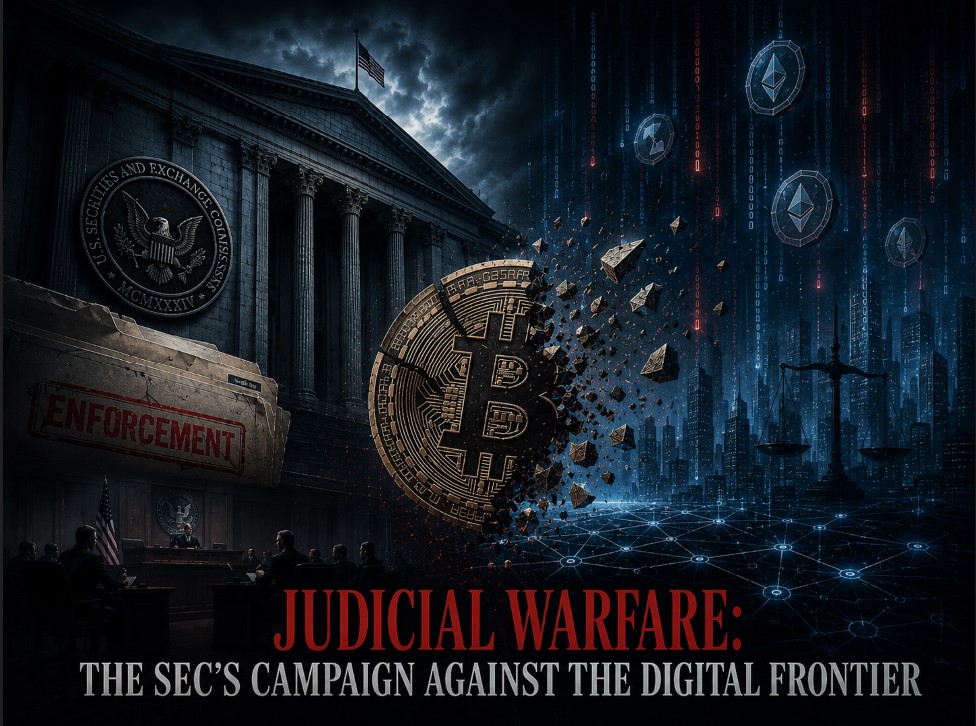
The Securities and Exchange Commission has transitioned from a period of observation to an era of aggressive enforcement, utilizing the 1946 Howey Test to categorize digital assets as securities. This shift represents a fundamental clash between 20th-century legal frameworks and 21st-century decentralized technology, threatening to push financial innovation outside of American borders. As litigation replaces legislation, the resulting regulatory uncertainty creates a precarious landscape for both institutional investors and retail participants.
The Enforcement Paradigm
The SEC’s current stance marks a definitive end to the 'Wild West' era of digital finance. Under the leadership of Chair Gary Gensler, the commission has adopted a philosophy of regulation through enforcement rather than clear rule-making. This strategy relies heavily on the 1933 Securities Act and the 1934 Securities Exchange Act, laws crafted in the wake of the Great Depression. By applying these nearly century-old statutes to blockchain technology, the SEC asserts that most digital tokens function as investment contracts. This assertion has triggered a cascade of lawsuits against major industry players, signaling a systemic purge of non-compliant platforms.
The Howey Mandate
At the heart of the regulatory offensive lies the Howey Test, a four-pronged legal standard established by the Supreme Court in 1946. To be considered a security, an asset must involve an investment of money in a common enterprise with a reasonable expectation of profits derived from the efforts of others. The SEC argues that the marketing and distribution of tokens like XRP or those listed on Coinbase meet these criteria. Critics argue that this interpretation is overly broad, failing to account for the utility and decentralization inherent in blockchain protocols. The tension between the intent of the 1946 ruling and the reality of programmable money remains the primary friction point in US courts.
Institutional Friction
The legal battle between the SEC and Coinbase exemplifies the current impasse. Coinbase, a publicly-traded American company, has repeatedly petitioned the SEC for formal rule-making to define which digital assets are securities. The SEC’s refusal to provide a bespoke framework for crypto, while simultaneously suing the exchange for operating as an unregistered broker, highlights a strategy of containment. According to Pew Research, approximately 17% of American adults have invested in or used cryptocurrency, making this a matter of significant public interest. The outcome of these cases will determine whether the United States remains the global hub for financial technology or cedes that ground to more permissive jurisdictions.
Algorithmic Siege
Regulatory scrutiny has intensified following the catastrophic collapse of FTX, which decimated billions in retail wealth. The SEC has used this failure as a catalyst to justify a broader crackdown on 'shadow' financial systems. While the FTX debacle was largely a result of old-fashioned fraud and mismanagement, the regulatory response has targeted the underlying technology of decentralized finance (DeFi). This broad-brush approach often conflates legitimate decentralized protocols with centralized entities that lack proper oversight. The result is a chilling effect on American developers who fear that writing code could be interpreted as a regulatory violation.
The Global Pivot
As the SEC doubles down on its enforcement-first approach, other nations are moving to capture the escaping capital. The European Union’s Markets in Crypto-Assets (MiCA) regulation provides a clear legal roadmap that contrasts sharply with American ambiguity. This regulatory divergence threatens the dominance of the US dollar if digital asset innovation moves to more favorable shores. History shows that when the US failed to provide clear frameworks for emerging industries, such as early internet gambling or certain fintech sectors, those markets matured abroad. The current trajectory suggests a potential exodus of high-tech talent and capital from the American ecosystem.
Constitutional Due Process
The ongoing litigation raises significant questions regarding the Administrative Procedure Act and the Due Process Clause of the US Constitution. Defendants argue that the SEC is exceeding its congressionally mandated authority by expanding the definition of a security without legislative approval. This 'Major Questions Doctrine' argument suggests that significant economic policy changes must come from Congress, not unelected bureaucrats. High-profile cases are currently winding through the appellate system, with many legal experts predicting they will eventually reach the Supreme Court. The final ruling will likely redefine the limits of the administrative state’s power over the private sector.
The Structural Ledger
The following data points summarize the primary legal battlegrounds and their implications for the American financial landscape.
The resolution of these conflicts will dictate the next decade of American economic history. If the SEC prevails in its current form, the digital asset industry in the US will likely be absorbed into the existing banking infrastructure. Conversely, a judicial or legislative check on the SEC’s power could foster a new era of decentralized innovation. The stakes extend beyond financial returns, touching on the fundamental right to privacy and the nature of ownership in a digital age. As the courts deliberate, the American financial sector remains in a state of suspended animation, waiting for a definitive signal.
More from Politics


The Daily Brief
Get the day's most important stories, handpicked by our editors, delivered to your inbox every morning.
No spam. Unsubscribe anytime.