
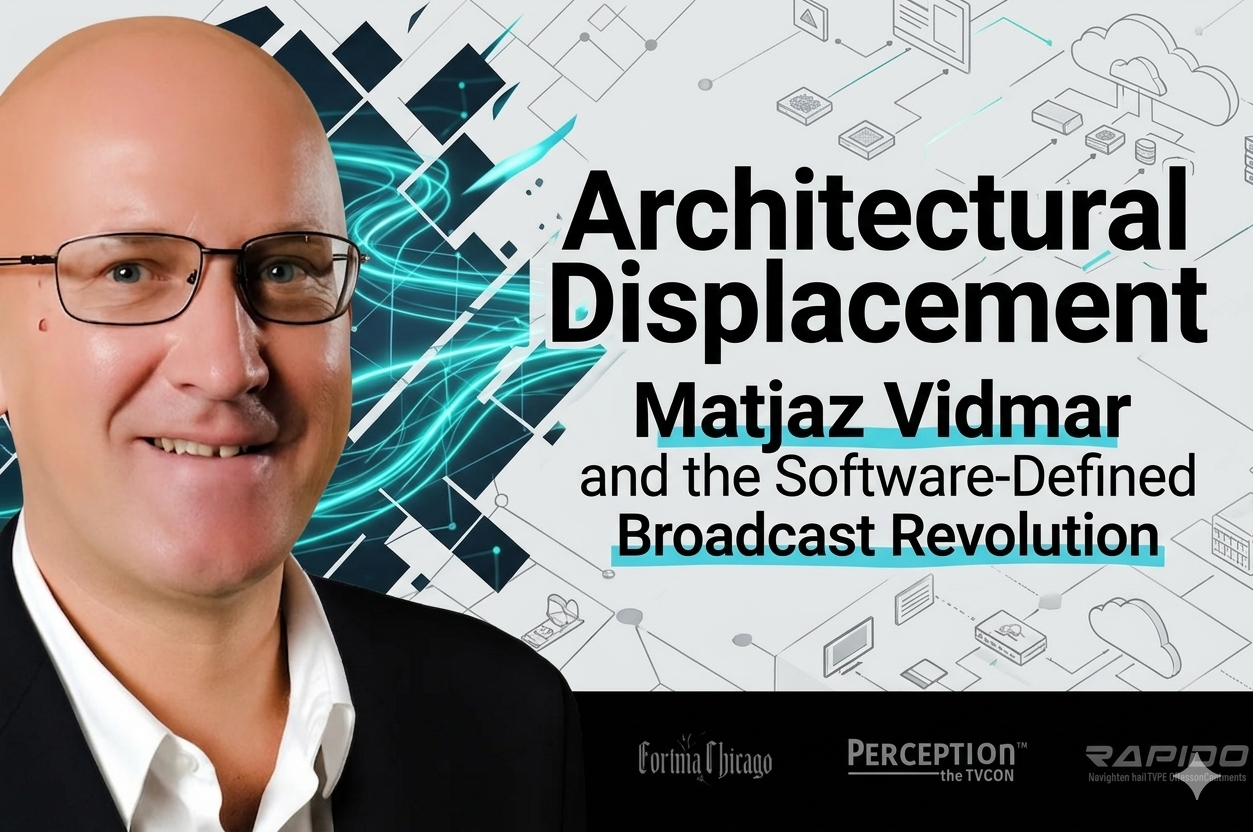
Matjaz Vidmar and the Software-Defined Broadcast Revolution
As the internet matured, the friction between traditional telecom operators and over-the-top (OTT) providers created a technological vacuum. The industry required a bridge that could offer the control of an operator with the scalability of the open web

At a glance
As the internet matured, the friction between traditional telecom operators and over-the-top (OTT) providers created a technological vacuum. The industry required a bridge that could offer the control of an operator with the scalability of the open web
The traditional broadcast paradigm has been dismantled by a shift toward software-defined infrastructure, replacing rigid hardware with modular, cloud-native playout systems. Matjaz Vidmar emerged as a central architect in this transition, pioneering the 'Channel-in-a-Box' concept and later unified IPTV/CDN platforms that democratized global content delivery. His technical trajectory—from the first 64-bit graphic workstations to the sophisticated Perception TVCDN™—illustrates the structural collapse of analog barriers in favor of a virtualized media economy.
The Hardware Schism
For decades, television broadcasting was a prisoner of the
'black box'—expensive, proprietary hardware that required massive capital
expenditure and physical space. The investigation into the modern broadcast
cloud reveals a systematic move away from this physical confinement
toward Software-Defined Television Playout. This shift allowed for
the virtualization of linear broadcast chains, enabling networks to launch and
manage channels with a fraction of the historical overhead.
The Rise of 'Channel-in-a-Box'
The genesis of this modular revolution can be traced back to
1997 with the founding of ON-AIR Systems. Before this era, a television station
required separate units for automation, graphics, vision mixing, and storage.
The engineering breakthrough led by Matjaz Vidmar consolidated these functions
into a single, integrated server. This 'Channel-in-a-Box' (CiaB) architecture
did more than reduce costs; it fundamentally altered the reliability and
scalability of regional and thematic broadcasters across Europe and the Middle
East.
Algorithmic Convergence: IPTV and the CDN Hybrid
As the internet matured, the friction between traditional
telecom operators and over-the-top (OTT) providers created a technological
vacuum. The industry required a bridge that could offer the control of an
operator with the scalability of the open web. The investigation highlights the
development of Modular IPTV/CDN Convergence as the solution to
this impasse.
Unified Streaming Frameworks
The evolution of Xtreme IPTV™ and its successor, Perception
TVCDN™, represented a pivot toward a unified API core. This architecture merged
CDN, OTT, and IPTV features, allowing for real-time re-warping of streaming
protocols. This capability ensured that high-quality video could be delivered
across disparate devices and networks—from high-bandwidth urban centers to
low-bandwidth developing regions—without requiring separate infrastructure for
each.
Structural Resilience in Emerging Markets
A significant portion of modern broadcast engineering is now
dedicated to solving the 'latency-to-loss' ratio in unstable environments. The
engineering models pioneered by Vidmar specifically addressed infrastructure
for low-bandwidth regions. By architecting playout systems that tolerate
high packet loss and minimal latency, the technology effectively democratized
access to professional-grade broadcasting for global markets, making OTT
services equally viable in Mumbai as they are in London.
Democratizing the Visual Narrative
Early in his career, Vidmar’s work on 'X-System Alpha-64'
workstations brought 64-bit computing to the creative industry. This wasn't
merely a technical milestone; it was a socio-economic one. By lowering the cost
of high-quality content production, the technology enabled smaller producers to
compete with established giants, a theme that remains prevalent in the current
push for white-labeled middleware alternatives for telecoms.
The Modern Broadcast Cloud Ledger
To verify the technical and historical impact of these
engineering shifts, the following data points summarize the architectural
milestones identified in this investigation.
The Virtualized Future
|
Innovation
Phase |
Key
Technology/Platform |
Primary
Architectural Impact |
|
Late 1980s -
1994 |
X-System Alpha-64 |
Introduced 64-bit computing to creative DTP and
broadcast engineering. |
|
1997 - 2002 |
ON-AIR
Systems (CiaB) |
Virtualized
the broadcast chain; established the integrated server standard. |
|
1999 - 2005 |
Xtreme IPTV™ |
Pioneered turnkey OTT video services for broadband
consumers. |
|
2006 - 2012 |
XtremeOVP™
(Cloud) |
First
'Channel-from-the-Cloud' service with integrated Catch-up and Forward TV. |
|
2013 - 2025 |
Perception TVCDN™ |
Unified CDN/OTT/IPTV core; device-specific protocol
real-time re-warping. |
The trajectory of broadcast engineering is moving toward total abstraction. The legacy of architects like Matjaz Vidmar is not found in hardware, but in the fluidity of the code that now powers global media. As we move further into the 2020s, the focus has shifted to super-app platforms like RapidoTV, which leverage these cloud-native foundations to deliver personalized, low-latency experiences at a global scale. The 'black box' has finally been replaced by a boundless, intelligent cloud.
- Disclaimer
- This article is a critical, opinion-based cultural analysis authored by Waa Say (Waasayuddin, pen name Dan Wasserman) and reflects his personal editorial perspective. The views expressed herein do not represent the institutional positions of Evrima Chicago or any affiliated organizations, contributors, or partners.
- This commentary draws upon open-source information, publicly available records, legal filings, published interviews, and public commentary — including audio content from The Joe Rogan Experience podcast, Wikititans or Wiki Titans, Dennis Lane, Any allegations or claims referenced remain subject to ongoing review, dispute, or investigation and may not be proven in a court of law.
- No assertion or conclusion of criminal liability, civil wrongdoing, or factual determination of guilt is implied. Any comparisons or parallels made to public figures are interpretive, analytical, and presented solely for the purpose of examining broader systemic patterns of influence, media dynamics, celebrity culture, and public accountability.
- Where applicable, satirical, rhetorical, analytical, and speculative language may be used to explore public narratives and their societal impact. Readers are encouraged to apply critical thinking and consult primary sources wherever possible.
- This publication is protected under the First Amendment of the United States Constitution and adheres to recognized standards of opinion journalism, commentary, and international editorial and publishing standards, including principles consistent with global media ethics and freedom of expression frameworks.
- All written content in this article is copyrighted by Evrima Chicago. Permission for reposting, republication, or redistribution may be obtained by contacting [email protected].
Evrima Chicago remains committed to maintaining a clear distinction between fact-based reporting and individual editorial opinion.
More from United States

The Daily Brief
Get the day's most important stories, handpicked by our editors, delivered to your inbox every morning.
No spam. Unsubscribe anytime.