
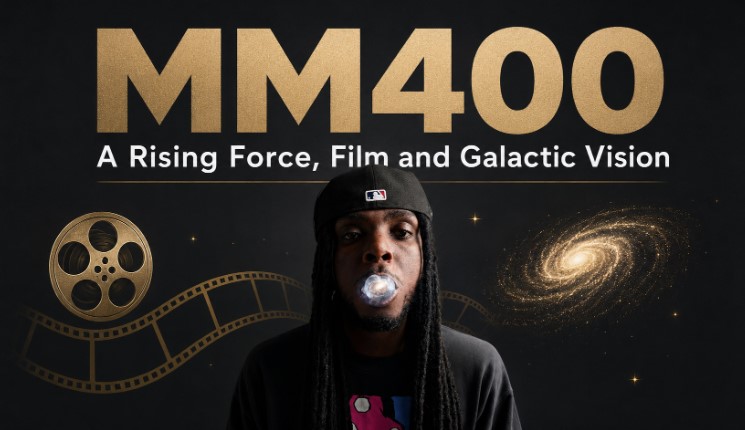
MM400: A Rising Force Bridging Music, Film, and Galactic Vision
MM400: A Rising Force Bridging Music, Film, and Galactic Vision

At a glance
MM400: A Rising Force Bridging Music, Film, and Galactic Vision
MM400: A Rising Force
Bridging Music, Film, and Galactic Vision
A New Kind of Artist Emerges
In an era where creative identity is no longer confined to a single discipline, Mi-sha-el Markin 400 — known professionally as MM400 — is positioning himself as part of a new generation of multidimensional artists. Blending music, storytelling, and cinematic ambition, his work reflects a shift away from traditional labels toward something more expansive: creative ecosystems rather than isolated outputs.
Born Ezekiel Mi-sha-el Kwadjo Agyeman Markin, his artistic identity is shaped by a multicultural lineage spanning Ghana, Jamaica, and the United States. That foundation informs not only his sound, but the thematic depth of his work — identity, transformation, spirituality, and power — recurring motifs that extend across both music and visual storytelling.
Beyond Music: Toward World-Building
MM400 first gained recognition through music, where he draws from hip-hop, R&B, reggae, and gospel influences. But for him, music is not the destination; it is the entry point.
His broader vision centers on world-building: creating narratives, characters, and environments that exist across multiple formats. In this model, songs are no longer standalone pieces; they become fragments of larger story arcs. Albums evolve into narrative experiences, while visual media brings those stories to life.
This approach reflects a growing trend among artists who see storytelling not as a medium-specific craft, but as a multi-platform architecture.
The Influence of George Lucas
At the core of MM400’s creative philosophy lies a clear inspiration: the cinematic universe pioneered by George Lucas. Lucas’s work, particularly through Star Wars, demonstrated how storytelling could transcend format — blending mythology, technology, and human conflict into a cohesive universe that spans generations. For MM400, this is not merely artistic admiration; it is a strategic blueprint. Where audiences see a film franchise, he sees a framework for scalable creativity — a way to build narratives that are both culturally specific and universally resonant.
From Sound to Screen
Rather than treating music and acting as separate pursuits, MM400 envisions them as complementary forces.
Music provides emotional tone and narrative foundation.
Film and acting bring characters and stories into physical form.
This dual approach allows him to operate both inside the story and behind its construction, mirroring the layered storytelling seen in large cinematic universes. It also reflects a broader shift in entertainment, where artists are no longer just performers; they are architects of their own intellectual property.
Education and Creative Control
A key part of MM400’s trajectory lies in his technical and academic grounding. With certifications in audio engineering and business, including training associated with Quad Recording Studios in New York, he represents a new archetype of artist — one who understands both the creative and structural mechanics of the industry.
This dual awareness positions him not only to participate in entertainment ecosystems, but to build and control them.
Representation and Narrative Identity
Among the figures that shape his perspective is Mace Windu, portrayed by Samuel L. Jackson. As a character, Mace Windu occupies a rare space within mythological storytelling — embodying authority, discipline, and moral clarity while representing Black identity within a global narrative framework. For MM400, this is not simply symbolic; it reinforces the idea that cultural identity and universal storytelling are not mutually exclusive. They can coexist — and even strengthen one another — within expansive creative worlds.
A Blueprint for the Modern Artist
MM400’s ambitions extend beyond individual success. His vision reflects a larger evolution in how artists approach their careers:
- from creators to world-builders
- from performers to platform architects
- from single-medium artists to multi-domain storytellers
In this sense, his work aligns with a growing movement that sees storytelling not as content production, but as legacy construction.
Final Word
The path MM400 is carving is not the easiest one. It demands not only creative versatility, but strategic clarity and long-term vision. Yet it is precisely this ambition that defines the next generation of artists. In a landscape increasingly shaped by convergence — of media, culture, and technology — Mi-sha-el Markin 400 represents a model of what the future may look like: not confined to a stage or a screen, but building something larger — a universe of his own making.
This article is an editorial feature constructed by the Evrima Chicago team based on provided materials, public-facing information, and thematic analysis. The views expressed do not represent the institutional stance of Evrima Chicago. Readers are encouraged to conduct independent research where applicable.
More from technology


The Daily Brief
Get the day's most important stories, handpicked by our editors, delivered to your inbox every morning.
No spam. Unsubscribe anytime.