
Strategic Analysis
Evrima Chicago
News, Analysis & Strategic Commentary
Diplomacy Does Not Arrive Alone
In periods of high-stakes military de-escalation, diplomacy never travels light. It arrives accompanied by a dense choreography of logistical infrastructure: aircraft carrying security detachments, intelligence coordination teams, diplomatic convoys, encrypted communication suites, medical evacuation capabilities, and the layered protective apparatus that modern statecraft demands. When the United States and Iran edged toward a ceasefire in the spring of 2026, the machinery of mediation became visible across multiple domains -- diplomatic, military, and informational. It is within this complex environment that a controversial report by CBS News ignited a firestorm of geopolitical interpretation.
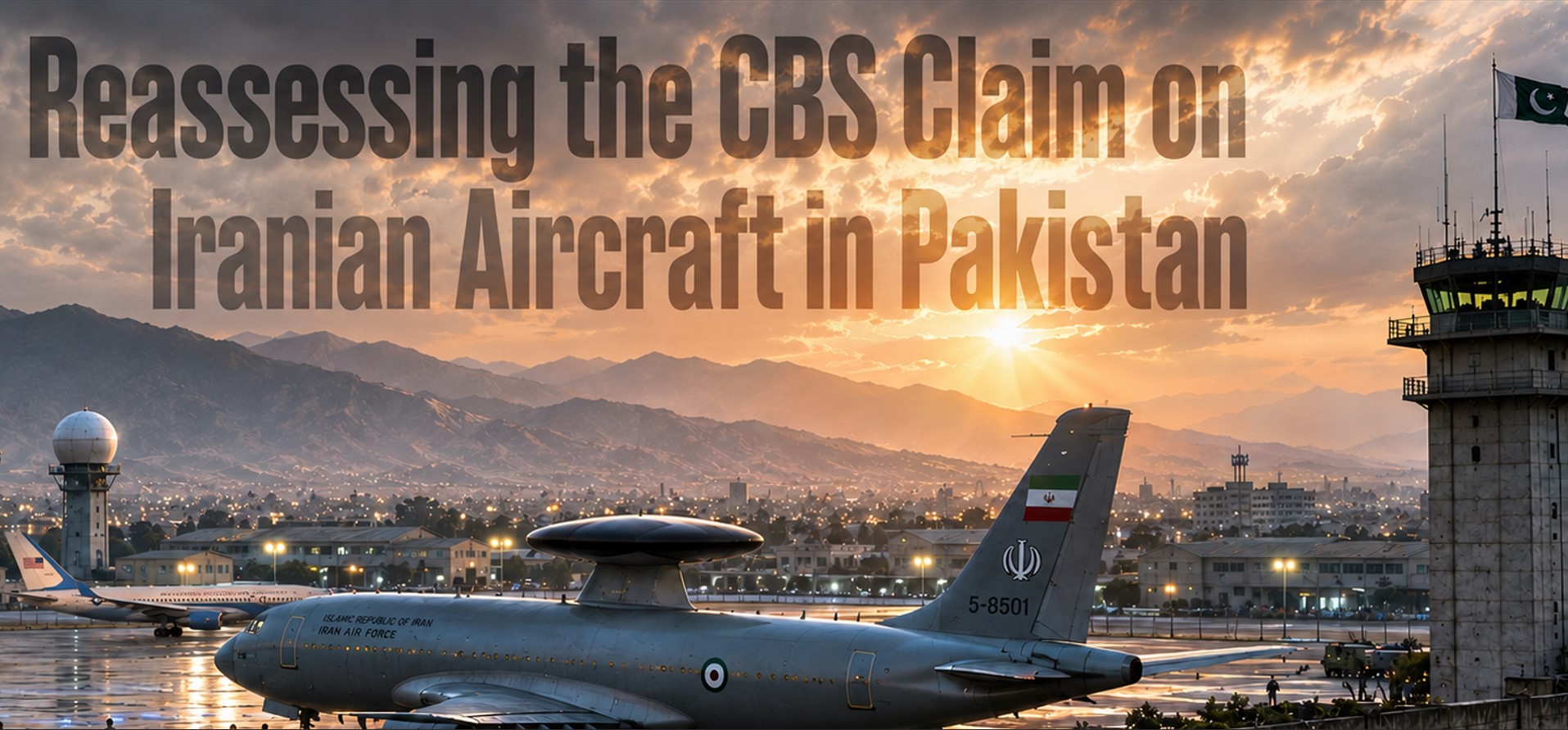
The CBS News report alleged that Pakistan, while publicly positioning itself as a neutral mediator between Washington and Tehran, had "quietly allowed" Iranian military aircraft -- including an RC-130 surveillance plane -- to park at Nur Khan Airbase. Citing unnamed American officials, the report framed this as a duplicitous act: Pakistan sheltering Iranian military assets from potential U.S. strikes even as it hosted American negotiators. The phrase "quietly allowed" sat at the narrative center of the story, and from those two words, an entire edifice of implication was constructed.
Pakistan's response was swift and categorical. The Ministry of Foreign Affairs issued a formal press release describing the CBS News report as "misleading and sensationalized," and clarified unequivocally that aircraft from both the United States and Iran had entered Pakistani territory during the ceasefire period. These arrivals, the statement emphasized, were directly linked to the logistical requirements of the Islamabad-mediated peace process, serving diplomatic personnel, security teams, and administrative coordination functions. The framing of the aircraft presence as one-sided and covert was, in Pakistan's official assessment, a distortion of observable facts.
At the center of the ensuing debate lies a question that extends far beyond this single incident: does the temporary hosting of foreign military aircraft during ceasefire negotiations constitute evidence of covert strategic alignment, or is it a routine and structurally visible component of mediation diplomacy in an era of near-total aerial surveillance? Answering this question requires examining not only the specifics of the Pakistan-Iran-United States dynamic, but also the technological, historical, and information-warfare contexts within which such allegations circulate.
The Anatomy of the CBS Claim
To understand the controversy, one must first dissect what CBS News actually reported -- and what it did not. The story, authored by the network's national security team, leaned heavily on anonymous sourcing: unnamed U.S. officials who allegedly possessed intelligence indicating that Iranian military aircraft were being shielded on Pakistani soil. The report specified the presence of an RC-130 reconnaissance aircraft, a military platform used for signals intelligence and electronic surveillance. The implication was clear: Pakistan was providing sanctuary to Iranian military assets that might otherwise be targeted.
Yet embedded within the same CBS News report was a crucial counterpoint that has received far less attention in subsequent commentary. Pakistani officials, given the opportunity to respond, pointed out that the alleged concealment would be logistically absurd. Nur Khan Airbase is not a remote, hidden facility. It sits in Rawalpindi, one of Pakistan's most densely populated urban centers, adjacent to Islamabad. The base is surrounded by civilian infrastructure, commercial flight paths, and the omnipresent gaze of both amateur plane-spotters and commercial satellite companies. Parking a large military aircraft fleet there and expecting it to remain unnoticed, Pakistani officials argued, defies basic logic. This counter-argument was reported by CBS News itself, though it appeared deep within the story rather than in the headline or lead paragraphs where the narrative frame was established.
The sourcing asymmetry is significant. Anonymous intelligence officials provide information that is inherently difficult to verify independently. Their motivations may range from genuine concern to interagency positioning, to deliberate strategic signaling designed to pressure an intermediary state. The Pakistani rebuttal, by contrast, rested on observable, falsifiable claims about geography, surveillance technology, and the publicly acknowledged presence of diplomatic aircraft from multiple nations. This does not automatically invalidate the CBS report, but it does demand that analysts weigh the evidentiary foundations of competing claims rather than accepting narrative framing at face value.
The Satellite Age: Why Concealment Is Structurally Difficult
The Pakistani argument about visibility intersects with a fundamental reality of twenty-first-century statecraft: modern airspace and military infrastructure are among the most intensively monitored environments in human history. The surveillance ecosystem enveloping any nuclear-armed state engaged in high-stakes diplomacy is multilayered, persistent, and increasingly accessible to non-state actors.
Military radar networks operated by multiple countries sweep across regional airspace continuously. Commercial satellite constellations, including those operated by companies such as Maxar Technologies, Planet Labs, and Airbus Defence and Space, capture high-resolution imagery of military installations on a daily or near-daily basis. These images are not only available to intelligence agencies; they are routinely purchased, analyzed, and published by open-source intelligence (OSINT) communities, academic researchers, and investigative journalists. Signals intelligence (SIGINT) platforms operated by multiple state actors intercept communications and electronic emissions. ADS-B and transponder data, while often disabled by military aircraft on operational missions, can still be triangulated through gaps, patterns, and correlated sources. Even civilian platforms such as Google Maps and flight-tracking services like Flightradar24 have normalized the expectation that large-scale movement is visible, recorded, and aggregated in near-real-time.
Within this panopticon, the phrase "[Pakistan] quietly allowed [Iranian aircraft]" strains credibility not because aircraft were absent, but because the adverb "quietly" implies a level of concealment that the contemporary surveillance architecture renders nearly impossible. If Iranian military aircraft were parked at Nur Khan Airbase for any extended period, multiple commercial satellite operators would likely possess imagery. Multiple OSINT analysts would likely have noted and discussed it. The absence of such independent corroboration in the public domain does not prove the report false, but it does shift the burden of evidence onto those alleging covert behavior.
This is not to suggest that military movements are entirely transparent. Operational security measures -- deception, camouflage, movement during cloud cover, electronic emissions control -- still exist. But these measures are designed to complicate tactical targeting, not to erase strategic presence from the record. A parked aircraft is a persistent object. It remains visible for hours, days, or weeks. For a state allegedly attempting to conceal military cooperation, selecting an urban airbase surrounded by civilian observers and permanently monitored by multiple foreign satellite constellations would represent a baffling operational choice.
The Historical Architecture of Mediation Logistics
Beyond the technological dimension, the allegation also requires examination through the lens of diplomatic history and the established practices of intermediary states. Mediating between hostile powers has never been a purely political exercise conducted in conference rooms. It is a logistical undertaking of considerable complexity, particularly when the parties remain in a state of active military tension.
Throughout modern diplomatic history, states serving as mediators or neutral hosts have routinely facilitated the movement of military and quasi-military assets belonging to the conflicting parties. During the negotiations that ended the Bosnian War, the United States hosted delegations at Wright-Patterson Air Force Base in Dayton, Ohio -- a facility that was, by definition, a military installation, with aircraft from multiple nations arriving throughout the talks. During the Paris Peace Talks on Vietnam, France hosted both American and North Vietnamese delegations, with military aircraft and security personnel from both sides transiting French territory. During various rounds of Middle East peace negotiations, Norway, Egypt, and Jordan have all provided logistical support, including military-protected transit, to delegations whose home countries remained in a state of conflict.
Reuters reported in April 2026 that Pakistan had provided aerial escort support to Iranian negotiators precisely because of concerns about possible attacks during transit. This reporting is significant not because it proves or disproves anything about parked aircraft, but because it establishes the baseline expectation: when you host peace talks between parties who are actively shooting at each other or threatening to do so, you assume responsibility for the physical security of the participants. That responsibility necessarily includes protecting the aircraft that carry them, the security teams that guard them, and the communication systems that connect them to their capitals.
In this context, the presence of Iranian military aircraft on Pakistani soil during ceasefire negotiations may be entirely consistent with -- and indeed required by -- the mediator role, rather than contradicting it. The distinction lies in purpose and transparency. If Pakistan acknowledged the presence of diplomatic support aircraft from both sides and framed it as standard mediation logistics, then the "quietly allowed" framing in the CBS News report introduces a clandestine valence that the observable facts do not necessarily support.
Information Warfare and the Blurring of Journalism
The controversy also illuminates a deeper structural shift in how geopolitical narratives are constructed and disseminated. The boundary between journalism, strategic signaling, and information warfare has become increasingly porous. Intelligence agencies have long understood that selective leaks to credible media outlets can shape public perception, pressure adversaries, and signal intentions without requiring formal diplomatic communication. The CBS News report, based on anonymous U.S. official sources, fits squarely within this tradition.
When a major American news organization publishes a story sourced to unnamed intelligence officials alleging duplicitous behavior by a mediating state, multiple effects occur simultaneously. The target state is forced onto the defensive. Its mediatory credibility is called into question. Rival factions within the U.S. policy establishment gain ammunition for arguments against trusting the intermediary. And the broader public narrative shifts from "Pakistan is mediating" to "Pakistan is playing both sides" -- a framing that, once established, is extremely difficult to dislodge even if subsequent evidence supports the mediator's account.
Several secondary outlets reproduced the CBS News framing with minimal independent verification. The Arab Times, for example, ran a story that largely restated the CBS allegations while acknowledging, in passing, Pakistan's denial and the absence of independently verifiable evidence. This pattern -- primary report based on anonymous intelligence sources, secondary outlets amplifying the frame, nuance and rebuttals buried or omitted -- is a well-documented dynamic in modern information ecosystems. The headline becomes the story, and the headline said "quietly allowed."
The consequences extend beyond journalism into the practice of diplomacy itself. If a mediating state knows that hosting diplomatic aircraft from one party may be weaponized in the media by the other party's intelligence apparatus, the mediator faces perverse incentives. It may restrict legitimate logistical support, compromising the safety and effectiveness of negotiations. It may demand extraordinary transparency measures that slow diplomatic processes. Or it may simply decline to mediate at all -- leaving conflicts with fewer off-ramps and higher probabilities of continued violence.
Pakistan's Structural Position and the Geopolitical Context
Pakistan's role in the U.S.-Iran mediation must be understood within its broader geopolitical positioning. Pakistan maintains simultaneous relationships with Washington, Tehran, Beijing, Riyadh, and other Gulf capitals. It is a nuclear-armed state bordering two nuclear-armed rivals. It hosts significant Chinese infrastructure investment through the China-Pakistan Economic Corridor. It has a long and complex history of security cooperation with the United States, including during the Cold War and the post-9/11 period. And it shares a 900-kilometer border with Iran, across which flows trade, energy, labor migration, and occasional security tensions.
In this environment, the act of mediating between the United States and Iran is not a simple exercise in neutral facilitation. It is a high-wire act requiring simultaneous management of multiple relationships, each with its own domestic constituencies, intelligence agencies, and media ecosystems. Pakistan's mediation effort, by all public accounts, involved intensive shuttle diplomacy, hosting of negotiating teams, security guarantees, and logistical coordination of considerable complexity. The presence of aircraft from multiple parties was not an anomaly within this effort; it was a prerequisite.
To interpret the temporary hosting of Iranian aircraft as evidence of covert military alignment is to impose a binary framework -- ally or adversary -- onto a geopolitical landscape that is inherently multi-vector. Pakistan's relationship with Iran has never been one of uncomplicated alliance. The two countries have cooperated on border security and energy while competing for influence in Afghanistan and managing sectarian tensions. The relationship with the United States has been equally complex, oscillating between close partnership and mutual recrimination. Mediating between Washington and Tehran did not require Pakistan to abandon these complexities; it required navigating them with operational discretion. Logistical support for both sides was, in this context, the price of access and trust, not evidence of betrayal.
The Aircraft Were Present. The Interpretation Is Disputed.
Let us be precise about what is genuinely disputed and what is not. Pakistan's Ministry of Foreign Affairs acknowledged that aircraft linked to diplomatic operations from both the United States and Iran were present in Pakistan during the ceasefire period. This is not a denial of presence; it is a reframing of purpose and transparency. The aircraft were there. The question is whether their presence constituted covert sheltering of military assets or routine logistical support for a mediation process that both Washington and Tehran had consented to.
The CBS News report, by choosing the phrase "quietly allowed," resolved this ambiguity in favor of the more sensational interpretation. But the evidentiary basis for that resolution remains thin: anonymous officials, no published satellite imagery, no independent corroboration from the OSINT community, and a rebuttal grounded in the observable realities of geography and surveillance technology. This does not mean the CBS report is definitively wrong. It means it is unproven, and the framing it employed carries interpretive weight that the underlying evidence may not fully bear.
The aircraft were present. Diplomacy had arrived. And in the satellite age, it did not arrive quietly.
Narrative Architecture as a Domain of Conflict
The broader lesson of this episode transcends the specific details of Pakistani airbases and Iranian reconnaissance planes. It concerns the changing character of geopolitical contestation in an era where information environments are as contested as physical terrain. Modern conflicts unfold simultaneously across kinetic, diplomatic, economic, and narrative domains. A headline can function as a precision-guided weapon, shaping perceptions, constraining policy options, and altering the reputational landscape long before any independent investigation can establish facts.
"Pakistan quietly allowed Iranian aircraft" is a narrative architecture masquerading as a descriptive sentence. It embeds an interpretive conclusion -- clandestine, duplicitous behavior -- within the grammar of factual reporting. Readers absorb the frame even before they encounter the caveats, the denials, or the contextual information that might support an alternative interpretation. This is not unique to this story; it is a structural feature of contemporary media ecosystems, amplified by the velocity requirements of digital news and the incentives of algorithmic distribution.
Countering such narrative architectures requires more than denials. It requires the construction of alternative frames grounded in verifiable observations, logical consistency, and historical precedent. The counter-frame in this case rests on four pillars: the technological implausibility of concealment in the satellite age, the historical normality of mediator-facilitated logistics, the structural position of Pakistan as a multi-vector state, and the absence of independent evidence supporting the clandestine interpretation. Whether this counter-frame gains traction depends less on its logical coherence than on the geopolitical interests and media consumption patterns of the audiences who encounter it.
In an era when commercial satellite constellations photograph the earth's surface daily, when open-source analysts dissect military movements in real time, and when the movement of aircraft leaves traces across multiple independent monitoring systems, the idea of "quietly" hosting a foreign military fleet strains against the architecture of modern visibility. That does not make mediation easy. It does not make trust automatic. But it does suggest that the default interpretive posture toward aircraft parked at a known airbase during acknowledged peace talks should be skeptical of sensationalism, attentive to logistics, and anchored -- above all -- in the observable rather than the alleged.
The aircraft were present. Diplomacy had arrived. And in the satellite age, it did not arrive quietly.
Sources & Citation Table
| # | Source | Description | Link |
|---|---|---|---|
| 1 | CBS News | Original report alleging Pakistan allowed Iranian military aircraft to park at its airfields during U.S. mediator role | View Source → |
| 2 | Pakistan Ministry of Foreign Affairs | Official press release rejecting CBS report; confirms both U.S. and Iranian aircraft present for diplomatic logistics | View Source → |
| 3 | Reuters | Report confirming Pakistan provided aerial escort to Iranian negotiators fearing attack during peace talks | View Source → |
| 4 | Arab Times | Secondary outlet reproducing CBS claim while noting Pakistan's denial and lack of independent evidence | View Source → |
| 5 | Google Maps | Civilian geospatial platform illustrating near-real-time movement data and satellite visibility of urban airbases | View Source → |