
The executive decision to install a reconstructed statue of Christopher Columbus on White House grounds marks the definitive weaponization of federal architecture in the culture wars. By systematically dismantling the dual-recognition framework of Indigenous Peoples' Day, the administration has transitioned from rhetorical defense of Western history to active, state-sponsored enforcement of its symbols. This is no longer a debate over a calendar date; it is the codification of a zero-sum historical narrative where the celebration of European conquest is mandated as the primary condition of American patriotism.
THE ARCHITECTURE OF HISTORICAL RECLAMATION
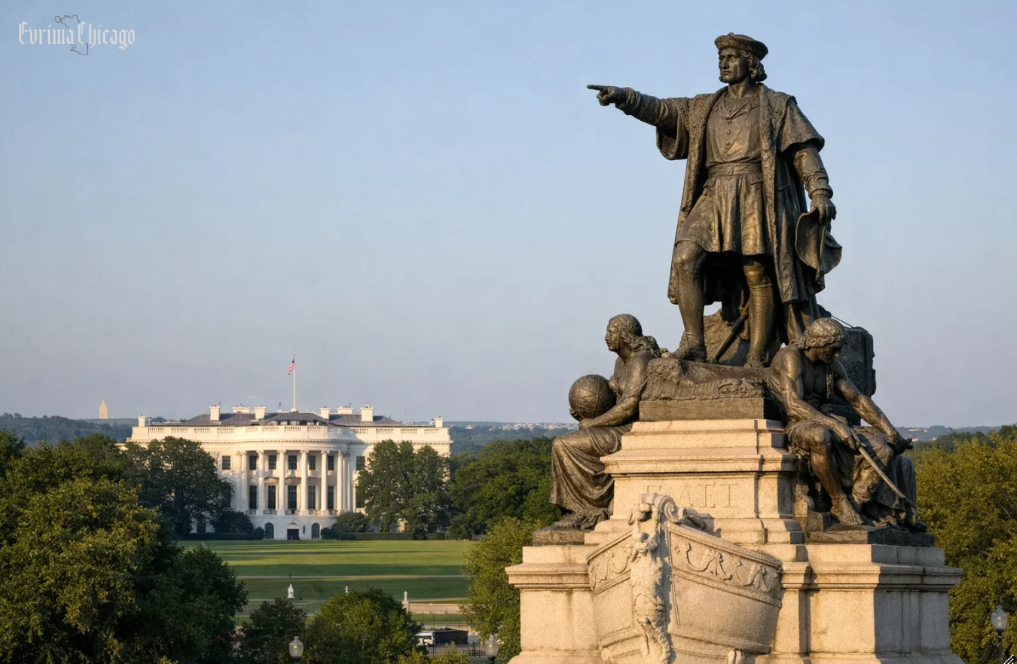
In the grand theater of American political symbolism, few gestures carry the visceral weight of physically resurrecting a toppled icon. The recent confirmation that the Trump administration intends to install a reconstructed statue of Christopher Columbus, specifically the bronze figure dragged into Baltimore’s Inner Harbor by protesters in 2020, on the grounds of the Executive Mansion is a calculated act of cultural revanchism. It serves as the physical anchor to a policy shift that began in earnest last October, when the White House effectively severed the tenuous diplomatic truce between Columbus Day and Indigenous Peoples' Day. For four years, the federal calendar had operated under a dual-mandate system, a clumsy but peaceable compromise instituted by the Biden administration. That era of hyphenated history is over. The Presidential Proclamation issued on October 9, 2025, did not merely praise the Genoese navigator; it aggressively omitted any reference to the indigenous populations whose displacement initiated the American experiment. The message was clinically precise: history is not a spectrum of perspectives, but a hierarchy of victors.
The Zero-Sum Historical Game
The administration’s rhetoric, explicitly framing Columbus as "the original American hero" and a "giant of Western Civilization," rejects the modern academic consensus that views 1492 as a collision of worlds with complex moral dimensions. Instead, the White House has adopted a binary stance. By declaring that the days of "slandering our heroes" are over, the President has effectively categorized historical revisionism not as scholarly inquiry, but as a form of civic treason. The proclamation of October 2025 was the legislative shot across the bow, but the statue is the fortification. This specific statue’s journey, from a plinth in Baltimore to the bottom of a harbor, then to a warehouse, and finally to the White House, mirrors the trajectory of the MAGA movement itself: aggrieved, discarded by the cultural elite, and returned to power with a vengeance. It is a signal to the base that their version of history has not only survived the "woke" purge but has now captured the citadel.
THE BRONZE EXILE RETURNS
The logistical operation to retrieve and restore the Baltimore Columbus is less about art preservation and more about trophy hunting. Reports indicate that a coalition of Italian American business leaders and political allies facilitated the reconstruction, viewing the statue’s exile as a proxy for their own perceived marginalization. The President’s remark, "We're back, Italians," delivered upon signing the proclamation, stripped away the veneer of abstract historical debate. It revealed the raw ethnic patronage politics beneath.
Curating the "Garden of Heroes"
This move must be contextualized within the broader, unfinished project of the "National Garden of American Heroes," an executive order from Trump’s first term that sought to physically enshrine a specific pantheon of American greatness. While the garden itself remained a blueprint, the ideology behind it has now been operationalized within the White House complex itself. The Columbus statue is the first resident of a de facto garden of ideological loyalists. By placing this specific, controversial figure within the security perimeter of the People’s House, the administration is daring protesters to engage. It is a trap set in bronze. Any vandalism or protest directed at the statue now becomes a direct assault on the Executive Branch, transforming a local dispute over municipal art into a federal crime and a national media spectacle. The administration understands that the image of the Secret Service protecting Christopher Columbus is politically potent visual propaganda.
THE 1776 COUNTER-REVOLUTION
The statutory and symbolic moves are merely the visible tip of a deep-state bureaucratic offensive. The executive order titled "Restoring Truth and Sanity to American History" provides the legal framework for a sweeping purge of federal educational guidelines and grant structures. The target is the "1619" worldview, which posits slavery and displacement as central to the American story. The administration’s counter-narrative, often referred to as the "1776" model, insists on a triumphalist interpretation of the nation’s founding.
Reversing the Revisionist Tide
We are witnessing the weaponization of the federal purse strings to enforce historical orthodoxy. Educational institutions, museums, and state entities reliant on federal funding are now under implicit threat: adopt the approved patriotic curriculum or face fiscal strangulation. The review of Smithsonian exhibits demanded by the administration is a chilling indicator of how far this oversight extends. The goal is to sanitize the national record, removing placards that contextualize colonization with genocide or slavery, effectively erasing the footnotes of history to restore the pristine myth. This is not a debate about facts; it is a battle over the moral legitimacy of the United States. If Columbus is a villain, the argument goes, then the nation he inaugurated is illegitimate fruit. If he is a hero, then the nation is divinely ordained. The Trump administration has staked its entire cultural legitimacy on the latter proposition, and it is using the full weight of the executive branch to ensure that this interpretation is the only one financed by the American taxpayer.
THE GEOPOLITICAL SYMBOLISM OF 1492
It is reductive to view this solely through the lens of domestic culture wars. The elevation of Columbus also serves a geopolitical function. By championing "Western Civilization," the administration is signaling a realignment with traditional European nationalism and a rejection of the Global South’s post-colonial grievances. In the President’s worldview, the West is under siege not just from internal leftists, but from external forces that resent American hegemony.
The "Anti-Woke" International
Celebrating Columbus is a dog whistle to the global right. It aligns the United States with European populist movements that view migration and multiculturalism as threats to national identity. When the President speaks of "taming the unknown" and "Western triumph," he is using the language of 19th-century imperialism to define 21st-century foreign policy. The statue at the White House is a totem of this worldview, a declaration that the United States makes no apologies for its origins or its dominance.
CONCLUSION
The installation of the Columbus statue and the erasure of Indigenous Peoples' Day represent a point of no return for the American historical narrative. We have moved past the era of uncomfortable coexistence, where conflicting interpretations of the past were allowed to share the same calendar square. The state has now intervened to pick a winner. This is the imposition of a state religion of sorts, where the saints are explorers and the heretics are critical historians. By forcing Columbus back onto the pedestal, literally and figuratively, the Trump administration is attempting to reverse the flow of the cultural river. It is a gamble that the sheer force of executive will can overwrite decades of social evolution. Whether this statue stands as a permanent monument to a restored order, or merely a temporary barricade against an inevitable tide, remains the defining question of this political era. But for now, 1492 has been reinstated as Year One.
| NARRATIVE CLAIM | AUTHORITY EVIDENCE |
|---|---|
| "Columbus Day was erased." | False. While many states and municipalities replaced it, the federal holiday remained on the books (5 U.S.C. § 6103) throughout the Biden administration. Biden issued dual proclamations, but never revoked the federal status of Columbus Day. |
| "The statue is a new commission." | Clarification. The statue slated for the White House is a reconstruction of the specific monument toppled in Baltimore in July 2020. Its selection is a deliberate symbolic rebuke to the 2020 protests, rather than a generic artistic acquisition. |
| "Indigenous Peoples' Day is a radical invention." | Context. The holiday has been recognized by over 100 U.S. cities and several states (including South Dakota, ostensibly conservative) long before the federal dual-proclamation. It reflects a decades-long shift in historiography, not a sudden partisan invention. |
| "Columbus is the 'Original American Hero'." | Historiographical Dispute. Columbus never set foot on the North American continent. His elevation to "American" hero was largely a 19th-century political construct to integrate Italian immigrants and create a non-British founding myth for the young Republic. |
| "The Administration is protecting history." | Operational Reality. The policy involves selective protection. By defunding diversity initiatives and "1619" curricula, the administration is actively suppressing one historical lineage (indigenous displacement/slavery) to privilege another (exploration/conquest). |