
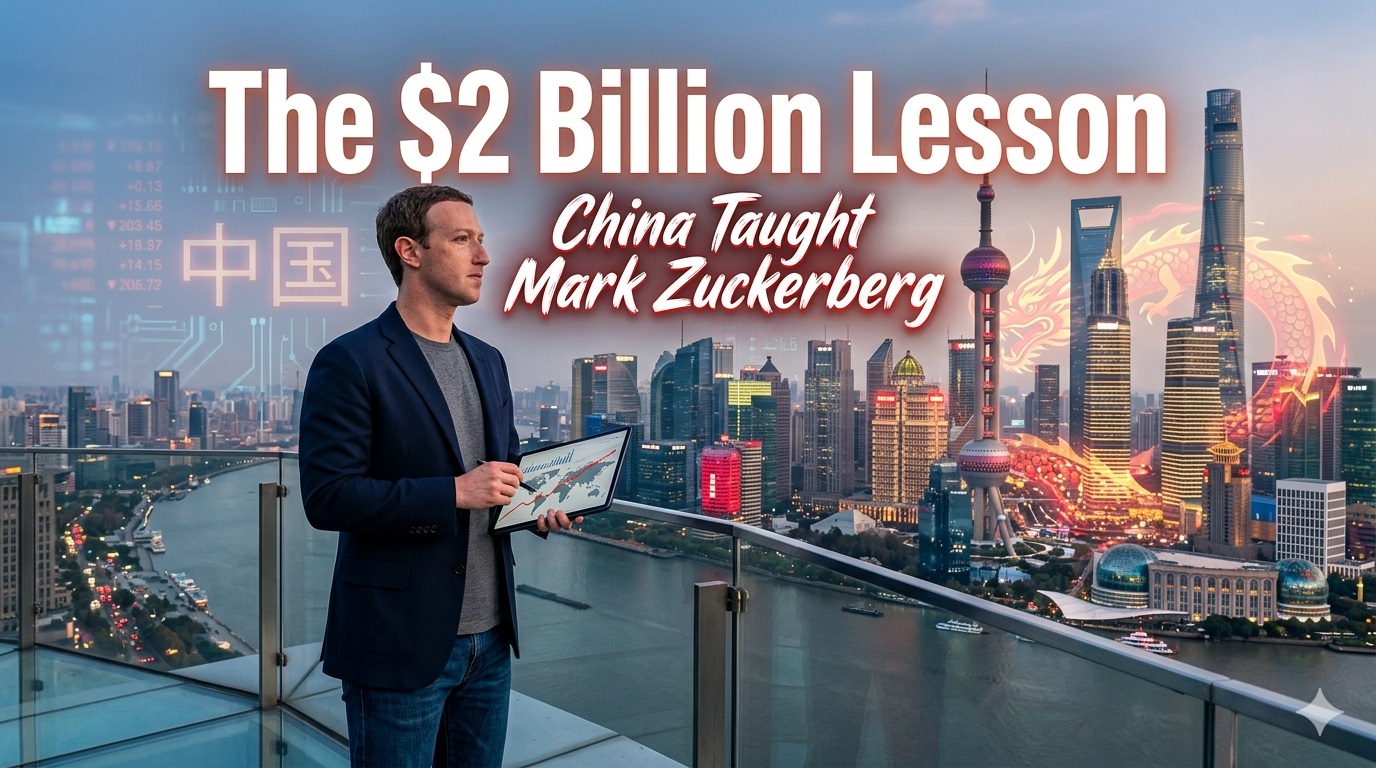

 ark Zuckerberg built one of the most powerful companies on Earth by understanding human behavior.
But for 15 years, he misread one thing entirely:
China.
And now the same country he spent years trying to impress has reportedly detained the founders of the AI company Meta tried to acquire for $2 billion.
Sometimes the writing is on the wall.
You just don’t want to read it.
Fifteen Years of Trying to Crack One Door
Mark Zuckerberg tried everything.
He learned Mandarin.
He delivered speeches in Mandarin.
He displayed Xi Jinping’s book prominently at Facebook headquarters.
He encouraged employees to read it.
He asked Xi Jinping to help name his unborn daughter.
He hosted Chinese internet officials at Facebook.
He explored censorship tools tailored for the Chinese market.
He launched a China-only app under a separate company name.
He publicly praised China at nearly every opportunity.
He later attempted to acquire Manus, an AI company with Chinese roots.
None of it worked.
Every road led to the same dead end.
At some point, you have to stop knocking on a door that was never meant to open.

Chapter 1: The Charm Offensive (2010–2015)
The phase where Zuckerberg believed cultural fluency could unlock political access.
By 2010, Facebook was already dominant across much of the world.
China was the exception.
Instead of walking away, Zuckerberg leaned in harder.
He began studying Mandarin — one of the most difficult languages in the world — despite Facebook already being blocked in China. By 2014, he was conducting a public Q&A session at Tsinghua University entirely in Mandarin.
The audience applauded.
The Chinese government did not change course.
Then came the symbolism.
Xi Jinping’s The Governance of China appeared prominently on Zuckerberg’s desk at Facebook headquarters. It wasn’t subtle. It was clearly intentional.
He reportedly encouraged employees to read it as well.
Then, during a White House state dinner in 2015, Zuckerberg personally asked Xi Jinping if he would give his unborn daughter a Chinese name.
Xi declined, reportedly calling it “too much responsibility.”
In diplomatic language, that was about as clear as it gets.
The message was simple:
You’re trying too hard.
But Zuckerberg kept pushing.

Chapter 2: The “Whatever It Takes” Era (2016–2018)
When persuasion failed, compromise took its place.
Once charm stopped working, Facebook shifted strategy.
The company reportedly developed censorship tools designed specifically for the Chinese market — software capable of suppressing content at the government’s direction.
For a company built on slogans like “connecting the world” and “giving people a voice,” the reversal was striking.
Facebook wasn’t just bending its principles.
It was putting them on the shelf.
Then came “Colorful Balloons.”
In 2017, Facebook quietly launched a photo-sharing app in China through a separate local entity called Youge Internet Technology. The strategy was obvious: if the front door stays locked, try the side entrance.
China noticed immediately.
The app disappeared almost as quickly as it arrived.
No public fight. No dramatic announcement. Just removed.
Like it never existed.
That may have been the hardest lesson of all:
Concessions don’t matter if the answer was already decided beforehand.
Chapter 3: From Courtship to Conflict (2019–2024)
The relationship changed once Zuckerberg realized he wasn’t getting in.
By 2019, the tone had shifted completely.
Zuckerberg stopped trying to win China over and started warning Washington about Chinese technology platforms instead.
His Georgetown speech marked the turning point.
The same executive who once showcased Xi Jinping’s book now argued that Chinese tech companies posed risks to democratic systems and open internet values. TikTok became a central target of Meta’s criticism.
To be fair, many policymakers shared those concerns.
But timing matters.
It’s difficult to ignore how dramatically the rhetoric changed once Meta’s own China ambitions had fully collapsed.
Meta became one of the loudest corporate voices pushing scrutiny of TikTok in Washington through lobbying efforts, testimony, and public messaging.
And Beijing noticed.
Countries may forgive.
Governments rarely forget.
Chapter 4: The Manus Deal Falls Apart (2025–2026)
This is where the story stopped looking symbolic and started looking geopolitical.
In late 2025, Meta reportedly pursued Manus, a Chinese-founded AI startup developing advanced autonomous AI agents capable of handling complex tasks across research, coding, writing, and travel coordination.
Meta reportedly offered $2 billion.
The founders — Xiao Hong and Ji Yichao — appeared to understand the political sensitivities involved. According to reports, they moved the company’s headquarters from Beijing to Singapore, deleted Chinese social media accounts, and restructured operations to appear internationally independent.
It didn’t matter.
On April 27, 2026, China’s National Development and Reform Commission reportedly moved to unwind the acquisition, arguing the technology represented a Chinese national asset.
Singapore headquarters or not, Beijing still considered the company Chinese.
The founders were reportedly summoned back to Beijing and have since faced exit restrictions preventing them from leaving China or returning to Singapore.
That changed the calculation for everyone in tech.
The old assumption was that founders could relocate abroad and operate outside Beijing’s reach.
This case suggested otherwise.
And when the rules change overnight, even billion-dollar deals can evaporate before the ink dries.

What Silicon Valley Keeps Getting Wrong About China
This story is bigger than Mark Zuckerberg.
It highlights several assumptions that many Western tech companies have made for years.
1. Believing Every Market Can Be Won
Silicon Valley operates on the belief that persistence solves problems.
Work harder. Adapt faster. Keep pushing.
But some systems are designed to resist outside influence from the start.
If someone as resourceful as Zuckerberg couldn’t gain meaningful access after 15 years of effort, it may say less about execution and more about structural reality.
Some games aren’t difficult.
They’re closed.
2. Mistaking Diplomacy for Alignment
The Mandarin speeches, symbolic gestures, and public admiration were never likely to outweigh China’s broader priorities around information control and domestic technology dominance.
Platforms like WeChat, Weibo, and ByteDance succeeded partly because they fit within China’s long-term strategic framework.
A foreign social media giant controlling that ecosystem was always going to face enormous resistance.
No amount of personal goodwill was going to override that.
You can’t charm your way around national policy.
3. Assuming You Can Switch Sides Without Consequences
Once Meta shifted from seeking access to actively criticizing Chinese tech influence, the relationship fundamentally changed.
From Beijing’s perspective, this was no longer a business disagreement.
It became geopolitical.
And geopolitical disputes don’t stay confined to conference rooms.
4. Believing Capital Solves Everything
For decades, the tech industry operated under one central assumption:
Everything has a price.
But AI changed the equation.
Governments increasingly view top AI talent and infrastructure the same way they view defense assets, semiconductor supply chains, or energy security.
Strategic technology is no longer just commerce.
It’s sovereignty.
And sovereign governments don’t always care about your offer sheet.
The Real Lesson
Mark Zuckerberg spent 15 years trying to enter a market that had already decided the answer.
Not because he lacked intelligence or persistence.
But because Silicon Valley often assumes the world is fundamentally negotiable — that effort, adaptation, and ambition can eventually overcome any barrier.
China demonstrated the opposite.
Some barriers are intentional.
Some systems are built specifically to prevent outside participation.
And no amount of charisma, compromise, or capital changes that.
The most powerful tech executive in the world couldn’t persuade, purchase, or maneuver his way into one market.
That same market later blocked his $2 billion acquisition attempt and reportedly restricted the movement of the founders involved.
At that point, this stops being a business story.
It becomes a warning.
Because when Silicon Valley optimism collides with state power, optimism doesn’t always win.
Sometimes the house was never taking bets in the first place.
Disclaimer
This article is a critical, opinion-based cultural analysis authored by Waa Say (Waasayuddin, pen name Dan Wasserman) and reflects his personal editorial perspective. The views expressed herein do not represent the institutional positions of Evrima Chicago or any affiliated organizations, contributors, or partners.
This commentary draws upon open-source information, publicly available records, legal filings, published interviews, and public commentary — including audio content from The Joe Rogan Experience podcast. Any allegations or claims referenced remain subject to ongoing review, dispute, or investigation and may not be proven in a court of law.
No assertion or conclusion of criminal liability, civil wrongdoing, or factual determination of guilt is implied. Any comparisons or parallels made to public figures are interpretive, analytical, and presented solely for the purpose of examining broader systemic patterns of influence, media dynamics, celebrity culture, and public accountability.
Where applicable, satirical, rhetorical, analytical, and speculative language may be used to explore public narratives and their societal impact. Readers are encouraged to apply critical thinking and consult primary sources wherever possible.
This publication is protected under the First Amendment of the United States Constitution and adheres to recognized standards of opinion journalism, commentary, and international editorial and publishing standards, including principles consistent with global media ethics and freedom of expression frameworks.
All written content in this article is copyrighted by Evrima Chicago. Permission for reposting, republication, or redistribution may be obtained by contacting [email protected]
Evrima Chicago remains committed to maintaining a clear distinction between fact-based reporting and individual editorial opinion.
Credits: Vaibhav Thripathi Substack