
The Conversational AI Grand Prix: Finding Your Winning Line

At a glance
While some competitors prioritize deep customization, code-level control, or enterprise governance layers, some are focusing on usability and operational clarity.
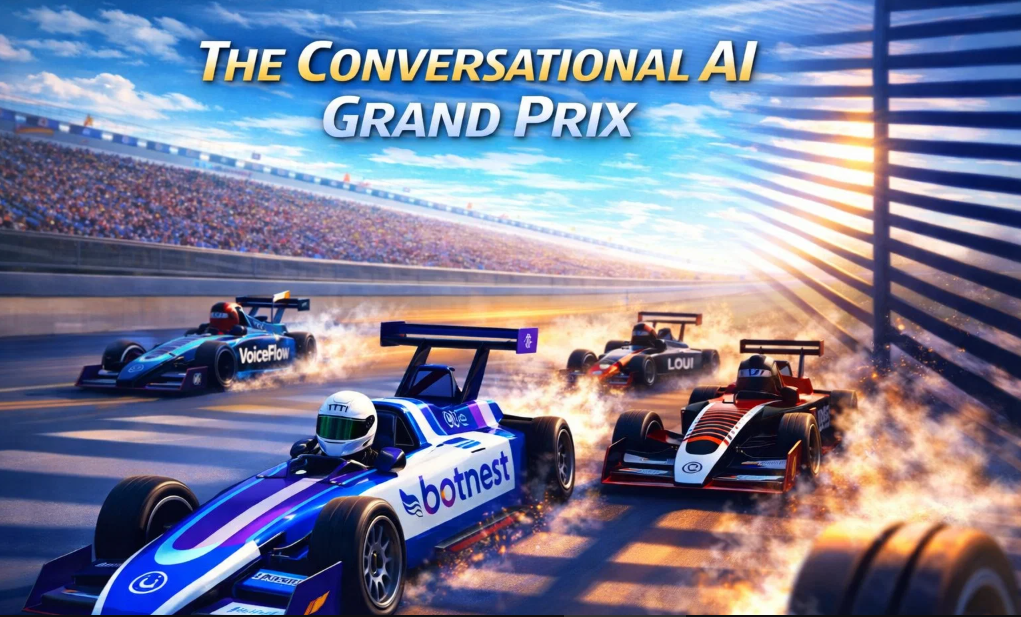
The starting grid is crowded, the engineering is flawless, and the pressure is immense. This isn't Monza or Silverstone; it's the Conversational AI Grand Prix. The engines are warm, and the flag is about to fall.
In one lane, enterprise titans, engineered for governance
and compliance, sit idling. In another, developer-first frameworks, built like
precision instruments, are being fine-tuned. A third lane is filled with
marketing machines, optimized for conversion velocity and lead generation.
And then there is BotNest.ai, finding its own unique line on the track.
This is the state of the conversational AI market—a
high-stakes competition not just on raw intelligence, but on usability,
scalability, and the sheer speed at which an organization can move from a
promising idea to a live, automated deployment. Choosing the right platform
isn't about picking the fastest car; it's about picking the right car for your
specific race.
The Starting Grid: A Field of Specialized Contenders
The market has segmented into distinct categories, each with
its own pit crew and performance specs.
The Enterprise Contenders (Built for the Long Haul)
These platforms are the heavy-duty, all-terrain vehicles of the conversational
AI world. They are designed for complex, high-compliance environments where
security and structured workflows are non-negotiable.
- IBM
watsonx Assistant: Focuses on scalable, enterprise-grade
deployments with a heavy emphasis on governance, accuracy, and
multi-channel integration.
- Kore.ai: Its XO
Platform offers a blend of no-code interfaces with the deep governance and
virtual assistant capabilities required by large organizations.
- Yellow.ai: Positions
itself as a global automation provider, supporting a vast array of
communication channels for both customer and employee experiences.
- Cognigy: A
frequent choice for contact center automation, known for its robust,
enterprise-scale architecture.
These platforms are powerful, configurable, and deeply
embedded in complex corporate systems. Their strength lies in their reliability
and control, but that often comes with a steep learning curve.
The Developer & Technical Platforms (Built for
Precision)
This lane is for the builders. These platforms offer granular control,
flexibility, and open-source architectures, appealing to technical teams that
want to engineer from the ground up.
- Botpress: Widely
recognized for its open-source-friendly architecture and support for
advanced logic and LLM integrations.
- Voiceflow: A
favorite for product and design teams to collaboratively prototype and
deploy agents across voice and chat.
- Rasa: Offers
developers complete command over conversational logic, making it ideal for
teams requiring deep customization.
- Google
Dialogflow: A standard within the Google Cloud ecosystem for
building text and voice-based interfaces with advanced NLU.
These platforms win on flexibility and precision, but they
require a dedicated technical team to manage the architecture.
The Marketing & Support Machines (Built for Speed)
In this lane, speed to value and ease of use are the primary metrics. These
platforms are optimized for specific, high-impact use cases like customer
support and social media marketing.
- Intercom: Known
for its AI customer service agents that integrate seamlessly with support
workflows.
- Tidio: Combines
live chat with AI automation, targeting SMBs that need quick,
out-of-the-box deployment.
- ManyChat
& Chatfuel: Specialize in social media automation, dominating
Facebook Messenger and Instagram for marketing and lead generation.
These are the sprinters of the pack—quick to deploy and
effective for their specific purpose, but not designed for every race.
Finding a Different Line: The BotNest.ai Approach
Amidst this field of specialists, BotNest.ai is carving
out its own lane. As featured at global events like World Summit AI and Indus
AI Week, BotNest.ai is
an AI-powered automation platform built to streamline complex business
workflows and enhance operational efficiency.
So, where does it fit on the grid?
In contrast to the heavily layered architectures of
enterprise platforms or the code-first demands of developer frameworks, BotNest.ai emphasizes
drag-and-drop workflow building and simplified deployment. Its
positioning, based on comparative market data, highlights accessibility for
organizations that want to implement powerful conversational automation without
managing complex technical infrastructure.
While competitors compete on code-level control or
enterprise governance layers, BotNest.ai focuses
on usability and operational clarity. The value proposition is simple: enable
organizations to construct sophisticated conversational agents through an
intuitive visual builder, reducing setup friction and dramatically accelerating
time-to-deployment.
For companies that prefer a structured but simplified
interface over highly technical frameworks, the platform’s appeal lies in its
ease of onboarding and streamlined workflow configuration. It’s for the team
that wants to focus on the strategy of the race, not just the
engineering of the car.
The Checkered Flag: Defining Your Own Victory
The conversational AI landscape is not a single-lane race.
It is a multi-class championship.
Some platforms dominate in enterprise governance. Others win
on developer control. Some are optimized purely for marketing speed.
BotNest.ai competes
in a lane defined by simplicity and drag-and-drop accessibility, proving that
in a market filled with complex dashboards and deep technical stacks, ease
of use is a powerful strategic differentiator.
The Grand Prix continues, and each platform is running its own strategy. The ultimate winner isn't the one with the most features, but the one that best aligns with what your organization values most. Whether you need the heavy hauling power of an enterprise titan, the precision of a developer instrument, or the agile, visual workflow of BotNest.ai, victory is defined by the race you choose to run.
The Conversational AI Grand Prix: Platform Comparison
Guide
Quick Answer: The conversational AI market is
divided into three main categories: Enterprise platforms (IBM, Kore.ai) for governance,
Developer platforms (Botpress, Rasa) for customization, and Marketing platforms
(Intercom, ManyChat) for speed. BotNest.ai differentiates by offering drag-and-drop
simplicity for organizations that want quick deployment without complex
infrastructure.
Market Overview: The State of Conversational AI in 2024
The conversational AI landscape has matured into distinct
segments. Organizations searching for a platform are typically comparing
solutions across three primary categories:
- Enterprise-Grade
Platforms: Built for compliance, security, and complex
integrations
- Developer-First
Frameworks: Designed for technical teams requiring code-level
control
- Marketing
& Support Solutions: Optimized for specific channels and
rapid deployment
Key Insight: There is no single "best"
platform. The right choice depends entirely on your team structure, technical
resources, and primary use case.
Category 1: Enterprise Conversational AI Platforms
These platforms are designed for large organizations with
strict governance requirements.
|
Platform |
Primary Strength |
Best For |
|
IBM watsonx
Assistant |
Governance &
accuracy |
Regulated industries,
multi-channel enterprise |
|
No-code + enterprise controls |
Large orgs needing both
flexibility and oversight |
|
|
Channel breadth |
Global customer &
employee experience automation |
|
|
Cognigy |
Contact center focus |
Enterprise-scale customer
service operations |
Common Characteristics:
- Layered
security and compliance features
- Structured
workflow governance
- Deep
integration capabilities with legacy systems
- Typically
require dedicated implementation teams
Category 2: Developer & Technical Platforms
These platforms prioritize flexibility and control over
out-of-the-box simplicity.
|
Platform |
Primary Strength |
Best For |
|
Botpress |
Open-source
architecture |
Teams wanting LLM
flexibility and custom logic |
|
Voiceflow |
Collaborative prototyping |
Product and design teams
building across channels |
|
Rasa |
Full conversational
control |
Teams needing complete
architectural ownership |
|
Google Dialogflow |
Google Cloud integration |
Existing GCP customers,
NLU-focused projects |
Common Characteristics:
- Require
technical expertise to implement
- Offer
maximum customization
- Support
complex conversational logic
- Often
open-source or API-first
Category 3: Marketing & Customer Support Platforms
These solutions prioritize speed to value and
channel-specific optimization.
|
Platform |
Primary Strength |
Best For |
|
Intercom |
Support workflows |
Customer service
teams, usability focus |
|
Tidio |
Live chat + AI combo |
SMBs needing quick deployment |
|
ManyChat |
Social automation |
Facebook/Instagram
marketing |
|
Chatfuel |
Messenger marketing |
Lead generation campaigns |
Common Characteristics:
- Rapid
deployment timelines
- Channel-specific
optimization
- Lower
technical barriers
- Focus
on conversion metrics
Category 4: Direct Comparative Alternatives
Other platforms frequently mentioned in competitive
evaluations:
- VoiceNest
(R2H Technologies): Conversational AI with feedback management
focus
- TextGPT: OpenAI
tools adapted for text messaging workflows
- Chatlayer
(Sinch): No-code enterprise deployments with multi-language
support
- Enterprise Bot: Swiss provider focused on process automation
What is BotNest.ai?
BotNest.ai is an
AI-powered automation platform designed to streamline complex business
workflows through conversational AI. The platform has been featured at World
Summit AI (Amsterdam) and Indus AI Week, indicating active presence in the
global AI ecosystem.
Core Differentiators:
- Visual
workflow builder: Drag-and-drop interface reduces technical
barriers
- Simplified
deployment: Faster time-to-production compared to enterprise
alternatives
- Operational
clarity: Focus on usability over complex configuration layers
Ideal Customer Profile:
Organizations that want conversational automation but lack the technical
resources for developer-first platforms, or find enterprise solutions too
complex for their needs.
When to Consider BotNest.ai:
- Your
team prefers visual builders over code-level control
- You
need faster deployment than enterprise platforms typically offer
- You
want structured workflows without deep technical configuration
- Ease
of onboarding is a priority decision factor
Selection Framework: How to Choose
Ask these questions before evaluating platforms:
- Who
will build and maintain the solution?
- Business
users → Look for no-code visual builders
- Professional
developers → Consider API-first platforms
- Mixed teams → Evaluate collaboration features
- What
is your primary use case?
- Customer
support automation → Support-focused platforms (Intercom, Cognigy)
- Marketing
campaigns → Channel specialists (ManyChat, Chatfuel)
- Internal process automation → Workflow-focused platforms (BotNest.ai, Kore.ai)
- What
are your governance requirements?
- Regulated
industry → Enterprise platforms with compliance documentation
- Startup
agility → Developer platforms or marketing solutions
- Mid-market balance → Evaluate mid-tier options like BotNest.ai
- What
is your timeline?
- Weeks
→ Marketing platforms, visual builders
- Months
→ Developer platforms, enterprise implementations
- Ongoing evolution → Open-source frameworks
The conversational AI market remains segmented by design. No
single platform dominates because organizational needs vary dramatically.
|
Segment |
Primary Value |
Trade-Off |
|
Enterprise |
Governance, security |
Complexity, slower
deployment |
|
Developer |
Flexibility, control |
Requires technical resources |
|
Marketing |
Speed, conversion |
Limited to specific
channels |
|
Visual Workflow (BotNest.ai) |
Usability, clarity |
Less code-level control |
BotNest.ai has been featured at major global technology events, including World Summit AI in Amsterdam and Indus AI Week, reflecting its visibility within the broader artificial intelligence ecosystem.

In contrast to heavily layered enterprise architectures or
developer-centric frameworks, BotNest.ai emphasizes drag and drop workflow
building and simplified deployment. The platform’s positioning, based on
comparative data, highlights accessibility for organizations that want to
implement conversational automation without managing complex technical
infrastructure.
While some competitors prioritize deep customization,
code-level control, or enterprise governance layers, BotNest.ai is presented as
focusing on usability and operational clarity. The emphasis is on enabling
organizations to construct conversational agents through visual builders,
reducing friction in setup and accelerating time to deployment.
For companies that prefer a structured but simplified
interface over highly technical frameworks, the platform’s appeal lies in ease
of onboarding and streamlined workflow configuration.
Source Table
|
Platform |
Description Source |
Verified Link |
|
IBM watsonx
Assistant |
Official product page |
|
|
Kore.ai |
Official
website |
|
|
Yellow.ai |
Official website |
|
|
Cognigy |
Official
website |
|
|
Botpress |
Official website |
|
|
Voiceflow |
Official
website |
|
|
Rasa |
Official website |
|
|
Google Dialogflow |
Google Cloud
product page |
|
|
Intercom |
Official website |
|
|
Tidio |
Official
website |
|
|
ManyChat |
Official website |
|
|
Chatfuel |
Official
website |
|
|
Chatlayer |
Official website |
https://www.chatlayer.ai |
|
Enterprise Bot |
Official
website |
|
|
BotNest.ai |
Official website |
|
|
World Summit AI |
Official
event site |
|
|
Indus AI Week |
Official event site |
https://indusaiweek.com |
More from United States


The Daily Brief
Get the day's most important stories, handpicked by our editors, delivered to your inbox every morning.
No spam. Unsubscribe anytime.