
The Icarus of Aabpara: The Rise and Ruin of General Faiz Hameed

At a glance
He was the architect of Pakistan’s hybrid regime and the face of Taliban triumph. Then the system he engineered turned to devour him. By Evrima Chicago Editorial Board
The Icarus of Aabpara: The Rise and fate of General Faiz Hameed
He was the architect of Pakistan’s hybrid regime and the face of Taliban triumph. Then the system he engineered turned to devour him.
It is difficult to pinpoint the exact moment when Lieutenant General Faiz Hameed believed he was untouchable, but a singular image from September 2021 serves as a compelling candidate. The setting was the lobby of the Serena Hotel in Kabul. The Americans had fled in chaotic disgrace; the Taliban were sweeping into the presidential palace; the geopolitical order of South Asia was fracturing. In the center of this storm sat Pakistan’s spy chief, legs crossed, a porcelain cup in hand.
When a reporter asked him what would happen next, Hameed didn’t dodge or defer. He smiled—a smile that was part reassurance, part victory lap—and delivered a line that would haunt the remainder of his career: “Don’t worry, everything will be okay.”
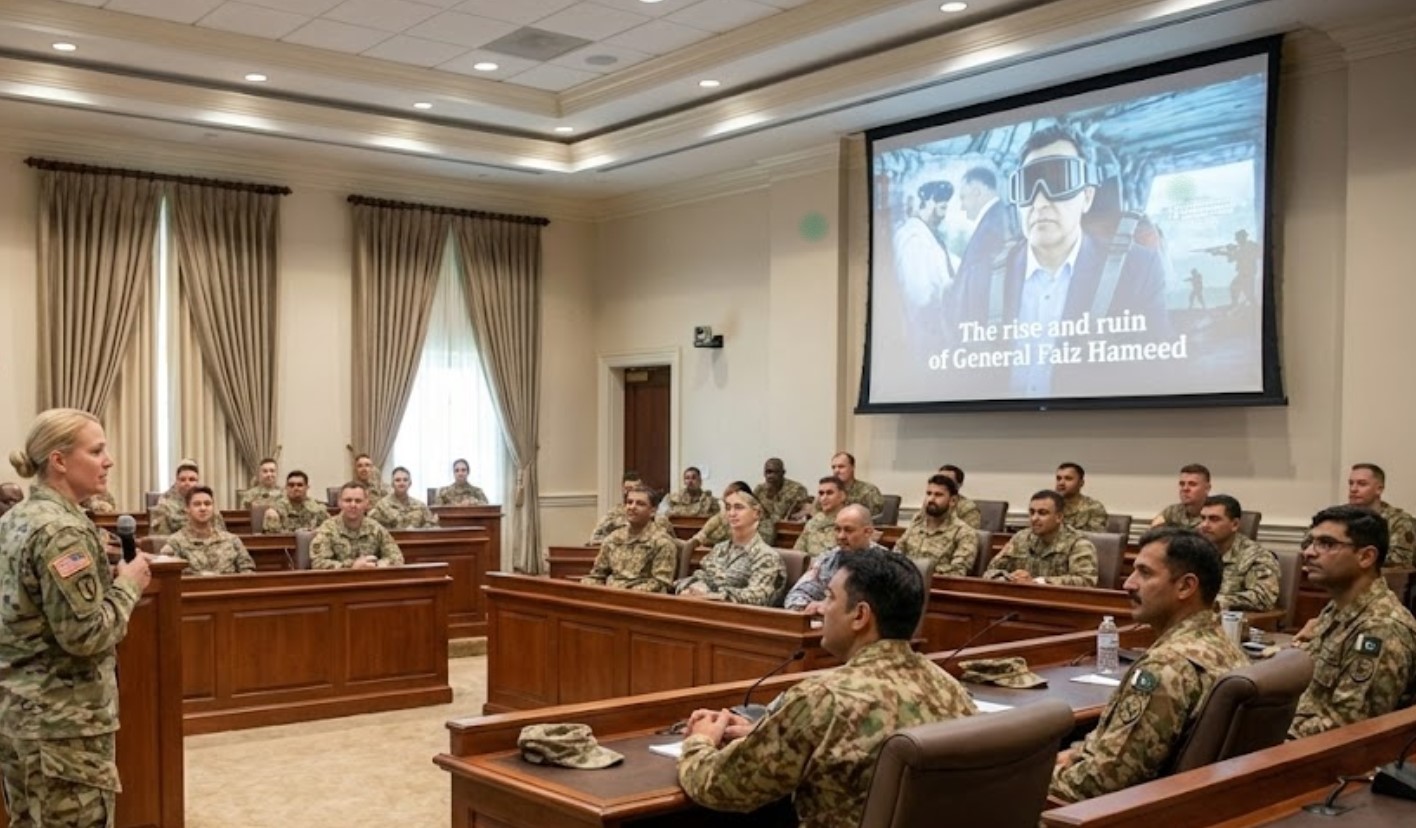
He was the Director-General of the Inter-Services Intelligence (ISI), the second most powerful man in a nuclear-armed state, and at that moment, he appeared to be the viceroy of a new Afghan order. Four years later, in the cold light of December 2025, that same man stood before a Field General Court Martial in Rawalpindi. Stripped of his uniform, his influence, and his aura of invincibility, Hameed was sentenced to 14 years of rigorous imprisonment. The charges were not merely about the geopolitical chaos he helped sow, but about the petty, sordid corruption of land grabs and stolen gold.
This is the story of a man who flew too close to the sun of absolute power, only to be incinerated by the very institution that forged him.
The Operator in the Shadows
To understand the fall of Faiz Hameed, one must first dissect his ascent. Before he was the face of the ISI, he was its internal mechanic. As the Director-General of Counter-Intelligence (DG-C), Hameed was the man in the engine room of Pakistan’s political management. He did not deal in foreign policy; he dealt in domestic compliance.
His signature first entered the public consciousness in November 2017, not on a treaty, but on a surrender. The Tehreek-e-Labbaik Pakistan (TLP), a hardline religious group, had paralyzed the capital with a weeks-long sit-in at the Faizabad Interchange. The civilian government was helpless. The military intervened, not to disperse the protesters, but to broker a deal.
The resulting agreement, which capitulated to the group’s demands, ended with a chilling postscript: “Through Major General Faiz Hameed.” It was a rare, visible fingerprint of the deep state on the throat of civilian administration. Justice Qazi Faez Isa, in a blistering Supreme Court verdict, would later question the legality of a uniformed officer underwriting a pact with agitators. But in 2017, the verdict that mattered wasn't legal; it was political. Hameed had proven he could manage the street, a skill that would make him indispensable to the incoming "hybrid regime."
The Architect of the Hybrid Order
In 2019, Hameed was elevated to Director-General of the ISI. His tenure coincided with the prime ministership of Imran Khan, a period defined by the doctrine of being on the "same page." The military and the civilian government were ostensibly in lockstep, but it was Hameed who provided the glue. He was accused by opposition parties of being the "political engineer" par excellence—managing votes, silencing dissent, and ensuring the parliamentary machinery hummed to the tune of the garrison.
During these years, the ISI’s reach turned inward with ferocious intensity. The press was muzzled, opposition leaders were jailed, and the judiciary was pressured. Hameed was not just a spy chief; he was the enforcer of a political project designed to create a singular, uncontested narrative for Pakistan.
“He operated with a hubris that suggested the old rules of the game no longer applied. He forgot that in the Pakistan Army, the institution always supersedes the individual.”
It was this alignment with Imran Khan that eventually became his undoing. The army chief, General Qamar Javed Bajwa, began to view Hameed not as a subordinate, but as a rival power center cultivating his own constituency within the civilian setup. In the rigid hierarchy of the Pakistan Army, loyalty to the chief is absolute; loyalty to a politician is mutiny.
The Kabul Delusion
The tea in Kabul was the zenith. For a brief window in 2021, Hameed was projected as a master strategist who had outplayed the United States. He was photographed meeting with warring Afghan factions, seemingly orchestrating the Taliban's cabinet formation. The narrative was one of strategic depth finally achieved.
But the victory was a mirage. The return of the Taliban emboldened the Tehreek-e-Taliban Pakistan (TTP), who turned their guns on the Pakistani state with renewed ferocity. The "peace" Hameed had toasted dissolved into a bloody insurgency in Pakistan's borderlands. The security establishment began to realize that their spy chief’s victory lap was premature, and the costs of his policy would be paid in the blood of soldiers.
By October 2021, the rift between the Army Chief and the Prime Minister over Hameed’s transfer exploded into the public domain. Imran Khan wanted to keep Hameed as DG ISI; the military high command wanted him out. The institution won. Hameed was shipped off to command the Peshawar Corps, a consolation prize that placed him far from the levers of political intrigue in Islamabad.
The Top City Scandal: A Grifter’s Fall
History is often decided by great battles, but careers are frequently destroyed by small greed. The charges that ultimately led to Hameed’s court martial were not about grand treason, but about a housing society near the new Islamabad airport.
The "Top City" case reads less like a John le Carré novel and more like a gangster procedural. Moeez Ahmed Khan, the owner of the Top City housing scheme, alleged that in May 2017, ISI officials raided his home and offices on Hameed’s orders. They didn’t just look for sensitive documents; they allegedly made off with 400 tolas of gold, diamonds, and cash. The accusation was that the machinery of the state’s premier intelligence agency was used for a private shakedown.
Following his retirement in November 2022—after failing to secure the position of Army Chief—Hameed might have expected the quiet immunity usually afforded to retired four-star generals. But the political winds had shifted. His former patron, Imran Khan, was in jail, and the new military leadership, under General Asim Munir, was in a mood for housekeeping.
In August 2024, the unthinkable happened: the military announced Hameed had been taken into custody. It was the first time a former head of the ISI had been arrested by his own institution.
The Reckoning
The Field General Court Martial that concluded in December 2025 was a secretive affair, but the message it broadcast was deafening. Found guilty of offenses under the Pakistan Army Act—including "misuse of authority" and "prejudice to good order and military discipline"—Hameed was sentenced to 14 years. His rank was stripped. The perks of a retired general, the batman, the pension, the prestige: gone.
The sentence was not merely legal; it was symbolic. It was a ritual cleansing. By sacrificing Hameed, the military establishment sought to distance itself from the "hybrid" experiment and the chaotic fallout of the Imran Khan years. They pinned the political meddling and the strategic blunders on a rogue operator, preserving the sanctity of the institution itself.
The Crux
The tragedy of Faiz Hameed is not that he was an anomaly, but that he was the perfect product of his environment, operating efficiently until he became inconvenient. He rose by blurring the lines between security and politics, weaponizing the agency he led to engineer outcomes that the state desired. His fatal error was not corruption—Pakistan’s history is littered with unpunished graft—but the belief that he had transcended the chain of command. He thought he was the architect, but he was merely the scaffolding. And when the building was complete, the scaffolding was taken down. His 14-year sentence serves as a brutal reminder to the uniformed class of Pakistan: You may run the state, but you must never think you are bigger than the Army.
Sources & Citations
- Wikipedia Contributors. Faiz Hameed. Wikipedia, The Free Encyclopedia. Accessed January 13, 2026. https://en.wikipedia.org/wiki/Faiz_Hameed
- Hussain, Abid. Pakistan’s ex-ISI chief faces court martial after arrest in property case. Al Jazeera. Published August 13, 2024. https://www.aljazeera.com/news/2024/8/13/pakistans-ex-isi-chief-faces-court-martial-after-arrest-in-property-case
- Editorial Staff. Former spy chief Faiz Hameed sentenced to 14 years in prison by military court. Dawn News. Published December 11, 2025. https://www.dawn.com
- Supreme Court of Pakistan. Suo Motu Case No. 7 of 2017 (Faizabad Sit-in Judgment). Supreme Court of Pakistan. Published February 6, 2019. https://www.supremecourt.gov.pk
Editorial Standard
Established 2026
EDITORIAL DISCLAIMER: This is a critical opinion-based cultural analysis authored by the editorial team at Writory and reflects their personal editorial perspective. The views expressed do not represent the institutional stance of Evrima Chicago. This article draws from open-source information, legal filings, published interviews, and public commentary. All allegations referenced remain under investigation or unproven in a court of law. No conclusion of criminal liability or civil guilt is implied. Any parallels made to public figures are interpretive in nature and intended to examine systemic patterns of influence, celebrity, and accountability in American culture. Speculative language is used to explore public narratives and their societal impact. Protected under the First Amendment of the U.S. Constitution. Editorial inputs: Waa Say waasay@evrimachicago.com. PR & Media Contact: Joe Flintoff (PR@evrimachicago.com)
More from Politics
The Daily Brief
Get the day's most important stories, handpicked by our editors, delivered to your inbox every morning.
No spam. Unsubscribe anytime.