
The Islamabad Accord: From
Civil War to Global Broker
The name "Islamabad
Accord" carries a heavy weight in the annals of diplomacy; once a symbol
of failed regional stabilization, now potentially the cornerstone of preventing
a global conflagration. To understand the current high-stakes mediation between
the United States and Iran in April 2026, one must first look back at the
original framework of 1993, as the two agreements represent the bookends of
Pakistan’s evolving role as a regional powerbroker.

Part I: The 1993 Foundation
– A Legacy of Fragility
On March 7, 1993, the
first Islamabad Accord was signed to stop the bleeding of the Afghan Civil War.
It was an ambitious power-sharing deal mediated by Pakistan to reconcile the
warring Mujahideen factions.
The Compromise:
President Burhanuddin Rabbani remained head of state, while his bitter rival,
Gulbuddin Hekmatyar, was appointed Prime Minister. In a gesture of pure
sacrifice for peace, the legendary commander Ahmad Shah Massoud resigned
as Defense Minister to appease Hekmatyar.
The Failure: The
ink was barely dry before the agreement crumbled. Hekmatyar, fearing the wrath
of Kabul’s citizens, refused to even enter the capital, instead resuming his
bombardment from the outskirts. This failure paved the way for the rise of the
Taliban and taught a cynical lesson to the world: a signed paper is only as
strong as the trust between the signatories.
Part II: 2026 – Strategic
Ambiguity at the Podium
Fast forward thirty-three
years, and the term has been resurrected. On April 6, 2026, the Foreign
Office of Pakistan adopted a posture of disciplined reticence. During a press
briefing, spokesperson Tahir Andrabi declined to provide granular details
regarding the rumored "New Islamabad Accord."
Despite intense questioning
from international media, Andrabi emphasized that Pakistan does not comment on
"individual, specific incidents." However, his repeated assertion
that the "peace process is ongoing" served as a tacit
acknowledgment of Pakistan's elevated role as the primary intermediary in the
U.S.-Iran crisis.
The Silent Architect: Field
Marshal Asim Munir
Behind the diplomatic
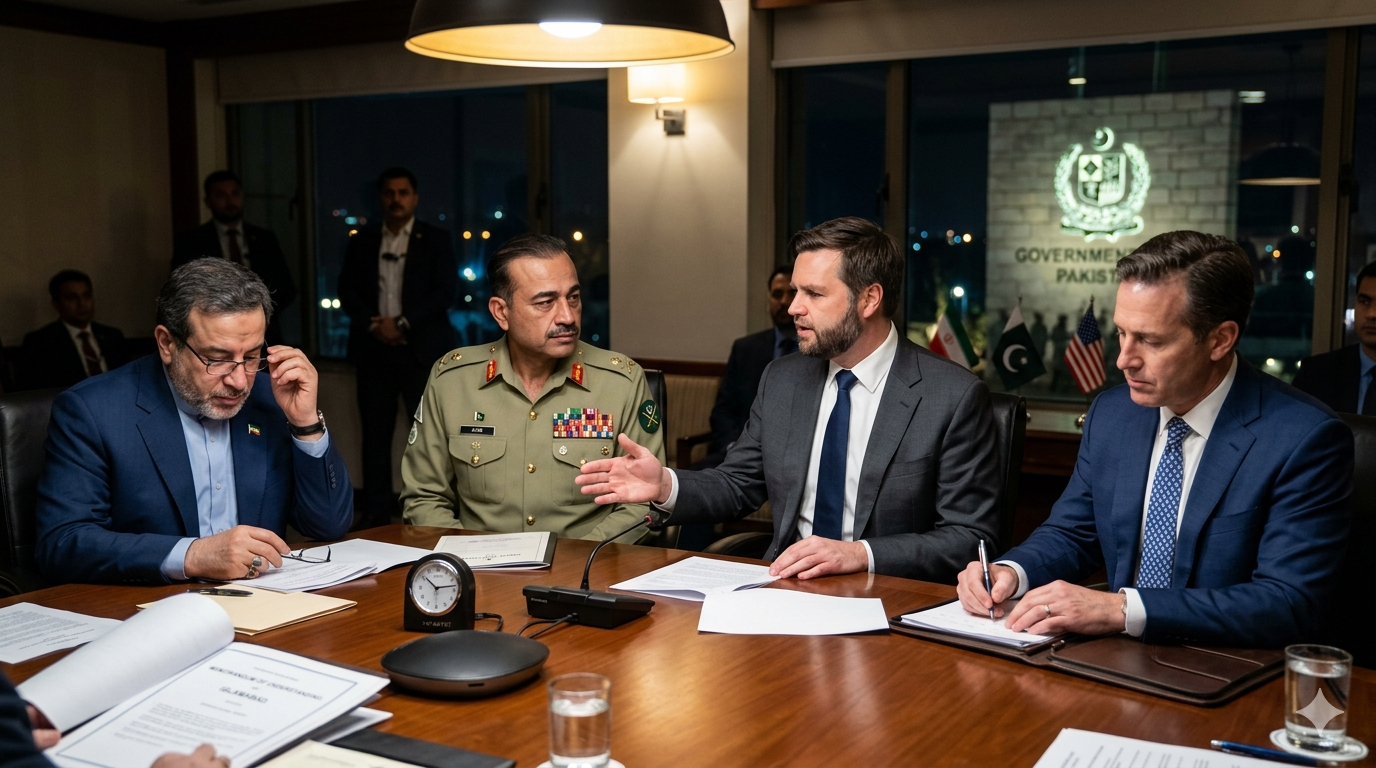
curtain, the scale of involvement appears far more robust. Investigative leads
point to an exhaustive overnight session where Field Marshal Asim Munir,
Pakistan’s Chief of Army Staff, acted as the central node in a communication
triangle. Munir reportedly held continuous discussions with US Vice
President JD Vance, special envoy Steve Witkoff, and Iranian Foreign
Minister Abbas Araghchi. This military-led diplomacy underscores Pakistan’s
unique position as the only channel capable of bridging the trust deficit
between the Trump administration and the Iranian leadership.
The 2026 Islamabad Accord:
US-Iran Peace Process
On April 6, 2026, reports
surfaced that Pakistan; acting as the primary communication channel; had
delivered a formal ceasefire proposal to both Washington and Tehran.
Key Provisions of the Proposal:
Phase 1: Immediate
Ceasefire: An instant cessation of hostilities and the immediate
reopening of the Strait of Hormuz to global oil traffic.
Phase 2: Final Settlement
(15–20 Days): A window to negotiate a permanent treaty in
person in Islamabad. This would reportedly include:
- Nuclear Curbs: Iranian commitments regarding its nuclear
program.
- Sanctions Relief: The unfreezing of Iranian
assets and lifting of energy sanctions.
- Regional Security: A multilateral framework for
the long-term management of the Persian Gulf.
Current Status (April 6,
2026)
The "Trump
Deadline": The diplomatic push is occurring under
extreme pressure, following an ultimatum from U.S. President Donald Trump for
Iran to open the Strait of Hormuz by Tuesday, April 7, or face "Hell"
(widely interpreted as strikes on Iran's power grid and infrastructure).
Pakistan’s Role:
Pakistan’s military leadership (Field Marshal Asim Munir) has reportedly been
in direct, "all-night" contact with U.S. Vice President JD Vance and
Iranian Foreign Minister Abbas Araghchi to finalize a Memorandum of
Understanding (MoU) electronically.
Official Stance: The
Pakistan Foreign Office (FO) has officially declined to comment on the
specific details of the "Islamabad Accord" to protect the sensitive
nature of the talks, though spokesperson Tahir Andrabi confirmed that the "peace
process is ongoing."
Iranian Response: As
of April 6, Tehran has expressed skepticism toward a "temporary"
ceasefire, with some officials stating they will only accept a permanent
cessation of hostilities with guarantees against future U.S. and Israeli
attacks.
Comparison: 1993 vs. 2026
|
Feature |
1993 Islamabad Accord |
2026 Islamabad Accord (Proposed) |
|
Primary Conflict |
Afghan Civil War |
U.S.-Iran War |
|
Mediator |
Nawaz
Sharif Government |
Field
Marshal Asim Munir / Govt of Pakistan |
|
Key Goal |
Power-sharing (PM/President) |
Ceasefire & Strait of Hormuz reopening |
|
Outcome |
Failed
within days |
Under
active negotiation |
The 2026 accord represents
Pakistan's attempt to leverage its unique position as a partner to the U.S. and
a neighbor to Iran to avert a global energy crisis and a full-scale continental
war.
Part III: The Architecture
of the 2026 Accord
The proposed framework,
finalized electronically to bypass the logistical hazards of a war zone, is
structured into two distinct stages designed to prevent a total regional
collapse.
Phase I: Immediate
De-escalation
The first tier demands an immediate
ceasefire and the instantaneous reopening of the Strait of Hormuz.
For the global economy, this is the most critical component, as the closure of
the strait has sent energy markets into a volatile spiral. This phase is
intended to be governed by a Memorandum of Understanding (MoU) facilitated
through Islamabad’s secure channels.
Phase II: The 20-Day
Settlement Window
If Phase I holds, the accord
provides a 15-to-20-day window for a comprehensive settlement. The
finality of these talks is slated to occur during an in-person summit in
Islamabad, positioning the city as the "Geneva of the East." Key
objectives include:
- Iranian Commitments: Curbs on the nuclear program
and cessation of proxy activity.
- US Concessions: Substantial sanctions relief and the release of
frozen assets.
Part IV: The Tehran
Hesitation
Despite the momentum, the
accord faces a significant hurdle in Tehran’s strategic calculus. Iranian
officials remain skeptical of a "temporary ceasefire" that could
allow U.S. and Israeli forces to regroup. Iran’s position is firm: they require
ironclad guarantees against future strikes on their top leadership and a
permanent end to hostilities. They have emphasized they will not be coerced by
"deadline threats," even as they confirm receipt of the Pakistani
proposal.
Strategic Ledger:
|
Key Feature |
Details |
Status/Verification |
|
Mediator |
Pakistan (Military & Foreign Office) |
Confirmed (Official FO statement) |
|
Primary Interlocutors |
COAS
Munir, VP JD Vance, FM Araghchi |
Reported
via Reuters/Axios |
|
Mechanism |
Electronic MoU via Islamabad |
Active Negotiation |
|
Phase I Objective |
Ceasefire
& Hormuz Reopening |
Time-sensitive
(April 6-7) |
|
Phase II Objective |
Nuclear curbs vs. Sanctions relief |
15-20 Day Window |
|
Regional Stakeholders |
China,
Egypt, Türkiye |
Backing
the process |
Conclusion
Pakistan’s diplomatic gambit
represents its most significant foray into global mediation in decades. By
leveraging its relationship with both Washington and Tehran, Islamabad has
placed a concrete framework on the table where others have failed. Whether the
2026 Islamabad Accord becomes a historical breakthrough or follows the tragic
path of its 1993 predecessor depends entirely on whether the warring parties
are ready to trade tactical advantages for long-term survival.
Disclaimer: This is a critical narrative analysis authored by the Writory Editorial Team. The views expressed reflect an editorial perspective on ongoing regional developments. Protected under the First Amendment.