

What actually is 'Karen'?
At a glance
Phenomenology of the 'Karen' Archetype: Socio-Digital Proliferation and Cultural Implications
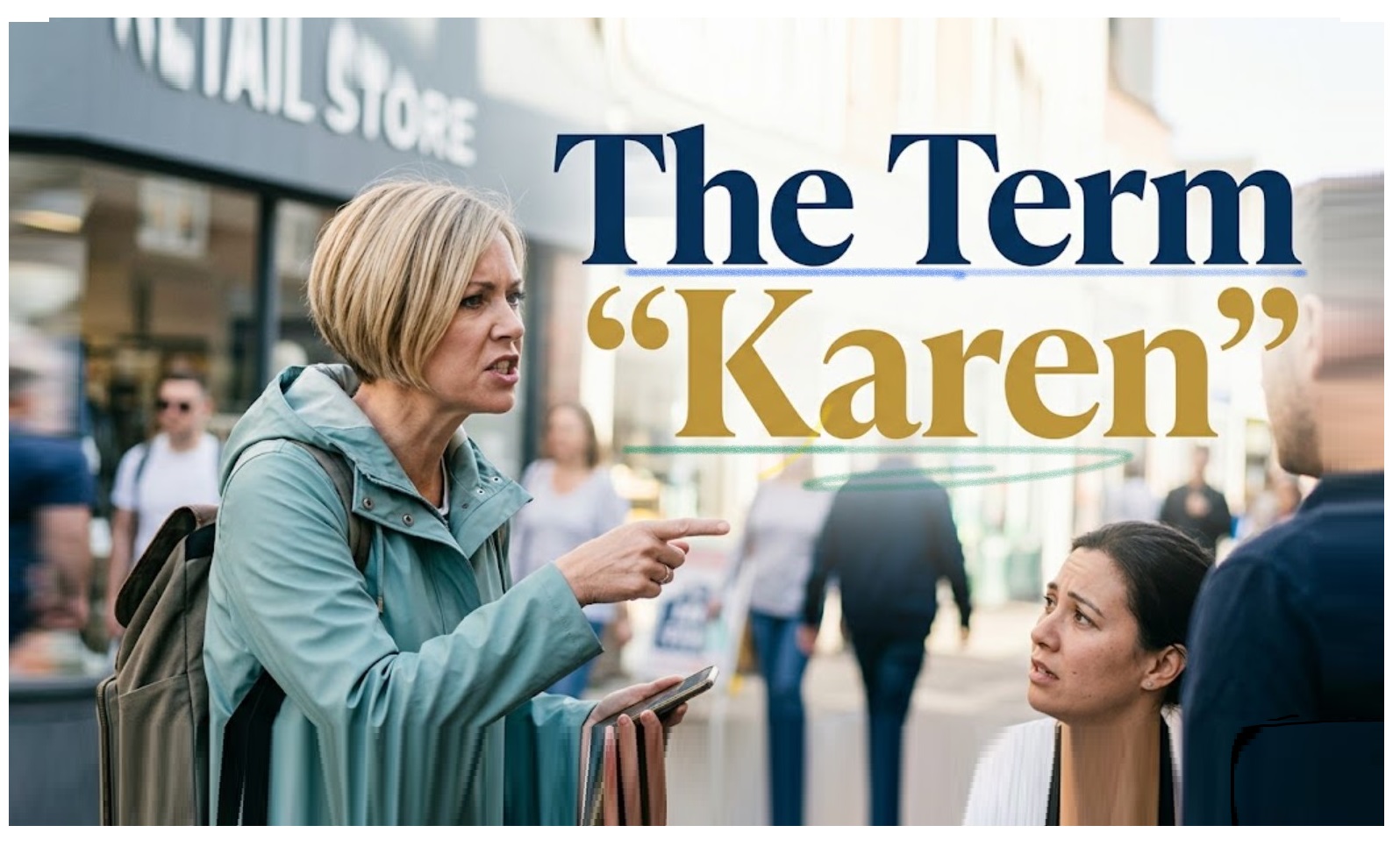
 aren' is a contemporary internet pejorative used to describe a woman perceived as entitled, demanding, or possessing an inflated sense of social authority beyond her objective standing. While its comedic precursors date back to the mid-2000s, the archetype solidified in the late 2010s as a critique of specific behaviors, particularly the weaponization of institutional systems against service workers and marginalized individuals.
By 2020, the term transitioned from a niche digital meme to a global sociopolitical label, reflecting broader tensions regarding race, class, and public conduct.
SUMMARY LEAD
The 'Karen' moniker represents a multifaceted cultural phenomenon that categorizes a specific behavioral profile: typically a middle-aged white woman who utilizes her perceived social privilege to coerce compliance or punish perceived slights. [1] The term is most famously associated with the phrase "I'd like to speak to the manager," symbolizing a demand for hierarchical intervention in mundane or retail settings. [2] Beyond its use as a tool for consumer-based mockery, the label evolved during the early 2020s into a potent socio-political descriptor, used to highlight instances where white women called law enforcement on Black individuals for non-criminal activities, thereby positioning the term at the intersection of gender and racial discourse. [3]
ETYMOLOGICAL ORIGINS AND COMEDIC PRECURSORS
The exact origin of 'Karen' as a pejorative is debated, though several cultural touchstones are credited with seeding its development.
Early Stand-up and Cinematic References

In 2005, comedian Dane Cook performed a routine titled "The Friend Nobody Likes," in which he used the name Karen to describe a person in a group who is consistently disliked and uninvited. [4] Concurrently, the 2004 film Mean Girls featured a character named Karen Smith (played by Amanda Seyfried), portrayed as unintelligent and socially oblivious, though this version lacked the aggressive entitlement associated with the modern slang. In 2016, Jay Pharoah's stand-up routine also utilized the name to describe certain behaviors, further cementing the name's association with specific, irritating social tropes. [5]
The 'Can I Speak to the Manager' Meme

By 2014, the visual component of the meme began to crystallize on platforms like Tumblr and Reddit. An image of a specific asymmetrical blonde bob haircut—often associated with reality television personality Kate Gosselin—became the definitive visual shorthand for the character. [6] This visual was paired with captions regarding retail demands, eventually leading to the creation of the subreddit r/FuckYouKaren in 2017, which served as a repository for stories and videos of entitled behavior. [7]
VIRAL EVOLUTION AND GLOBAL ADOPTION
The transition of 'Karen' from a Reddit-specific joke to a mainstream cultural label occurred in three distinct phases.
Phase I: Digital Satire (2017–2019)
During this period, 'Karen' was primarily used to mock middle-class consumer behavior. The character was often depicted in memes as a woman who would complain about expired coupons or slight service delays. [8] The term became synonymous with a lack of empathy for service industry workers, reflecting a growing class consciousness among younger digital natives.
Phase II: The Summer of 2020
The COVID-19 pandemic and the subsequent social justice movements following the death of George Floyd catalyzed the term's most aggressive evolution. The term was applied to "anti-maskers" who protested public health mandates, framing the refusal to wear masks as a peak manifestation of personal entitlement over collective well-being. [9] More significantly, the 'Central Park Birdwatching Incident' in May 2020, involving Amy Cooper, demonstrated the 'Karen' archetype's capacity for racial weaponization. [10] When Cooper called the police on a Black birdwatcher, the internet labeled her the "Central Park Karen," shifting the term's focus from retail annoyance to systemic racism and the misuse of emergency services.
Phase III: Institutional Recognition
By late 2020, the term had entered the lexicon of major news outlets and academic journals. It was no longer merely a meme but a sociolinguistic tool used to analyze power dynamics. [11] In some jurisdictions, legislative efforts such as the 'CAREN Act' (Caution Against Racially Exploitative Non-emergencies) in San Francisco were introduced to penalize the racially motivated misuse of 911, directly referencing the slang's cultural impact. [12]
VISUAL AND BEHAVIORAL SEMIOTICS
The 'Karen' archetype is defined by a specific set of semiotic markers that allow for instant identification in digital media.
The 'Managerial' Aesthetic
The most prominent visual marker is the 'Speak to the Manager' haircut: a short, blonde, stacked bob that is spiked in the back. [13] Accessories often include oversized sunglasses and designer athleisure or 'live-laugh-love' themed home decor, symbolizing a specific suburban middle-class lifestyle.
Behavioral Patterns
The core behavior of a 'Karen' is the escalation of a minor inconvenience to a level of institutional conflict. This includes: 1. Soliciting supervisors or owners in retail environments. 2. Threatening legal action or police involvement over non-legal matters. 3. Recording interactions with a smartphone while claiming to be the victim. 4. Expressing high-volume outrage in public spaces to enforce social norms that favor the speaker. [14]
CRITICISM AND SOCIOPOLITICAL DEBATE
The proliferation of the term has sparked significant debate regarding its intent and impact.
The Gender Bias Argument
Some critics argue that 'Karen' is a sexist slur. They contend that the term is used to silence women who voice legitimate concerns or to discourage women from being assertive in public. [15] These critics point out that there is no equally popular or potent male equivalent, suggesting that the term reinforces patriarchal double standards where vocal women are pathologized.
The Social Accountability Defense
Proponents of the term argue that it is not an attack on women, but an attack on privilege. They suggest that 'Karen' provides a necessary vocabulary for marginalized groups to describe the specific type of microaggressions and systemic threats they face from white women. [16] From this perspective, the term is a tool for social accountability, highlighting how individual entitlement can lead to dangerous real-world consequences for others.
Strategic Ledger: Archetypal Metrics
- Primary Behavioral Trigger: Perceived loss of control or challenge to social hierarchy/authority.
- Key Linguistic Marker: "I would like to speak to the manager." / "You are harassing me."
- Socio-Economic Association: Middle-to-upper-middle class; suburban demographic.
- Peak Cultural Saturation: Q2-Q3 2020 (Pandemic and Social Justice protests).
- Primary Platforms: Reddit, TikTok, Twitter (X), Facebook.
- Legal Impact: Inspiration for the CAREN Act and similar anti-bias legislation.
Citation
| Citation Key | Source (clickable) | Reference |
|---|---|---|
| [1][2][3] | Time Magazine / The Atlantic / SHRM | Lang, C. (2020); Tiffany, K. (2020); Nagele-Piazza, L. (2020) |
| [4][5] | Comedy & Stand-up archives | Cook, D. (2005); Pharoah, J. (2016) |
| [6][7] | Vox / Reddit r/FuckYouKaren | Jennings, R. (2020); Reddit (2017) |
| [8][9][10] | Quartz / The Atlantic / CNN | Goldhill, O. (2020); Lewis, H. (2020); Vera, A. (2020) |
| [11][12] | Insider / SF CAREN Act | Greenspan, R. E. (2020); San Francisco Board of Supervisors (2020) |
| [13][14] | Journal of Visual Culture / UChicago | Bond, S. (2020); University of Chicago (2021) |
| [15][16] | NPR / African American Policy Forum | Hadid, J. (2020); Crenshaw, K. (2020) |
| [17] | Merriam-Webster | Merriam-Webster (2021). 'Words We're Watching: Karen' |
Extended healthy conclusion (full length): A mature, balanced approach requires distinguishing between retail-level frustration (annoying but comparatively harmless) and dangerous escalation (false police reports, racialized threats). The term's power should be used for accountability, not viral harassment. Lasting change depends on policy reforms: strengthening penalties for knowingly false reports, de-escalation training, and community investment. The 'Karen' phenomenon forced a necessary conversation about how everyday entitlement intersects with institutional authority. When anchored to real-world events like the Central Park incident or the CAREN Act, language can become a catalyst for civic change. A balanced conclusion acknowledges that while the meme provides catharsis, dismantling the systems that enable weaponized entitlement is the real remedy. The archetype remains one of the most significant linguistic developments of the 21st century, illustrating both the promise and peril of rapid-fire digital accountability.
Disclaimer:
This article is a critical, opinion-based cultural analysis authored by Waa Say (Waasayuddin, pen name Dan Wasserman) and reflects his personal editorial perspective. The views expressed herein do not represent the institutional positions of Evrima Chicago or any affiliated organizations, contributors, or partners.
This commentary draws upon open-source information, publicly available records, legal filings, published interviews, and public commentary — including audio content from The Joe Rogan Experience podcast. Any allegations or claims referenced remain subject to ongoing review, dispute, or investigation and may not be proven in a court of law.
No assertion or conclusion of criminal liability, civil wrongdoing, or factual determination of guilt is implied. Any comparisons or parallels made to public figures are interpretive, analytical, and presented solely for the purpose of examining broader systemic patterns of influence, media dynamics, celebrity culture, and public accountability.
Where applicable, satirical, rhetorical, analytical, and speculative language may be used to explore public narratives and their societal impact. Readers are encouraged to apply critical thinking and consult primary sources wherever possible.
This publication is protected under the First Amendment of the United States Constitution and adheres to recognized standards of opinion journalism, commentary, and international editorial and publishing standards, including principles consistent with global media ethics and freedom of expression frameworks.
All written content in this article is copyrighted by Evrima Chicago. Permission for reposting, republication, or redistribution may be obtained by contacting pr@evrimachicago.com
More from Phenomenology
The Daily Brief
Get the day's most important stories, handpicked by our editors, delivered to your inbox every morning.
No spam. Unsubscribe anytime.