

What are the Numeronyms?

At a glance
How Numeronyms Became the Native Language of the Digital Economy
 he Architecture of Brevity: Walk into any boardroom in Palo Alto, Austin,
or the West Loop of Chicago and you’ll hear a dialect that feels less like
English and more like compressed code. In this world, syllables are
liabilities, verbosity is friction, and efficiency is doctrine. The American
technology sector didn’t just optimize software. It optimized language itself.
he Architecture of Brevity: Walk into any boardroom in Palo Alto, Austin,
or the West Loop of Chicago and you’ll hear a dialect that feels less like
English and more like compressed code. In this world, syllables are
liabilities, verbosity is friction, and efficiency is doctrine. The American
technology sector didn’t just optimize software. It optimized language itself.
Out of that pressure cooker emerged the numeronym:
a linguistic microchip that shrinks entire words into tight, efficient packets.
What looks like a typo is, in reality, a system. A design choice. A philosophy.
Decoding the Silicon Valley Lexicon
Language as Compression Technology
The numeronym follows a deceptively simple
formula:
Take the first letter. Count the letters in between. End with the final letter.
- “Internationalization” becomes i18n.
- “Localization” becomes l10n.
It’s less abbreviation and more algorithm.
This isn’t just shorthand. It’s linguistic
engineering. In environments where developers communicate across continents,
time zones, and languages, clarity must coexist with speed. Numeronyms act like
universal constants in a chaotic system, reducing ambiguity while increasing
velocity.
The numeronym is not merely a shortcut. It is
a structural response to an industry where every keystroke, every second, and
every cognitive cycle carries measurable cost.
The Pillars of Global Software
A Living Dictionary of Modern Development
As software expanded beyond borders in the
late 1990s and early 2000s, a new vocabulary formed to support global
scalability. These numeronyms are now foundational:
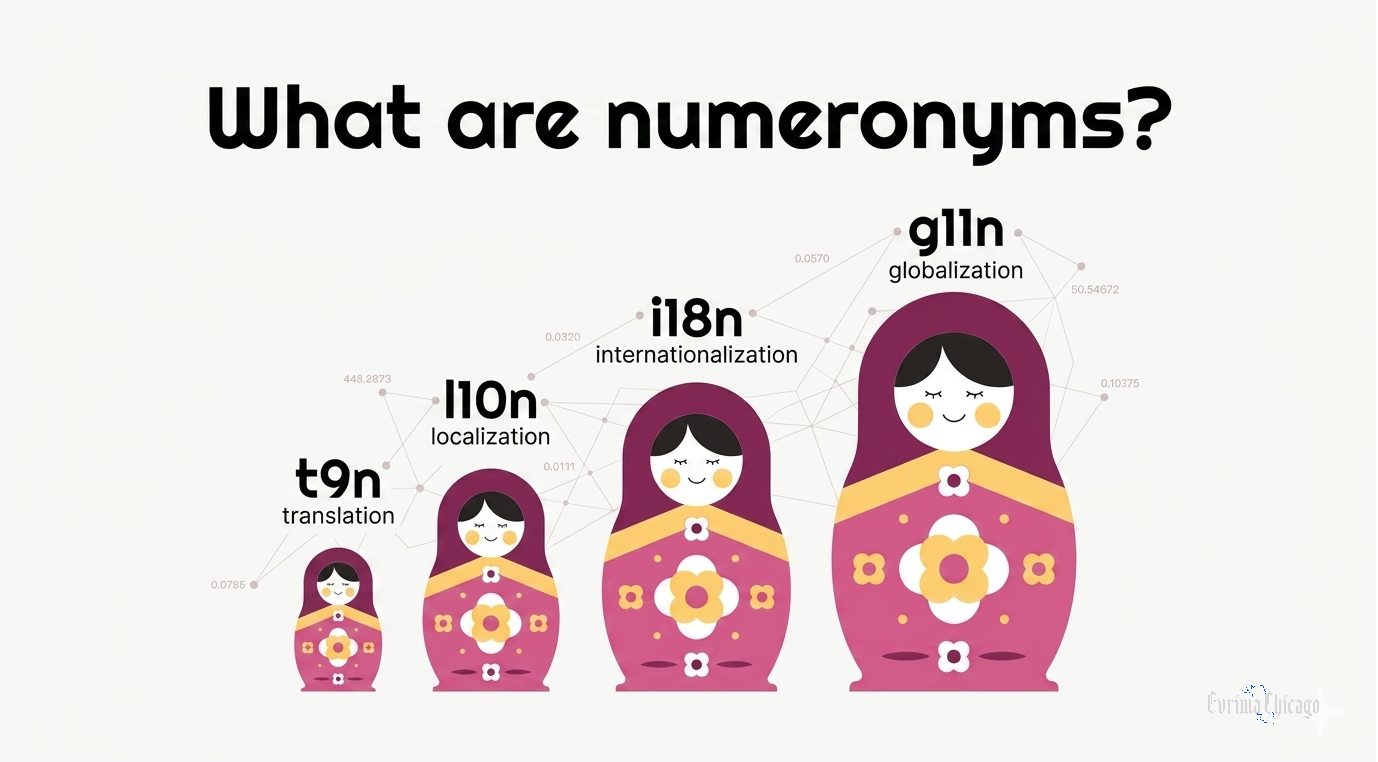
- i18n (Internationalization):
Designing software to support multiple languages and regions from the
ground up.
- l10n (Localization):
Adapting software for specific cultures, languages, and markets.
- g11n (Globalization): The
umbrella process combining internationalization and localization for
worldwide deployment.
- t9n (Translation):
Converting text across languages for accessibility and reach.
Accessibility, Experience, and Inclusion
- a11y (Accessibility):
Ensuring usability for individuals with disabilities through inclusive
design.
- p13n (Personalization):
Tailoring user experiences based on behavior, preferences, and context.
Infrastructure and Systems Thinking
- k8s (Kubernetes): The
backbone of modern cloud infrastructure, orchestrating containers at
scale.
- v12n (Virtualization):
Creating virtual environments to maximize efficiency and flexibility.
- m12n (Modularization):
Breaking systems into independent, manageable components.
Data Integrity and System Harmony
- c14n (Canonicalization):
Standardizing data into a consistent format.
- n11n (Normalization):
Structuring data to reduce redundancy and improve performance.
- i14y (Interoperability): Enabling
systems to communicate and function seamlessly together.
Communication and Compatibility
- c12s (Communications):
Information exchange between systems, services, or users.
- c11y (Compatibility):
Ensuring software works across devices, platforms, and versions.
Documentation and Observability
- d11n (Documentation): The
written backbone of software understanding and maintenance.
- o11y (Observability):
Deep visibility into system health through logs, metrics, and traces.
Localization Readiness and Language
Flexibility
- l12y (Localizability):
Designing software to be easily adaptable for different regions.
- m17n (Multilingualization):
Supporting multiple languages within a single system simultaneously.
- i11l (International):
Describing systems inherently designed for cross-border use.
Standards and Structure
- s13n (Standardization):
Establishing uniform practices across systems and teams.
The Economic Current Beneath the Code
Why Language Had to Evolve
In the early days of computing, software was
static. Built once, shipped once. Language could afford to be slow,
descriptive, even indulgent.
Today, software is alive. It updates hourly,
deploys globally, and operates continuously.
This shift to software-as-a-service compressed
development cycles from years to hours. Communication had to keep pace.
Numeronyms became the verbal equivalent of high-frequency trading, stripping
away inefficiency in favor of speed and precision.
At the same time, open-source ecosystems
created a borderless workforce. A developer in Chicago collaborates with one in
Warsaw, another in Karachi, another in São Paulo. Numeronyms function as a
shared dialect, reducing linguistic friction in a globally distributed system.
The Cultural Legacy of Digital Shorthand
When Code Starts Speaking Back
What began as a niche habit among engineers
has seeped into the broader corporate bloodstream. Product managers,
executives, investors, and marketers now casually deploy terms like “a11y” and
“o11y” as if they’ve always existed.
This is more than jargon creep. It’s cultural
takeover.
Numeronyms signal membership in a system.
Fluency implies proximity to innovation. To speak the language is to
participate in the machinery of modern technology.
And like all powerful languages, it shapes
thought. It nudges teams toward efficiency, modularity, scalability. It rewards
brevity and punishes ambiguity.
Conclusion
Efficiency as Identity
Numeronyms are not just tools. They are
artifacts of a worldview. A worldview where speed is survival, clarity is
currency, and language itself must justify its existence.
Each compressed word carries the imprint of an
industry that grew from garage experiments into the operating system of global
commerce.
When a developer types “k8s” or “i18n,” they
are not just saving time. They are participating in a quiet tradition of
engineered efficiency, one keystroke at a time.
Editorial Disclaimer
This is a critical opinion-based cultural analysis authored by the editorial team at Writory and reflects their personal editorial perspective.
The views expressed do not represent the institutional stance of Evrima Chicago. This article draws from open-source information, legal filings, published interviews, and public commentary.
All allegations referenced remain under investigation or unproven in a court of law. No conclusion of criminal liability or civil guilt is implied.
Any parallels made to public figures are interpretive in nature and intended to examine systemic patterns of influence, celebrity, and accountability in American culture.
Speculative language is used to explore
public narratives and their societal impact. Protected under the First Amendment
of the U.S. Constitution.
- Editorial inputs: waasay@evrimachicago.com
- PR & Media Contact: Joe Flintoff (PR@evrimachicago.com)
Evrima Chicago remains committed to the
highest standards of opinion journalism.
More from Phenomenology

The Daily Brief
Get the day's most important stories, handpicked by our editors, delivered to your inbox every morning.
No spam. Unsubscribe anytime.