

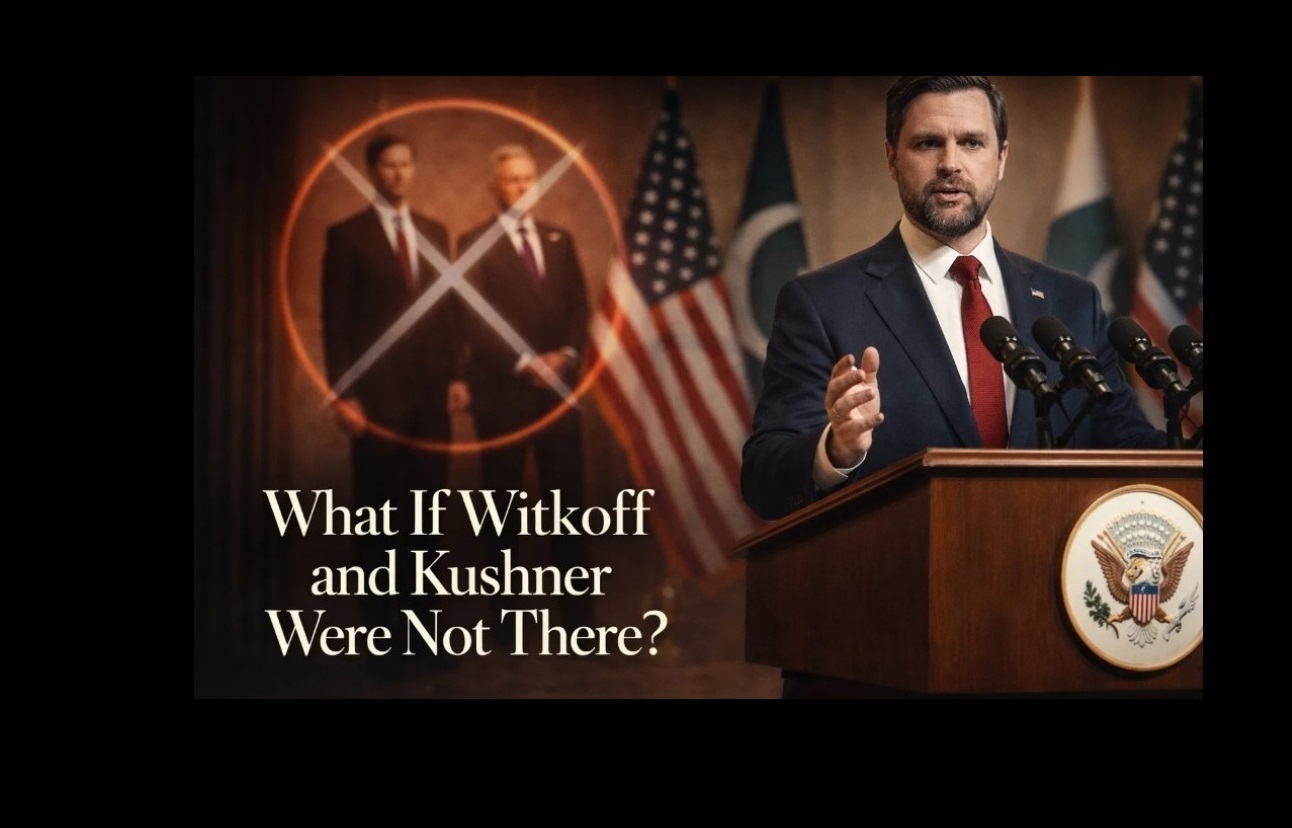
What If Witkoff and Kushner Were Not There? #Islamabadtalks
At a glance
Critical Opinion-Based Cultural Analysis By Waa Say (Waasayuddin, pen name Dan Wasserman)
The conclusion of the high-stakes negotiations in Islamabad on April 12, 2026, marked a somber milestone in modern diplomacy. Vice President JD Vance confirmed in a final press briefing that the historic dialogue between the United States and the Iranian delegation failed to produce a workable agreement. While the technical "red lines" regarding nuclear enrichment and maritime security in the Strait of Hormuz remained significant hurdles, the composition of the American delegation has emerged as a central point of contention for analysts.
The
presence of Steve Witkoff, the Special Envoy to the Middle East, and Jared
Kushner at the negotiating table introduced a complex layer of political
baggage. Both figures are inextricably linked to the Israeli security
establishment and the regional architecture of the Abraham Accords. For an
Iranian delegation entering the highest level of direct engagement with the
United States in decades, the inclusion of these specific advisors likely
signaled a lack of neutrality.
Diplomacy
relies heavily on the management of optics and the establishment of trust. When
negotiators are perceived as proxies for a third party that is not an active
participant in the dialogue, it creates an immediate bottleneck. The conflict
that began in February 2026 involved direct military exchanges between Israel,
the United States, and Iran, making the presence of individuals with deep ties
to Israeli interests a significant psychological barrier for the Iranian side.
The
Allegation: Pro-Israeli Influence as a Hindrance
Claims
that Witkoff and Kushner acted as informal representatives of Israeli interests
are not new, but they took on renewed urgency in the context of the Islamabad
talks. Tariq Rauf, a former official of the International Atomic Energy Agency
(IAEA), has explicitly stated that Steve Witkoff and Jared Kushner "are in
reality agents of Israel" and that they "mislead Trump"
regarding negotiations with Iran. This source alleges that the two individuals
have pushed the US toward conflict rather than a diplomatic resolution.
Further
skepticism was voiced in an analysis by National Herald India,
which questioned the seriousness of the US approach from the outset, citing the
composition of the US delegation—including Kushner and Witkoff—as a reason for
doubt. The same report noted that Iranian sources believed the US delegation
arrived in Islamabad with a "maximalist approach" and "expected
capitulation rather than compromise," a stance that aligns closely with
hardline Israeli strategic interests regarding Iran's nuclear program and
regional influence.
The
Trust Gap and the Shadow of Israeli Interests
Iranian
Parliament Speaker Mohammad-Baqer Qalibaf explicitly stated that the United
States "failed to gain the trust" of his delegation. When negotiators
seen as "Israeli lobbyists" or close affiliates are present, it
reinforces the Iranian perception that they are not dealing with a neutral
arbiter, but with a unified front that prioritizes the security of America's
closest regional ally.
Because
the current war—which began in February 2026—involved direct military exchanges
between Israel and Iran, the Iranians likely viewed Kushner and Witkoff as
representatives of an active combatant. Their participation may have made the
talks feel less like a diplomatic "reset" and more like a
continuation of the battlefield dynamics. To Tehran, their presence meant that
any US proposal would have been vetted or influenced by Israeli strategic
needs, specifically regarding the containment of Iran's regional influence.
The
Counter-Argument: Structural Obstacles and Deep-Seated Rivalry
In
contrast to the claims above, a significant body of reporting points to
fundamental geopolitical obstacles that made success unlikely, regardless of
which individuals were present. Multiple sources agree that the core positions
of the US and Iran remain diametrically opposed. JD Vance stated that the US
presented its "final and best offer," which included a long-term
commitment from Iran to forgo nuclear weapons, while Tehran refused to accept
these core terms. On the other side, Iran presented demands that included
sanctions relief and control over the Strait of Hormuz—terms the US was
unwilling to meet. This represents a zero-sum conflict where one side's gain is
the other's loss.
Additionally,
forty-seven years of hostility have created a deep chasm of mistrust. Iran's
negotiators stated that "trust had yet to be earned," indicating that
the issue was not merely the composition of the US team, but the fundamental
lack of faith in US intentions.
Pakistan's
role was to facilitate, not to force, an agreement. Analysts and even JD Vance
himself acknowledged that Pakistan did an "amazing job" as a mediator
by holding the room and keeping the dialogue going. The failure to reach a
final deal was attributed to the two adversaries' own "deep structural
divergences" that no mediator could resolve in a single 21-hour session.
The
Impact of Selective Participation: A Tactical Miscalculation
There
is a compelling argument that the talks might have seen a different outcome had
the delegation been streamlined. Pakistan mediated the summit precisely because
of its unique ability to balance relations with both Washington and Tehran. A
team focused strictly on the bilateral issues of US-Iran relations, free from
the entanglements of broader Middle East envoy teams, might have allowed for a
more focused discussion on de-escalation.
However,
the reality of modern statecraft is rarely so simple. By early 2026, even the
internal perceptions of these negotiators had become fragmented. Recent reports
indicated that some Israeli officials had grown critical of Witkoff, suggesting
that his pressure during earlier ceasefire negotiations made him appear more
aligned with Qatari interests than their own. This internal friction highlights
the difficulty of selecting a "neutral" party in a region where every
player is interconnected.
The
theory of a tactical miscalculation suggests that the administration may have
prioritized internal political optics and ally reassurance over the actual
mechanics of the negotiation. By including figures like Jared Kushner and Steve
Witkoff, the US likely intended to signal to domestic critics and Israeli
leadership that no "backdoor deal" was being made that would
compromise regional security. However, this domestic insurance policy became a
foreign policy poison pill. For the Iranian negotiators, the presence of these
men was likely viewed not as a sign of American strength, but as a structural
barrier to any genuine compromise.
In
the world of high-level diplomacy, "presence is policy." The
inclusion of Jared Kushner and Steve Witkoff likely functioned as a silent
signal to the Iranian delegation that the shadow of Israeli security concerns
was firmly cast over the negotiating table.
Our
Take: The "What If" Question
So,
could the talks have had a higher chance of success if Witkoff and Kushner were
not there?
The
"Yes" argument holds that their presence, given their well-known
personal ties to Israel and the allegations of them misleading the president,
would have made it nearly impossible for Iran to trust the process. The fact
that they stayed in Islamabad after Vance left could be interpreted by a
suspicious Iranian side as them having a different, perhaps more aggressive,
agenda. Removing them might have been a necessary, though not sufficient,
condition for building the trust Iran said was lacking. If the goal was truly
to secure a deal in Islamabad, a delegation composed of career State Department
diplomats and non-partisan nuclear experts might have lowered the temperature.
Instead, by bringing in the architects of the Abraham Accords, the US
effectively imported the very regional tensions the summit was supposed to
bypass.
The
"No" argument contends that the failure was inevitable because the US
and Iran's national interests are fundamentally at odds. The US, regardless of
who is in the room, likely demands verifiable nuclear disarmament. Iran,
regardless of who it is negotiating with, likely demands an end to sanctions
and recognition of its regional role. The conflict is a product of state-level
security dilemmas, not just the influence of individual envoys. Therefore,
swapping Witkoff and Kushner for different US officials would not have changed
the red lines set by Washington.
The result was a briefing where Vice President Vance had to admit failure, perhaps because the "shadow" participants made the price of admission too high for Tehran to pay without appearing to capitulate to their primary regional rival.
Against this backdrop of diplomatic mistrust and perceived proxy influence, the role of Pakistan’s own military leadership—particularly Chief of Army Staff and Field Marshal Asim Munir—cannot be overlooked. As the host nation’s top military figure, Munir’s presence and personal engagement were critical to the summit even taking place. Unlike the controversial US envoys, Munir carries a different kind of political weight in Washington. As we previously covered in “Trump’s Great Fighter: Field Marshal Asim Munir - Pakistan’s First Chief of Defense Forces”, Munir has been repeatedly praised by former President Donald Trump as “a great fighter” and “my favorite field marshal,” a rare distinction for a foreign commander. This unusual rapport meant that Munir was arguably the one figure at the table whom both the US and Iranian delegations could view as a credible, stabilizing mediator—not a partisan actor. Had the American side mirrored Pakistan’s approach by sending career diplomats without the baggage of regional proxy affiliations, Munir’s bridging role might have been more effective. Instead, his efforts to “hold the room,” as Vance acknowledged, were ultimately undermined by the very structural and perceptual divides that the presence of Witkoff and Kushner only deepened.
Key
Perspectives at a Glance
|
Source |
Stance on Witkoff/Kushner
Role |
Stated Reason for Talks’
Failure |
|
Tariq Rauf (Former IAEA
Official) |
States Witkoff and Kushner
are "agents of Israel" who mislead Trump and push for war. |
US delegation's pro-Israeli
bias and maximalist approach. |
|
Iranian Sources (as
reported by National Herald India) |
Believed the US demanded
"everything it could not achieve through war"; delegation
insincere. |
US delegation's lack of
good faith and unrealistic demands. |
|
Mohammad-Baqer Qalibaf
(Iranian Parliament Speaker) |
Implicitly critical; stated
US "failed to gain the trust" of Iran. |
Lack of US trustworthiness,
reinforced by delegation composition. |
|
JD Vance (US Vice
President) |
Did not directly address
their role; focused on US red lines. |
Iran refused to accept the
US's core terms. |
|
Michael Kugelman
(Atlantic Council) |
No direct comment on
Witkoff/Kushner. |
Massive, inherent
difficulty of bridging gap between two deeply hostile states. |
Disclaimer
·
This article
is a critical, opinion-based cultural analysis authored by Waa Say
(Waasayuddin, pen name Dan Wasserman) and reflects his personal editorial
perspective. The views expressed herein do not represent the institutional
positions of Evrima Chicago, Wiki Titan, Dennis Lane, or any affiliated
organizations, contributors, or partners.
·
This
commentary draws upon open-source information, publicly available records,
legal filings, published interviews, and public commentary — including audio
content from The Joe Rogan Experience podcast. Any allegations or claims
referenced remain subject to ongoing review, dispute, or investigation and may
not be proven in a court of law.
·
No assertion
or conclusion of criminal liability, civil wrongdoing, or factual determination
of guilt is implied. Any comparisons or parallels made to public figures are
interpretive, analytical, and presented solely for the purpose of examining
broader systemic patterns of influence, media dynamics, celebrity culture, and
public accountability.
·
Where
applicable, satirical, rhetorical, analytical, and speculative language may be
used to explore public narratives and their societal impact. Readers are
encouraged to apply critical thinking and consult primary sources wherever
possible.
·
This
publication is protected under the First Amendment of the United States
Constitution and adheres to recognized standards of opinion journalism,
commentary, and international editorial and publishing standards, including
principles consistent with global media ethics and freedom of expression
frameworks.
·
All written
content in this article is copyrighted by Evrima Chicago. Permission for
reposting, republication, or redistribution may be obtained by
contacting pr@evrimachicago.com.
·
Evrima
Chicago remains committed to maintaining a clear distinction between fact-based
reporting and individual editorial opinion.
Citation
Table
|
Citation ID |
Source |
Reference |
|
[1] |
Tariq Rauf via The
Cradle |
"Agents of
Israel" claim |
|
[2] |
National Herald India |
Iranian sources on
maximalist approach |
|
[3] |
JD Vance Press Briefing |
US "final and best
offer" statement |
|
[4] |
JD Vance Press Briefing |
Praise for Pakistan's
mediation |
|
[5] |
Michael Kugelman / Atlantic
Council |
Deep structural divergences |
|
[6] |
The Cradle |
Witkoff and Kushner
remaining in Islamabad |
|
[7] |
National Herald India |
Iran's demand for sanctions
relief and Hormuz control |
|
[8] |
Iranian Parliament Speaker
Mohammad-Baqer Qalibaf |
US "failed to gain the
trust" of Iran |
|
[9] |
Analysis of February 2026
conflict |
Direct military exchanges
between Israel, US, and Iran |
|
[10] |
Reports on Israeli
criticism of Witkoff |
Internal friction regarding
Witkoff's perceived alignment with Qatari interests |
Contributor
Waa Say or Waasay Uddin is a Journalist & currently serves as the Editor-in-Chief of Evrima Chicago, a NaaS digital platform focused on security, inclusivity for "aging and ultra-visible clients". Based on published press releases from June 2025, here are details about Waa Say: Role: He is described as the "caffeinated compass" and Editor-in-Chief of the Evrima Chicago newsroom. Editorial Style: He is noted for a sharp, "old-school newsroom" style, working to provide clarity on political and social issues. Partnership: He works closely with Mr. Ovais Riaz, who serves as the Chicago Bureau Chief. Mission: His work is part of Evrima Chicago’s broader goal to create a "safer, more inclusive digital world – one elder, one executive, one encrypted connection at a time". He can be reached via email at waasay@evrimachicago.com. As seen in: Evrima Chicago, Associated Press: Press Releases, Digital Journal, Morningstar, StreetInsider, KRON-TV (San Francisco, CA), KTVI-TV (St. Louis, MO), WJW-TV (Cleveland, OH), WHTM-TV (Harrisburg, PA), KFOR-TV (Oklahoma City, OK), WCMH-TV (Columbus, OH), WPIX-TV (New York, NY), Fresno Bee, KOHA-TV (Omaha, NE), WRBL-TV (Columbus, GA), WXIN-TV (Indianapolis, IN), WGHP-TV (High Point, NC), WREG-TV (Memphis, TN), WTEN-TV (Albany, NY), Waco Tribune-Herald, WJTV-TV (Jackson, MS), WANE-TV (Fort Wayne, IN), Financial Content, KFOL-TV (Houma, LA), KSNT-TV (Topeka, KS), KXRM-TV (Colorado Springs, CO), Minyanville, FinanzNachrichten.de, Observer-Reporter, WCNN-FM (Atlanta, GA), WMPW-FM (Danville, VA), WETM-TV (Elmira, NY), WMBB-TV (Panama City, FL), KCAU-TV (Sioux City, IA), KMLK-FM (El Dorado, AR), KODE-TV (Joplin, MO), Rewind 1019, The Union Democrat, Bertie Ledger-Advance, The Podcast Park, WPHL-TV (Philadelphia, PA), KLST-TV (San Angelo, TX), Cadillac News, Voice of Alexandria, ACCESS Newswire, CRWE World, Central Charts, Mid Florida Newspapers, The Batesville Daily Guard, KSVI-TV (Billings, MT), The Antlers American, Miles City Star, Chicago Chronicle, Today’s Family Magazine, KYNT-AM (Yankton, SD), Pennsylvania Sun, Oregon Family Magazine, Illinois Intelligencer, KCCR-AM (Pierre, SD), KLXS-FM (Pierre, SD), KZLK-FM (Rapid City, SD), KDAM-FM (Yankton, SD), Detroit Star, East Hanover Florham Park Life, Lifestyle Newark Life, The Eagle Your Country Lifestyle Source: https://www.cheboygannews.com/press-release/story/1622/guardians-of-the-gray-net-evrima-chicagos-elite-mission-for-aging-and-ultra-visible-clients/#:~:text=Waa%20Say%20is%20the%20caffeinated,and%20old%2Dschool%20newsroom%20grit.
View all articles →More from US Iran 2026
The Daily Brief
Get the day's most important stories, handpicked by our editors, delivered to your inbox every morning.
No spam. Unsubscribe anytime.