
Talented Minorities Can’t Succeed in America

At a glance
Debunking the Myth | Evrima Chicago

November 22nd 2024 / Naperville, IL / PR Team - Evrima Chicago / The aforementioned statistical picture has been tweeted by an infamous channel “The Rabbit Hole” with the title “Some of the most successful people in the United States are from minority groups. America is the land of opportunity” retweeted by Elon Musk with a caption “True” highlighting the narrative that talented minorities in America cannot succeed due to systemic discrimination has been pervasive in many discussions about race and inequality. While discrimination is a historical and ongoing challenge, framing it as an absolute barrier oversimplifies the reality of social mobility and achievement in the U.S. Today, minorities continue to break barriers and excel across industries, bolstered by evolving policies, cultural shifts, and individual resilience. This article examines statistical evidence to refute the claim, highlighting key areas where minorities have made significant strides.
Education: A Catalyst for Minority Success
Education has long been viewed as a gateway to opportunity, and many minorities have leveraged it to achieve remarkable success. Data from the National Center for Education Statistics (NCES) reveals a steady increase in educational attainment among minority groups over the decades.
African Americans: The percentage of Black Americans aged 25 and older with a bachelor's degree or higher rose from 11% in 1990 to 26% in 2021.
Hispanic Americans: Hispanic college enrollment rates have climbed significantly, with a 29% college completion rate in 2021 compared to just 13% in 1990.
These trends illustrate that systemic discrimination has not precluded minorities from accessing education, often a critical stepping stone to professional and economic advancement.
Professional Achievements: Breaking Barriers

In the professional sphere, minorities have made notable strides, becoming leaders in traditionally underrepresented fields. For example:
African American CEOs: As of 2023, the Fortune 500 boasts a record number of Black CEOs, including Rosalind Brewer (Walgreens) and Marvin Ellison (Lowe’s).
Hispanic Entrepreneurs: Hispanic-owned businesses have grown by 34% over the past decade, according to the U.S. Census Bureau, outpacing the national average.
Such achievements debunk the idea that discrimination universally limits opportunities for talented minorities.
Income Growth: Narrowing Gaps
While income disparities persist, minorities have seen measurable progress in earnings over the years.
Pew Research Center data shows that median household incomes for Black and Hispanic families increased by 45% and 64%, respectively, between 2000 and 2020.
Asian Americans, often categorized as a minority group, have the highest median household income among racial groups in the U.S., demonstrating how cultural emphasis on education and entrepreneurship can overcome systemic challenges.
Representation in High-Profile Fields

Another indicator of minority success is representation in high-profile industries, from entertainment and sports to politics and technology.
Entertainment and Sports: Figures like Oprah Winfrey and LeBron James exemplify how talented minorities have dominated their fields, earning both influence and wealth.
Politics: Kamala Harris becoming the first woman of color to serve as Vice President is a significant milestone.
Tech and Innovation: Leaders like Sundar Pichai (Google) and Satya Nadella (Microsoft) exemplify how minorities, including immigrants, can succeed in high-tech leadership roles.
The Role of Policies and Initiatives
The U.S. has implemented numerous policies to mitigate the effects of discrimination and promote equity.
Affirmative Action: Although controversial, affirmative action in education and employment has been a significant factor in boosting minority representation in elite institutions and industries.
Small Business Programs: Initiatives such as the Minority Business Development Agency (MBDA) have provided critical support for minority entrepreneurs.
Such frameworks reflect an evolving commitment to creating an inclusive environment where talented minorities can thrive.
Persistent Challenges and Success Stories

Acknowledging that discrimination exists does not negate the progress minorities have made. Success stories abound:
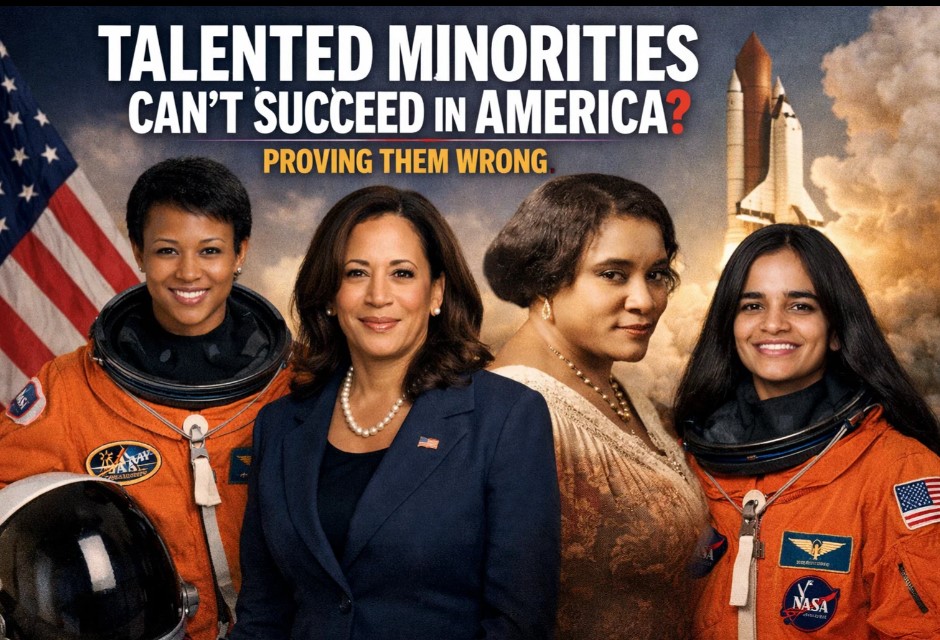
STEM Fields: Black women like Dr. Mae Jemison (the first African American woman in space) and Hispanic leaders like Ellen Ochoa (the first Latina astronaut) have shattered stereotypes in STEM.
Cultural Influence: Writers, filmmakers, and artists from minority backgrounds increasingly shape cultural narratives, gaining both critical acclaim and commercial success.
However, challenges remain. Discrimination manifests in subtle ways, such as unconscious bias and unequal access to resources. Yet, these barriers are not insurmountable, as evidenced by the growing representation and success of minorities across sectors.
Conclusion: Opportunity Over Adversity
The idea that talented minorities cannot succeed in America due to discrimination is an oversimplified and outdated myth. Statistical data and countless success stories highlight how minorities have leveraged education, entrepreneurial spirit, and societal shifts to achieve extraordinary accomplishments. While systemic issues require continued attention, the progress made underscores that talent and determination, combined with opportunity, can pave the way for success.

"Madam C.J. Walker didn’t just break barriers; she built her own opportunities. As one of America’s first self-made female millionaires, she refused to let discrimination or adversity stop her, proving that with hard work and perseverance, anyone can succeed in America - the symbol of diversity, owes its origins to a group of English-speaking settlers who defied the Anglo monarchy in the 17th century" - Waasay - Head of News & PR - Evrima Chicago
Minorities in America are not defined by barriers but by their ability to overcome them, proving that the narrative of impossibility is no match for the resilience and potential of a diverse population.
Written by the Team Editorial - under Waa Say Editoral Head - Evrima Chicago.
Data Sources:
Pew Research Centre https://www.pewresearch.org/
National Center for Education Statistics (NCES) https://nces.ed.gov/
Q
More from Culture


The Daily Brief
Get the day's most important stories, handpicked by our editors, delivered to your inbox every morning.
No spam. Unsubscribe anytime.