

The Amodei Siblings

At a glance
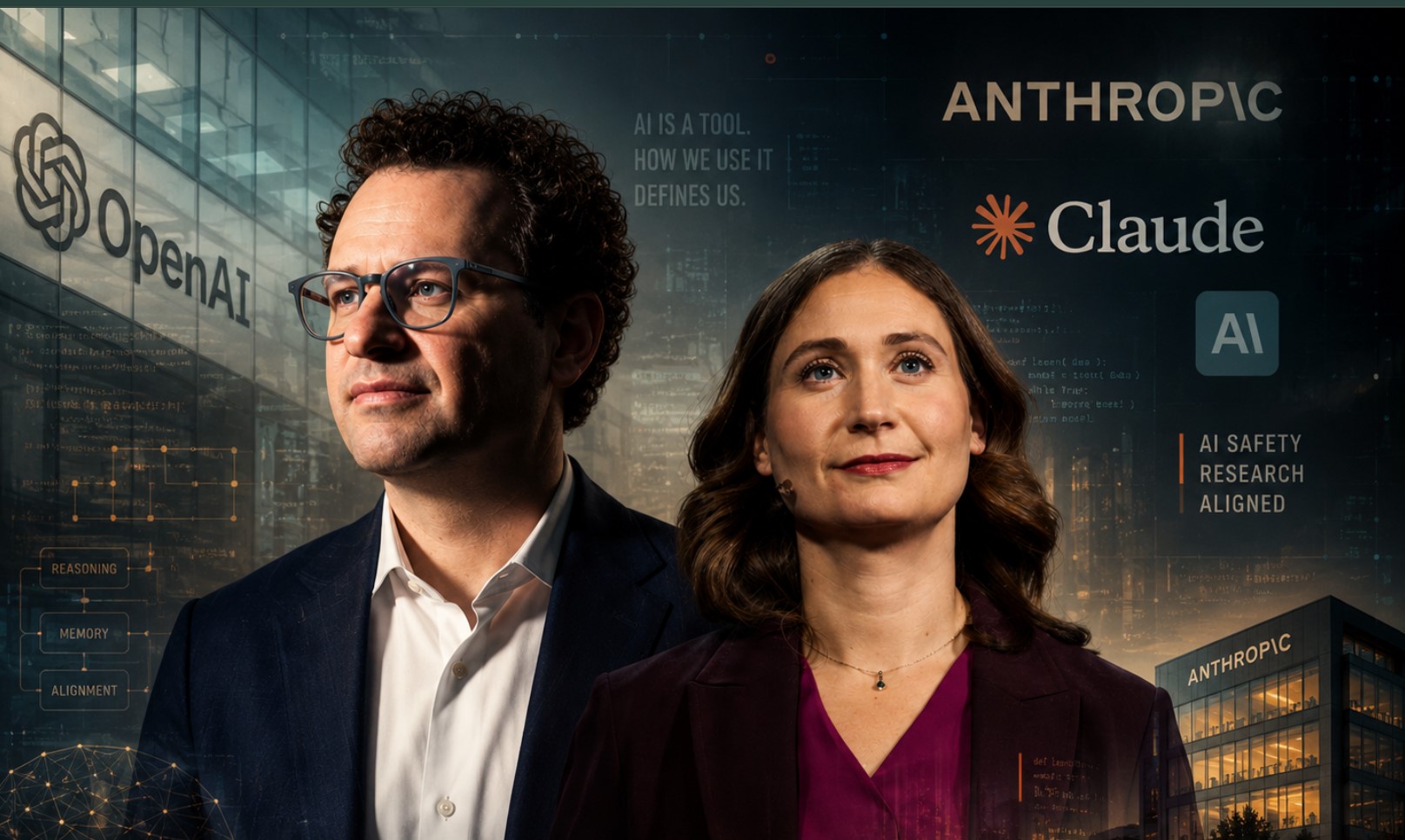
This year, the world took formal notice. Dario and Daniela Amodei were named together to TIME's 2026 list of the 100 Most Influential People in the World
The Siblings Who Taught Silicon Valley to Fear Its Own Reflection
The easiest way to describe them is as the founders of Anthropic, the company behind Claude. The truer description is more unsettling: they are siblings who walked into the fiercest industrial race of the century carrying not only code, but conscience.
What actually is Anthropic? — The Company Quietly Writing the Rules for Artificial Intelligence
By Dan Wasserman · 10 min read
Read the full story →The Weight of Recognition
This year, the world took formal notice. Dario and Daniela Amodei were named together to TIME's 2026 list of the 100 Most Influential People in the World, a recognition that places them among the defining architects of our era. TIME called Anthropic "a family affair," led by Dario as chief executive and Daniela as president, and highlighted the company's extraordinary rise in the global AI race. Dario had already been honored individually on TIME's 2025 TIME100 list, making the siblings' joint recognition in 2026 all the more remarkable.
Influence is often mistaken for celebrity. The Amodeis possess something rarer: they have altered the terms of the conversation. Before Anthropic, much of the public debate around AI revolved around capability, speed, and market dominance. The siblings insisted that the deeper question was whether humanity could create systems more intelligent than itself without surrendering judgment, dignity, or control.
Dario: The Restless Theorist
Dario arrived at this moment through science. Trained in physics and neuroscience and shaped by work at OpenAI, he became known not only for advancing powerful AI systems but also for warning about their risks. His writing and public advocacy repeatedly return to a difficult idea: intelligence is not automatically wisdom, and progress without restraint can become a form of negligence.
Daniela: The Custodian
Daniela's influence is quieter and, in many ways, more formidable. As president of Anthropic, she has helped turn a philosophical concern about AI safety into an institutional culture, a business strategy, and a public standard. If Dario often speaks the language of possibility and peril, Daniela speaks the language of stewardship. Great technological movements rarely endure on vision alone; they require disciplined builders who can translate ideals into organizations.
"Great technological movements rarely endure on vision alone; they require disciplined builders who can translate ideals into organizations."
A Single Civic Imagination
What makes their story literary is not simply that they are siblings. It is that they represent two halves of a single civic imagination. Dario is the restless theorist staring into the future's storm; Daniela is the custodian making sure the roof is reinforced before the weather arrives. Together they form a kind of modern double portrait: invention and restraint sharing the same surname.
Disrupting the Silicon Valley Myth
Silicon Valley has long celebrated the mythology of the solitary genius, the founder alone in a garage illuminated by destiny and monitor light. The Amodeis disrupt that myth. Their ascent suggests that the next chapter of technological leadership may be collaborative, familial, and ethically negotiated rather than purely individualistic. Anthropic itself was founded in 2021 by Dario, Daniela, and other former OpenAI leaders who departed amid disagreements over direction and safety, and that origin story still echoes through the company's identity.
Symbols of a New Era
The symbolism matters. We are living through a moment when algorithms write prose, compose music, diagnose disease, and increasingly participate in decisions once reserved for human beings. In such a moment, the people who shape these systems become not merely entrepreneurs but custodians of social reality. The Amodeis understand that an AI model is never just software; it is a distribution mechanism for values.
Critics sometimes argue that safety slows innovation. The siblings have wagered the opposite: that trust will become the decisive infrastructure of the AI century. Their company's rise has demonstrated that caution and ambition need not be enemies. Whether history ultimately proves them right remains uncertain, but uncertainty is precisely the condition in which moral seriousness matters most.
A Family Debate at Planetary Scale
There is a striking image hidden inside their public story. A brother and sister, raised in the same household, now stand at the threshold of a technology that may reshape labor, education, medicine, creativity, and governance. One can imagine future historians looking back on this period and seeing not merely a startup, but a family debate conducted at planetary scale: How much power should intelligence possess? What obligations accompany invention? Who bears responsibility when a machine begins to think in ways its creators cannot fully predict?
"How much power should intelligence possess? What obligations accompany invention? Who bears responsibility when a machine begins to think in ways its creators cannot fully predict?"
A New Archetype
TIME's recognition did not create their importance; it acknowledged it. The real significance of Dario and Daniela Amodei lies in the possibility that they have introduced a new archetype into public life: the technologist who refuses to separate innovation from ethics, and the institution-builder who treats responsibility as a design requirement rather than a public-relations accessory.
The Industrial Revolution had its engineers. The atomic age had its physicists. The AI age may be remembered for a pair of siblings who insisted that intelligence, however artificial, must remain answerable to something profoundly human.
That insistence is why they matter. That insistence is why the world is watching.
Disclaimer
This article is a critical, opinion-based cultural analysis authored by Waa Say (Waasayuddin, pen name Dan Wasserman) and reflects his personal editorial perspective. The views expressed herein do not represent the institutional positions of Evrima Chicago, Wiki Titan, Dennis Lane, or any affiliated organizations, contributors, or partners.
This commentary draws upon open-source information, publicly available records, legal filings, published interviews, and public commentary — including audio content from The Joe Rogan Experience podcast. Any allegations or claims referenced remain subject to ongoing review, dispute, or investigation and may not be proven in a court of law.
No assertion or conclusion of criminal liability, civil wrongdoing, or factual determination of guilt is implied. Any comparisons or parallels made to public figures are interpretive, analytical, and presented solely for the purpose of examining broader systemic patterns of influence, media dynamics, celebrity culture, and public accountability.
Where applicable, satirical, rhetorical, analytical, and speculative language may be used to explore public narratives and their societal impact. Readers are encouraged to apply critical thinking and consult primary sources wherever possible.
This publication is protected under the First Amendment of the United States Constitution and adheres to recognized standards of opinion journalism, commentary, and international editorial and publishing standards, including principles consistent with global media ethics and freedom of expression frameworks.
All written content in this article is copyrighted by Evrima Chicago. Permission for reposting, republication, or redistribution may be obtained by contacting pr@evrimachicago.com.
Evrima Chicago remains committed to maintaining a clear distinction between fact-based reporting and individual editorial opinion.
Sources: TIME100 2026, Anthropic public statement
More from Op-Ed
The Daily Brief
Get the day's most important stories, handpicked by our editors, delivered to your inbox every morning.
No spam. Unsubscribe anytime.