
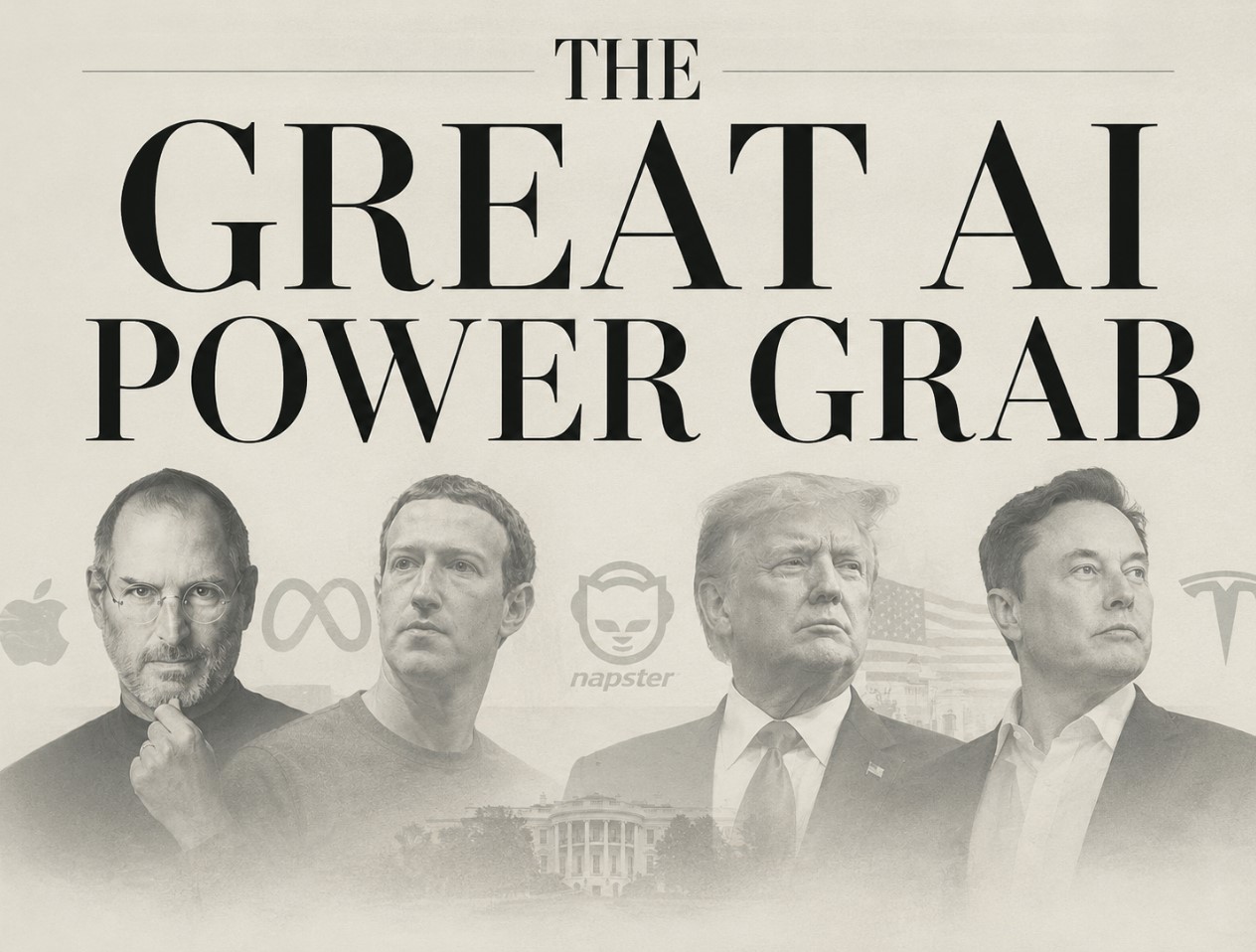
The Great AI Power Grab

At a glance
Trump's "Money Machines" and the Battle for America's Electric Future Or, How 23 Governors Signed a Pledge to Keep Your Lights On While Big Tech Racks Up the Bill
The pledge, in essence, promises that the sprawling, energy-sucking data centers powering the artificial intelligence revolution won't jack up your electricity bill. The companies building them? They'll pay their own way, thank you very much. Or so the theory goes.
"The amount of times I've said 'big, strong, bold, and Money Machines' — it's tremendous. You have to convince your community how great these things are. You can't fight it, you have to go with it, and you're going to have all this protection. You're going to make a tremendous amount of money, you're going to reduce taxes, and you're going to have something where, if you don't have it, everybody else wants it."
The Pledge: A Coalition of the Willing (and the Wary)
The administration's self-congratulatory press release trumpeted that the pledge now covers "80% of all power delivered to U.S. homes and businesses" and protects "263 million Americans when a data center is built nearby". More than 200 utilities, developers, and state governments have signed on, including seven of the world's largest tech companies — Google, Microsoft, Meta, Oracle, xAI, OpenAI, and Amazon.
- Data center operators will fund their own electricity generation and infrastructure
- They'll negotiate separate rate structures with utilities
- They'll pay whether they use the power or not
- They'll invest in local jobs
- They'll contribute to grid resilience
"It's a novel concept," White House spokeswoman Taylor Rogers said in a statement. "Everyone involved in building and powering data centers covers their own costs instead of passing them on to American families."
The evidence, the administration claims, is already in the numbers. In Michigan, DTE Energy's agreements with Google and Oracle are "projected to produce billions in customer savings." In Indiana, NiSource's arrangements with Amazon and Alphabet are set to return at least $1.4 billion to customers over 15 years. In Georgia, Southern Company is freezing base rates through 2029 and delivering more than $1.7 billion in savings — saving the typical residential customer over $100 per year.
The Holdouts: Three Republicans Who Said No
But in the spirit of full disclosure — and because this is a story about electricity bills, not campaign rhetoric — it's worth noting that not everyone signed the pledge. Three of the nation's 26 Republican governors declined:
- Vermont Gov. Phil Scott
- New Hampshire Gov. Kelly Ayotte
- Florida Gov. Ron DeSantis
DeSantis, ever the independent operator, signed a new state law this year that implemented strict regulations for data centers — a move that suggests he's less concerned about protecting ratepayers from Big Tech and more concerned about protecting Florida from Big Tech's insatiable appetite for land, water, and power.
No Democrats signed the pledge. This is not a surprise. The pledge, after all, is a Republican solution to a problem that Democrats see as an existential threat to the working class: the rapid, unregulated expansion of data centers that consume electricity like frat boys at a kegger.
The New York Problem: "LIQUID GOLD" vs. "Scraps"
To understand the stakes, look no further than New York. On July 14, Gov. Kathy Hochul, a Democrat, signed Executive Order No. 62, imposing a one-year moratorium on the construction of hyperscale data centers — those consuming 50 megawatts or more of power. It made New York the first state to halt the building of the very facilities Trump has called "Money Machines" and "Cash Cows."
Trump demanded that New York reverse its policy "IMMEDIATELY," warning that projects would now go to "Red States" such as Texas, Florida, and Alabama, where "Both the Taxes and the Jobs amount to LIQUID GOLD!"
— Gov. Kathy Hochul, via X
The moratorium, Hochul's office explained, was about protecting ratepayers, water supplies, and the environment. The state's grid operator had more than 12 gigawatts of data center load requests in its interconnection queue — with more than 8 gigawatts entering in 2025 alone. To put that in perspective: one gigawatt of electricity can power about 750,000 homes.
The Uncomfortable Truth: Electricity Prices Are Rising
Here's where it gets sticky for the administration. Trump campaigned in 2024 on bringing down prices, but electricity costs are up by about 4% from last year, and energy costs have increased by 16%. According to the Energy Information Administration, residential rates climbed 5.2% in the year ending October 2025 — nearly twice the rate of inflation.
And this is just the beginning. Energy prices have surged by double digits since March amid Middle East turmoil, and electricity costs for U.S. data centers are projected to rise by more than 5% in 2026 alone.
- Electricity costs: ↑ 4% from last year
- Energy costs: ↑ 16% overall
- Residential rates: ↑ 5.2% (year ending Oct 2025)
- Data center electricity costs: ↑ 5%+ projected for 2026
The administration's solution — the Ratepayer Protection Pledge — is non-binding. It's a handshake, a promise, a good-faith effort. But it's also a political document, designed to deflect blame from the uncomfortable reality that the AI boom is straining the grid and driving up costs for ordinary Americans.
Paul Krugman, the Nobel Prize-winning economist, put it bluntly in a recent Substack post titled "Kilowatt Madness":
"Trump campaigned on bringing down energy prices. He talked very big, and made specific promises. Notably, he declared that he would cut the price of electricity in half within 12 months of taking office. So how's that going?"
Krugman points to "three major stagflationary forces" — tariffs, mass deportations, and soaring electricity prices — and notes that the data center-driven surge in power consumption is a primary culprit.
The China Factor: A Shadow Over the Energy Debate
Trump's urgency on data centers is driven by more than just a love of "Money Machines." It's about the global AI race with China. The "Global Artificial Intelligence Innovation Index Report 2026," released at the World Artificial Intelligence Conference on July 17, shows that the United States leads with a score of 78.44, while China is second with 60.49.
| Country | AI Innovation Score | Key Advantage |
|---|---|---|
| United States | 78.44 | Leading in foundational models |
| China | 60.49 | Cost-efficient models (¼ the token price) |
But the gap is narrowing. China's score has been inching closer to America's since 2023, and Chinese AI models are more cost-efficient: the token price of China's top models is about one-quarter that of comparable U.S. models. China has also achieved 88.7% of global humanoid robot shipments in 2025.
Local Resistance: Not Just a Blue State Problem
It's easy to frame this as a red vs. blue debate. But data center fights have erupted in both Democratic and Republican strongholds. Nashville, Virginia suburbs outside D.C., rural Utah, and small towns in New Jersey have all seen local opposition. Even Palm Beach, Florida — home of Trump's Mar-a-Lago resort — has fiercely debated a new AI data center planned there.
The reasons are not ideological: data centers take up enormous space, produce noise, consume massive amounts of water, and bring few direct benefits to the neighborhoods where they're built. A Georgia Tech study released last week found that data center gains are unevenly distributed, with metropolitan counties capturing most of the benefits while rural communities host the buildings and absorb higher electricity bills.
The Bottom Line: A Pledge, Not a Guarantee
So what does the Ratepayer Protection Pledge actually achieve? It's a political document, a statement of intent, a coalition-building exercise. It includes an addendum for governors to "implement the principles established in the Ratepayer Protection Pledge, to the greatest extent possible in our respective positions" — which is a fancy way of saying "we'll try our best."
Historic Parallels: The Gold Rush Meets the Digital Age
There's something deeply American about this story. In the 19th century, it was railroads and land grants. In the 20th, it was highways and suburban development. Now, in the 21st, it's data centers and electricity.
But as with any gold rush, the real winners are often the ones selling the picks and shovels — in this case, the tech companies and utilities — while the locals are left with the environmental and economic costs.
The question, as always, is who pays. The Ratepayer Protection Pledge is an attempt to ensure that the answer is not "you and me." But as electricity prices continue to rise and the AI boom accelerates, the pledge's promise may prove as ephemeral as a summer lightning strike.
Sources: USA TODAY, White House press releases, Energy Information Administration, Georgia Tech study, Global Artificial Intelligence Innovation Index Report 2026
More from technology


The Daily Brief
Get the day's most important stories, handpicked by our editors, delivered to your inbox every morning.
No spam. Unsubscribe anytime.