
The Lovely Chemistry of Theo Von and Donald Trump

At a glance
A literary exploration of the most unlikely political conversation of the 2024 campaign
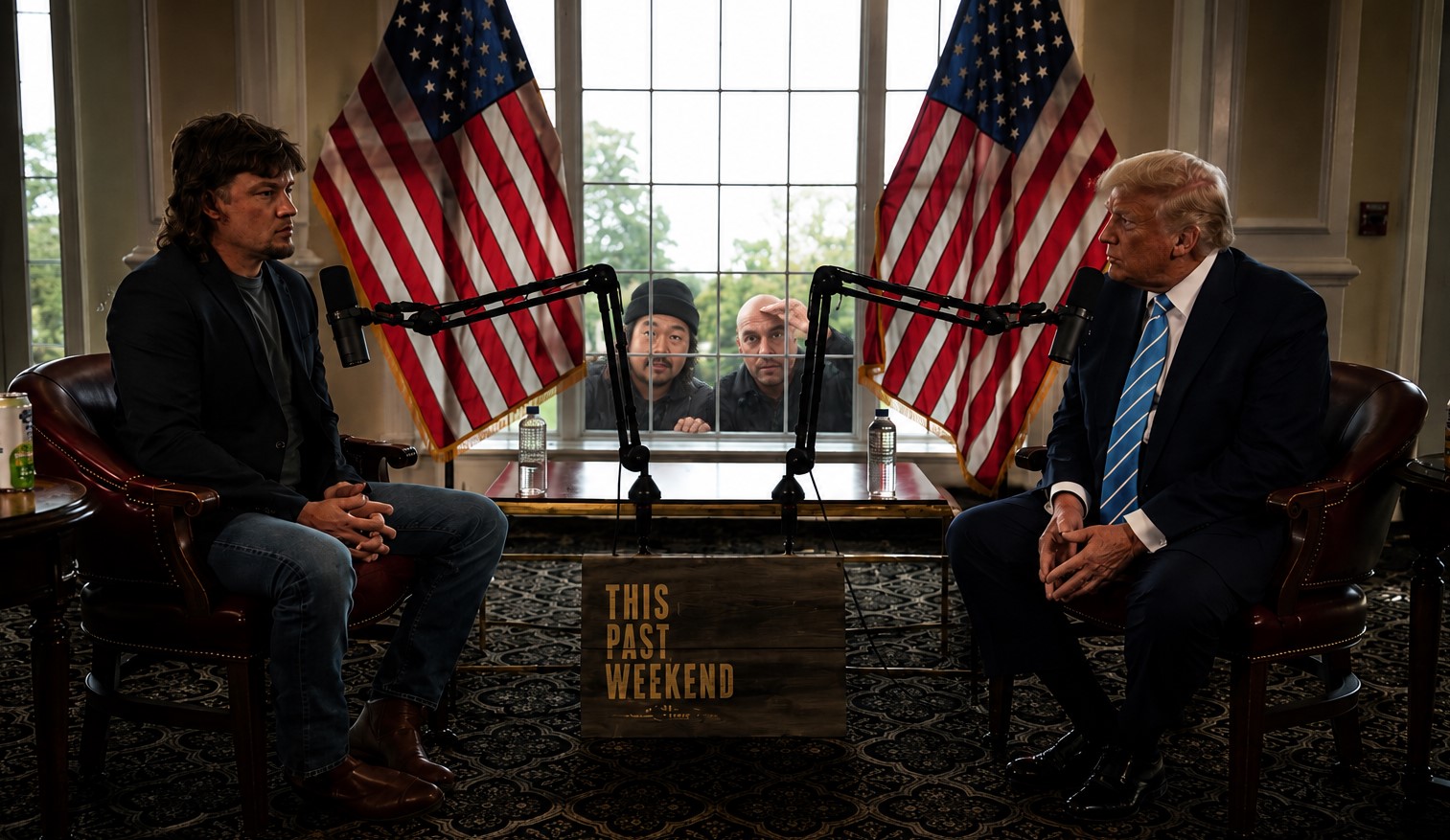
Trump is accustomed to rooms arranged around him. He enters as the subject, the spectacle, the person everyone has come to see. Theo Von, however, has built his peculiar corner of the podcast world around the opposite principle. His conversations have the looseness of a late-night drive with someone who has forgotten where he was going. Stories wander. Memories arrive half-formed. A perfectly ordinary question can suddenly lead somewhere so strange that the listener is left wondering how the conversation got there in the first place.
So when Trump appeared on This Past Weekend in August 2024, the result was never likely to resemble a conventional political interview.
It was stranger than that.
It was funny in places, uncomfortable in others, occasionally sincere, and at times so peculiar that the political significance of the encounter seemed to dissolve altogether. For nearly an hour, the former president and the comedian moved through subjects ranging from addiction and family to healthcare and politics, while repeatedly wandering into the sort of territory that would have been almost impossible to imagine in a presidential debate or a Sunday morning political program.
The most memorable detour concerned cocaine.
Trump, who has spoken for years about never drinking alcohol or using drugs, began asking Von about his past experiences with cocaine and other substances. The questions were remarkably direct. There was no apparent attempt to disguise curiosity as expertise. Trump seemed genuinely interested in what the experience felt like.
Von answered in the language that has made him one of podcasting's most distinctive personalities.
He did not give Trump a clinical explanation of stimulant addiction. He gave him Theo Von.
At one point, Von described cocaine as something that could turn a person into a "damn owl," a wonderfully strange image that seemed to contain the entire Theo Von philosophy of storytelling in four words. The drug makes you awake. It makes you strange. It makes you sit there at impossible hours, looking out into the darkness as though the night itself has become your occupation.
Trump listened.
That may have been the funniest part.
There was something almost childlike about his curiosity. He asked follow-up questions as though Von had just introduced him to an unfamiliar species. What was the feeling? Was it stronger than alcohol? Why did people do it if the consequences were so unpleasant?
For a moment, the former president of the United States seemed less interested in winning an election than in understanding why somebody would voluntarily put cocaine into his body.
Von, meanwhile, seemed perfectly comfortable explaining it.
The exchange was funny, but beneath it was something considerably darker. Von has spoken publicly about addiction and recovery, and the conversation eventually moved away from the comic absurdity of the subject and toward the damage substances can do. Trump connected the subject to his older brother, Fred Trump Jr., whose struggle with alcoholism profoundly affected the family and helped shape Trump's own lifelong decision to avoid alcohol and drugs.
The tone changed almost without warning.
That tonal instability is one of the things that makes Theo Von's conversations unusual. He can spend several minutes making a subject sound ridiculous and then, without any obvious preparation, reveal the wound underneath it.
The Trump interview was full of those collisions.
One minute, the two men were discussing cocaine. The next, they were talking about family, grief, addiction, or the consequences of decisions made decades earlier.
Then Theo would say something that sounded as though it had been discovered in a roadside diner at three in the morning.
"The Theo Von philosophy: A story becomes an image. An image becomes a joke. The joke becomes a confession. The confession becomes another story."
This was the particular chemistry of the interview.
Trump himself is an unusual conversationalist, but his strangeness is of a different variety. His speech tends to move through association rather than argument. A subject can begin with healthcare and somehow arrive at a story about a person he knows, a building, an election, a business deal, or a memory from decades earlier.
Von operates similarly, except that his associative leaps have been filtered through comedy.
He doesn't merely change subjects.
He bends them.
A story becomes an image. An image becomes a joke. The joke becomes a confession. The confession becomes another story.
The interview therefore had the peculiar feeling of two very different improvisational instincts meeting in the same room.
Trump brought the grandiosity of a man who has spent half a century living inside enormous stories about himself.
Von brought the surrealism of someone who can make a sentence about a mechanic, a drug addict, an owl, or a stranger in a parking lot sound as though it belongs to a larger mythology that only he has been given access to.
It was inevitable that things would get weird.
One of the strangest recurring features of the conversation was how often the grandeur of Trump's political identity simply disappeared.
There were no campaign podiums.
No television moderators.
No split-screen graphics announcing a disagreement.
No carefully timed commercial break.
Instead, there was Theo Von asking questions in the same loose conversational atmosphere in which he has interviewed musicians, comedians, fighters and other public figures.
That environment matters.
A traditional political interview asks a candidate to explain himself.
Theo Von often asks people to reveal themselves.
Those are not the same thing.
A politician can prepare an answer to a policy question. It is much harder to prepare for Theo Von asking about the emotional texture of cocaine or steering a conversation toward some bizarre memory that neither person could have anticipated five minutes earlier.
This is also why some of the funniest moments of the episode were not jokes in the conventional sense.
They were moments of mismatch.
Trump would respond with the seriousness of someone accustomed to enormous consequences.
Von would answer with the bewildering specificity of someone describing a dream he had the previous night.
And somehow, it worked.
There was even a running absurdity around the idea of Trump eating a worm, an episode of podcast weirdness that sounds almost fabricated when removed from the context of the conversation. Yet that was precisely the appeal of having Trump on Theo's show. The improbable was allowed to remain improbable.
The conversation did not need to be polished into something respectable.
Its charm was that it was allowed to be odd.
That distinction is increasingly important in an age when political appearances are often manufactured with extraordinary precision. Every sentence can be tested. Every gesture can be evaluated. Every answer can be clipped into a thirty-second video and circulated as evidence for or against someone.
Theo Von's podcast operates according to a different rhythm.
There is room for dead air.
There is room for a strange question.
There is room for somebody to misunderstand something.
There is room for a story that goes nowhere.
There is even room for a joke that is not particularly good.
That looseness can produce something television rarely does anymore: the sensation that you are actually watching people talk.
Whether one agreed with Trump politically was almost beside the point during the strangest passages of the interview. The spectacle was simply the encounter itself.
A former president and presidential candidate sitting across from a comedian whose greatest conversational asset may be his refusal to behave like a conventional interviewer.
The combination produced a curious intimacy.
Trump was still Trump. The familiar mannerisms remained. The stories remained. The self-confidence remained.
But the setting stripped away some of the machinery surrounding him.
And Von did something that traditional political interviewers rarely manage to do: he made Trump seem, at least intermittently, like a person sitting in a room rather than an institution delivering a message.
That does not make the conversation politically neutral, nor does it mean every answer should be accepted uncritically. A podcast is not a substitute for rigorous political journalism. Policy claims deserve scrutiny, and charisma is not evidence.
But that is not really what made this episode memorable.
Its significance was cultural.
The interview demonstrated how dramatically the center of public conversation has shifted. A presidential candidate can now reach millions of people not through a newspaper editorial board or a network television anchor, but by sitting down with a comedian whose audience is willing to spend an hour listening to two people talk about subjects that would never survive the architecture of a traditional interview.
And Theo Von understood the assignment without appearing to have one.
He did not turn himself into a political correspondent.
He remained Theo.
That meant the conversation could move from the enormous machinery of American politics to something as small and ridiculous as a question about cocaine, then toward a painful family memory, then back into comedy.
The transitions were not elegant.
They were human.
Perhaps that is why the episode lingered.
"The strangest thing about the Trump and Theo Von conversation was not that a former president appeared on a comedian's podcast. By 2024, that had become almost normal. The stranger development was that, for stretches of the interview, the enormous cultural machinery surrounding Trump seemed to fall away."
The strangest thing about the Trump and Theo Von conversation was not that a former president appeared on a comedian's podcast. By 2024, that had become almost normal. The stranger development was that, for stretches of the interview, the enormous cultural machinery surrounding Trump seemed to fall away.
What remained was a man answering questions.
And sitting across from him was another man who seemed constitutionally incapable of asking those questions in the ordinary way.
The result was messy, funny, occasionally serious and sometimes downright surreal.
It was not history being made in the grand sense.
There were no treaties, no speeches, no state dinners.
There was just a podcast.
A microphone.
A former president.
A comedian.
A discussion about drugs that somehow became a discussion about family.
A joke about a worm.
An owl wandering through the conversation.
And the peculiar realization that, in the modern American media landscape, some of the most revealing political conversations no longer happen where politics traditionally happens.
They happen in rooms like Theo Von's.
And sometimes, the stranger the room, the more memorable the conversation becomes.
Sources: This Past Weekend with Theo Von (August 2024), public interviews, cultural commentary
More from entertainment

The Daily Brief
Get the day's most important stories, handpicked by our editors, delivered to your inbox every morning.
No spam. Unsubscribe anytime.